
حوّل رؤى الذكاء الاصطناعي إلى أفعال منسّقة

الرائج الآن
Categories
Gardner Aerospace Advances Supply Chain to Support Sustainable Aviation
Gardner Aerospace Advances Supply Chain to Support Sustainable Aviation
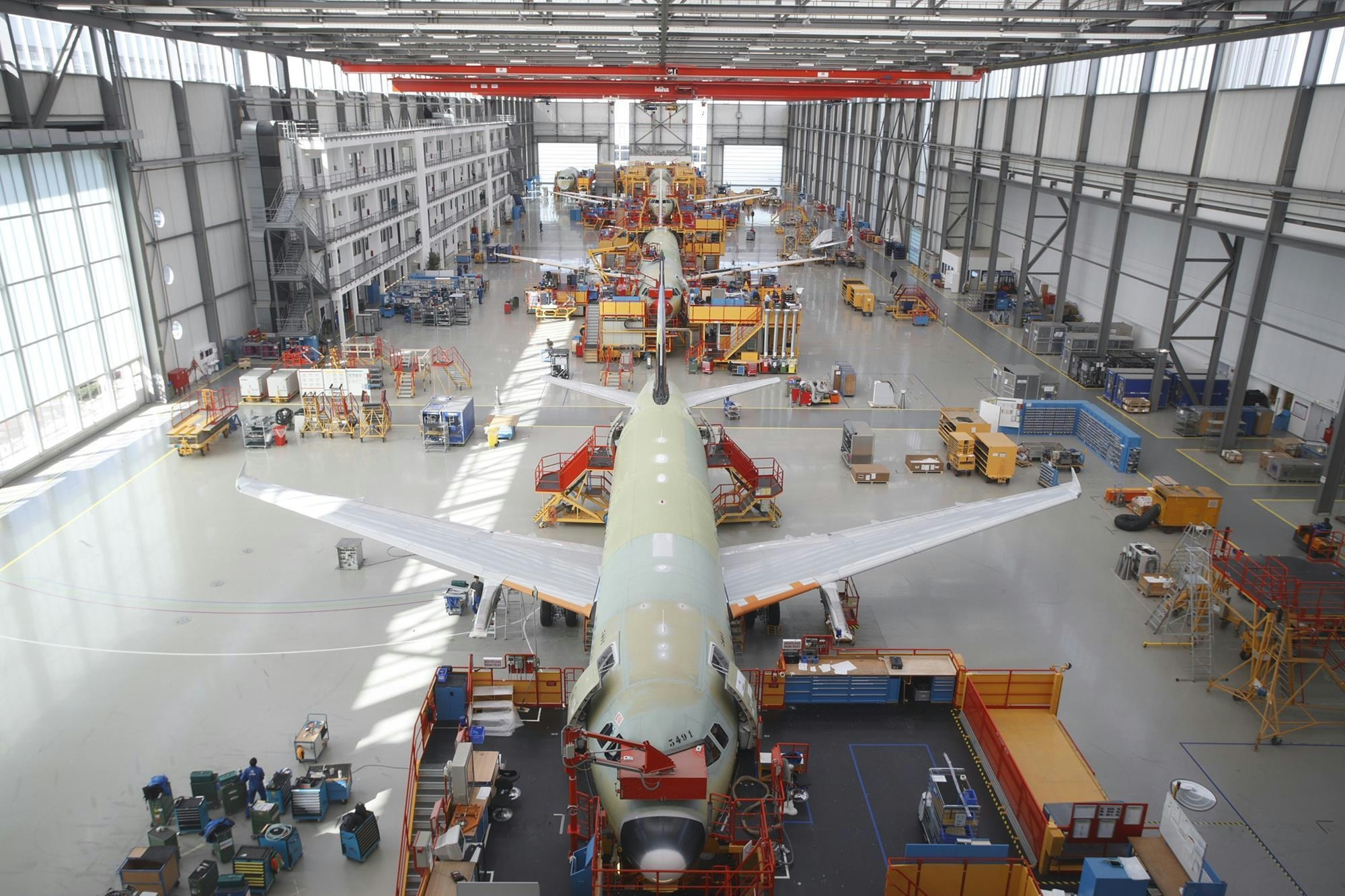
At the Advanced Engineering conference, Gardner Aerospace CEO Philipp Visotschnig presented a supplier-driven strategy to address the aviation industry's sustainability challenges. He emphasized that the sector’s forthcoming transformation will be influenced as much by advances in manufacturing, materials, and data management as by developments in aircraft and engine design. “We don’t build the aircraft. We build the parts that make flight possible with precision, reliability, and partnership,” Visotschnig remarked, underscoring Gardner’s pivotal role within the global supply chain that supports commercial aviation.
Gardner Aerospace’s components are integral to nearly every major commercial aircraft, with operations spanning Europe and Asia and servicing all leading original equipment manufacturers (OEMs). Visotschnig outlined aviation’s evolution through four distinct phases: enabling flight, ensuring safety, expanding accessibility, and now, pursuing sustainability. He described the current phase as the most demanding yet: making flight sustainable.
The Current Landscape of Aviation Supply Chains
The aviation supply chain today is extensive and intricately connected, facilitating the transport of nearly five billion passengers annually on approximately 25,000 commercial aircraft. Production is dominated by industry giants such as Airbus and Boeing, supported by a limited number of engine and systems suppliers alongside over a thousand parts and service providers. Visotschnig highlighted the complexity of aircraft manufacturing, noting that a single defective component can disrupt entire production lines.
While aviation delivers substantial economic and social benefits, it remains highly energy- and material-intensive. Visotschnig emphasized that emissions are the core issue, not aviation itself, advocating for sustainability efforts that enhance the system rather than impose restrictions. Although the majority of lifecycle emissions occur during aircraft operation, the supply chain contributes between 2% and 5% of total emissions, equating to millions of tonnes of CO₂ annually given the production of over 1,000 large commercial aircraft each year.
Gardner Aerospace employs around 2,000 people across nine sites, producing more than 20,000 part numbers and delivering over two million parts annually. The company is currently undergoing a comprehensive digital and operational transformation. “For us, sustainability is not a project beside the business. It is how we run the business,” Visotschnig stated.
Overcoming Challenges Amid Market Shifts
Progressing toward a sustainable supply chain presents significant challenges. Gardner Aerospace, like many in the sector, contends with ongoing disruptions including tariffs, trade uncertainties, labor shortages, rising material costs, and volatile freight markets. These difficulties are further intensified by heightened scrutiny from customers and regulators, who increasingly demand transparency and sustainable practices throughout the industry.
Competitors are similarly investing in sustainable technologies and supply chain optimization to remain competitive. The market for sustainable aviation technologies is expected to experience substantial growth, offering both challenges and opportunities for innovation.
Commitment to Net Zero and Industry Collaboration
The aviation industry’s pledge to achieve net zero emissions by 2050 hinges on three primary strategies: developing more efficient aircraft, adopting sustainable aviation fuels at scale, and utilizing lighter, more efficient materials. Suppliers are directly involved in advancing all three areas. Gardner Aerospace contributes to Airbus’s “Wing of Tomorrow” program by manufacturing prototype components for next-generation lightweight wing structures, exemplifying how suppliers beyond tier one can drive sustainability forward.
Visotschnig observed a notable shift in industry attitudes toward sustainability: “Sustainability used to be a box-ticking exercise, another audit, another report. That mindset is obsolete.” As Gardner Aerospace and its peers evolve, the pursuit of sustainable aviation is reshaping the entire supply chain and establishing new benchmarks for the future of the industry.

Etihad Airways Suspends Airbus A380 Flights on Key Route

Aditya Birla Group Seeks Approval for Aircraft Leasing in GIFT City

Qatar Airways Highlights Innovation and Connectivity at Arabian Travel Market 2026

Hong Kong's Five-Year Plan Includes Andrew Fan's Aircraft Parts Processing Hub Proposal

ACIA Aero Leasing Delivers ATR72-600 to Air Nostrum

RTX Appoints Jill Albertelli as Head of Pratt & Whitney

TAT Technologies Joins Beyond Aero Hydrogen Aircraft Program

AURAK Study Highlights Barriers to Air Taxi Adoption in Emerging Economies

Xiamen Air Selects Altitude for 787 Maintenance at Heathrow

Etihad and Swissport Extend Global Partnership
