
حوّل رؤى الذكاء الاصطناعي إلى أفعال منسّقة

الرائج الآن
Categories
Icelandair to Retire Boeing 767 Fleet by End of 2026
Icelandair to Retire Boeing 767 Fleet by End of 2026
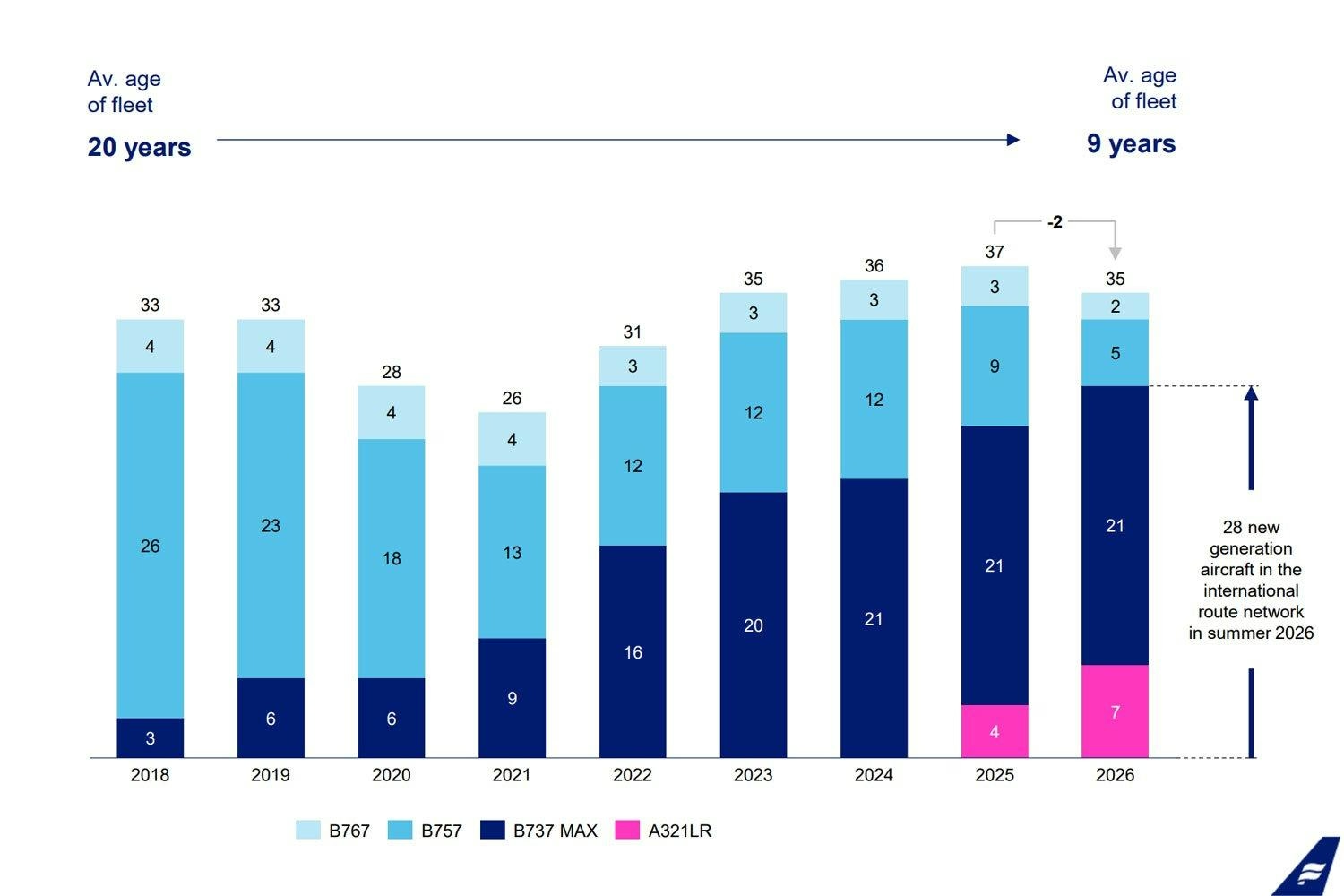
Icelandair has announced plans to retire its entire Boeing 767-300 fleet by the end of 2026, accelerating the phase-out of its widebody aircraft as part of a comprehensive restructuring strategy. This decision, revealed alongside the airline’s third-quarter 2025 financial results, represents a pivotal shift aimed at restoring profitability after eight consecutive years of financial losses.
Financial Performance and Strategic Focus
The airline reported third-quarter revenue of $585 million, marking a 6% increase compared to the same period last year. Despite this growth, net profit declined to $57 million, down $12 million from the previous year, highlighting persistent financial challenges. Chief Executive Bogi Nils Bogason emphasized that the company’s foremost objective remains achieving sustained profitability by 2026.
Icelandair attributes its rising operational costs to factors including a strengthening Icelandic krona, increased wage expenses, and broader inflationary pressures. In response, the airline is advancing a fleet simplification initiative, which involves retiring three Boeing 757s and one 767 by the end of 2025, followed by an additional four 757s and two 767s in 2026. By mid-2026, the carrier expects to operate a streamlined fleet of 41 aircraft, consisting exclusively of narrowbody types: 21 Boeing 737 MAX jets and seven Airbus A321LRs.
Fleet Restructuring and Market Positioning
This accelerated retirement timeline moves forward the previously scheduled 2029 phase-out of the 767s, aligning with Icelandair’s renewed emphasis on point-to-point markets and operational efficiency. The airline plans to reduce its overall fleet size by two aircraft in 2026 as part of a broader transformation program designed to stabilize its financial position.
Despite the reduction in fleet size, Icelandair projects a 2% increase in capacity for 2026, reflecting efforts to optimize aircraft utilization and route planning. These changes are unfolding amid a shifting competitive landscape, as several rivals have exited the Icelandic market, presenting both challenges and opportunities for the carrier.
Market reactions to Icelandair’s restructuring have been mixed. Some investors are reportedly exploring acquisitions of other struggling airlines, reflecting broader uncertainty within the sector. Competitor responses remain largely speculative. Nevertheless, Icelandair’s strategy aligns with a wider industry trend toward fleet consolidation and enhanced efficiency. For instance, the Lufthansa Group recently announced plans to retire six long-haul aircraft types by 2030, underscoring a sector-wide move toward simplified and more cost-effective fleets.
Icelandair’s leadership maintains that these decisive measures are essential to returning the airline to sustainable profitability and positioning it competitively within a rapidly evolving aviation environment.

Etihad Airways Suspends Airbus A380 Flights on Key Route

Aditya Birla Group Seeks Approval for Aircraft Leasing in GIFT City

Qatar Airways Highlights Innovation and Connectivity at Arabian Travel Market 2026

Hong Kong's Five-Year Plan Includes Andrew Fan's Aircraft Parts Processing Hub Proposal

ACIA Aero Leasing Delivers ATR72-600 to Air Nostrum

RTX Appoints Jill Albertelli as Head of Pratt & Whitney

TAT Technologies Joins Beyond Aero Hydrogen Aircraft Program

AURAK Study Highlights Barriers to Air Taxi Adoption in Emerging Economies

Xiamen Air Selects Altitude for 787 Maintenance at Heathrow

Etihad and Swissport Extend Global Partnership
