
حوّل رؤى الذكاء الاصطناعي إلى أفعال منسّقة

الرائج الآن
Categories
Performance of Boeing and Airbus Airliners with the World’s Most Powerful Jet Engine
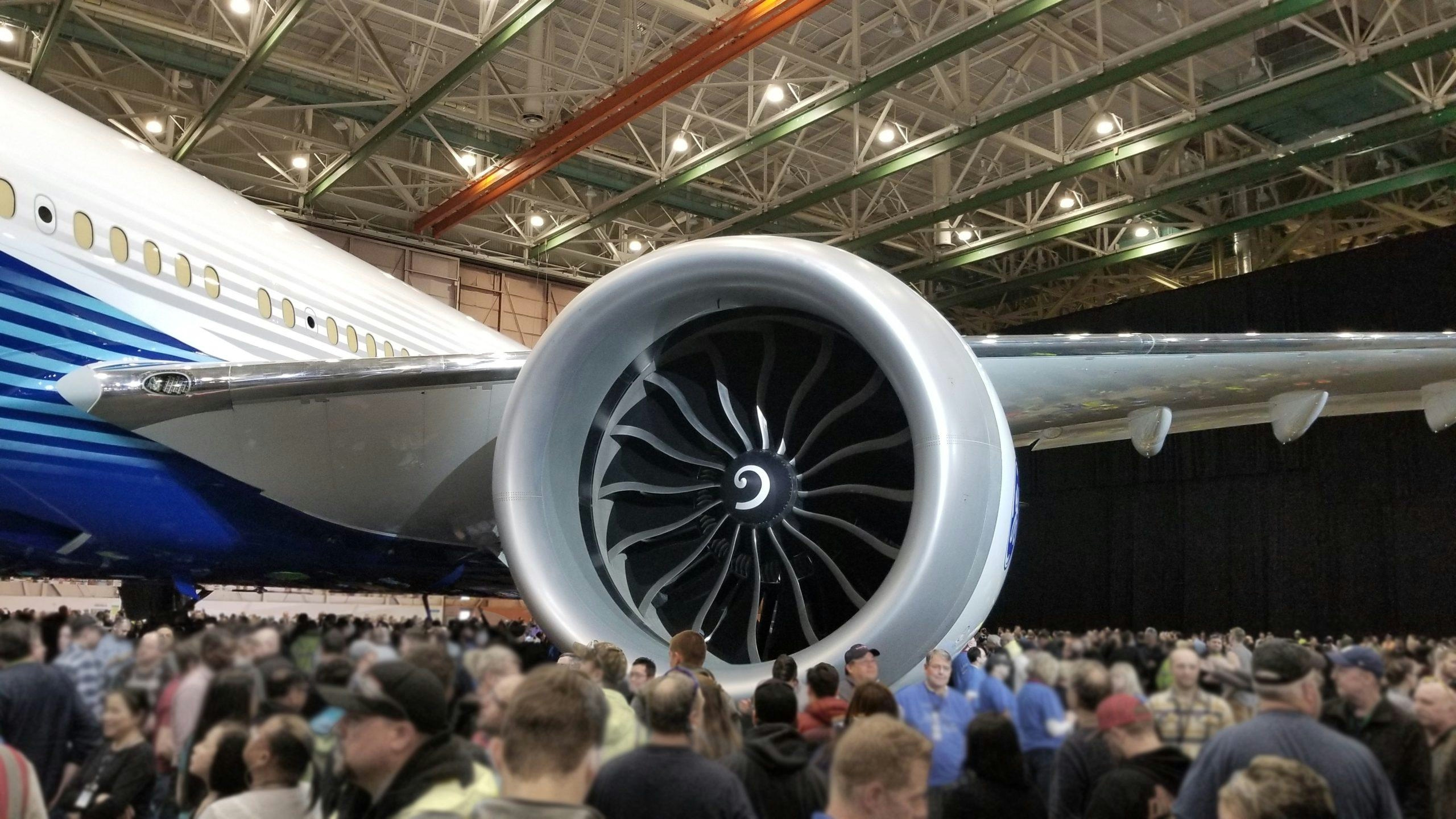
Performance of Boeing and Airbus Airliners with the World’s Most Powerful Jet Engine
The GE9X Engine and Its Impact on Commercial Airliners
A recent experiment conducted by aviation content creator Swiss001 has brought to light the extraordinary effects of equipping commercial airliners from Boeing and Airbus with the GE9X, currently the world’s most powerful jet engine. Originally engineered exclusively for the Boeing 777X, the GE9X features a fan diameter larger than the fuselage of a Boeing 737, representing a significant leap in aviation propulsion technology.
In the experiment, Swiss001 installed the GE9X on aircraft not designed to accommodate such immense power, including the Boeing 737 and various Airbus models. The results were striking and, at times, chaotic. The Boeing 737, overwhelmed by the engine’s thrust, surged forward uncontrollably despite brakes being fully engaged. Takeoffs became nearly vertical, and the aircraft struggled to decelerate, as even idle thrust levels were excessive for safe approaches. Reverse thrust was indispensable during landings, and the stopping power was so pronounced that even the shortest runways posed no challenge.
Airbus aircraft retrofitted with the GE9X faced similar difficulties, consuming fuel at unprecedented rates and proving challenging to control. The only model that approached managing the engine’s power was the Boeing 747-8, whose existing engines are nearly matched in thrust by two GE9X units. While the jumbo jet handled takeoff and climb phases with relative ease, the low placement of the oversized engines introduced a risk of ground strikes, underscoring the incompatibility of fitting such powerful engines onto airframes not originally designed for them.
Market Context and Industry Challenges
These extreme test scenarios emerge amid significant operational and market challenges confronting both Boeing and Airbus. Airbus is currently addressing the operational repercussions of a major software recall affecting approximately 6,000 A320 aircraft, raising broader concerns about the resilience and reliability of aviation software systems. Concurrently, both manufacturers are engaged in intense competition for dominance in the commercial jet market, with recent airline orders sending mixed signals.
At the Dubai Airshow, flydubai placed a provisional order for 75 Boeing 737 MAX jets, while simultaneously committing to a larger order of 150 Airbus A321neo aircraft. This dual commitment intensifies the rivalry between the two aerospace giants. Airbus is actively pursuing additional orders to narrow the gap, while Boeing maintains a strong position bolstered by a $38 billion order for the 777X from Emirates. Boeing’s stock performance is also influenced by the resolution of a defense contract dispute, anticipated airshow orders, and a recent setback involving a NATO surveillance contract.
The unmatched power of the GE9X engine highlights the critical importance of designing engines and airframes in tandem. Retrofitting such advanced technology onto existing aircraft can result in uncontrollable performance characteristics and operational hazards. As Boeing and Airbus navigate these technical challenges and fierce market competition, the industry’s focus remains firmly on innovation, safety, and adaptability amid rapid technological advancement.

Etihad Airways Suspends Airbus A380 Flights on Key Route

Aditya Birla Group Seeks Approval for Aircraft Leasing in GIFT City

Qatar Airways Highlights Innovation and Connectivity at Arabian Travel Market 2026

Hong Kong's Five-Year Plan Includes Andrew Fan's Aircraft Parts Processing Hub Proposal

ACIA Aero Leasing Delivers ATR72-600 to Air Nostrum

RTX Appoints Jill Albertelli as Head of Pratt & Whitney

TAT Technologies Joins Beyond Aero Hydrogen Aircraft Program

AURAK Study Highlights Barriers to Air Taxi Adoption in Emerging Economies

Xiamen Air Selects Altitude for 787 Maintenance at Heathrow

Etihad and Swissport Extend Global Partnership
