
حوّل رؤى الذكاء الاصطناعي إلى أفعال منسّقة

الرائج الآن
Categories
Seven Breakthrough Commercial Aircraft Engines
Seven Breakthrough Commercial Aircraft Engines
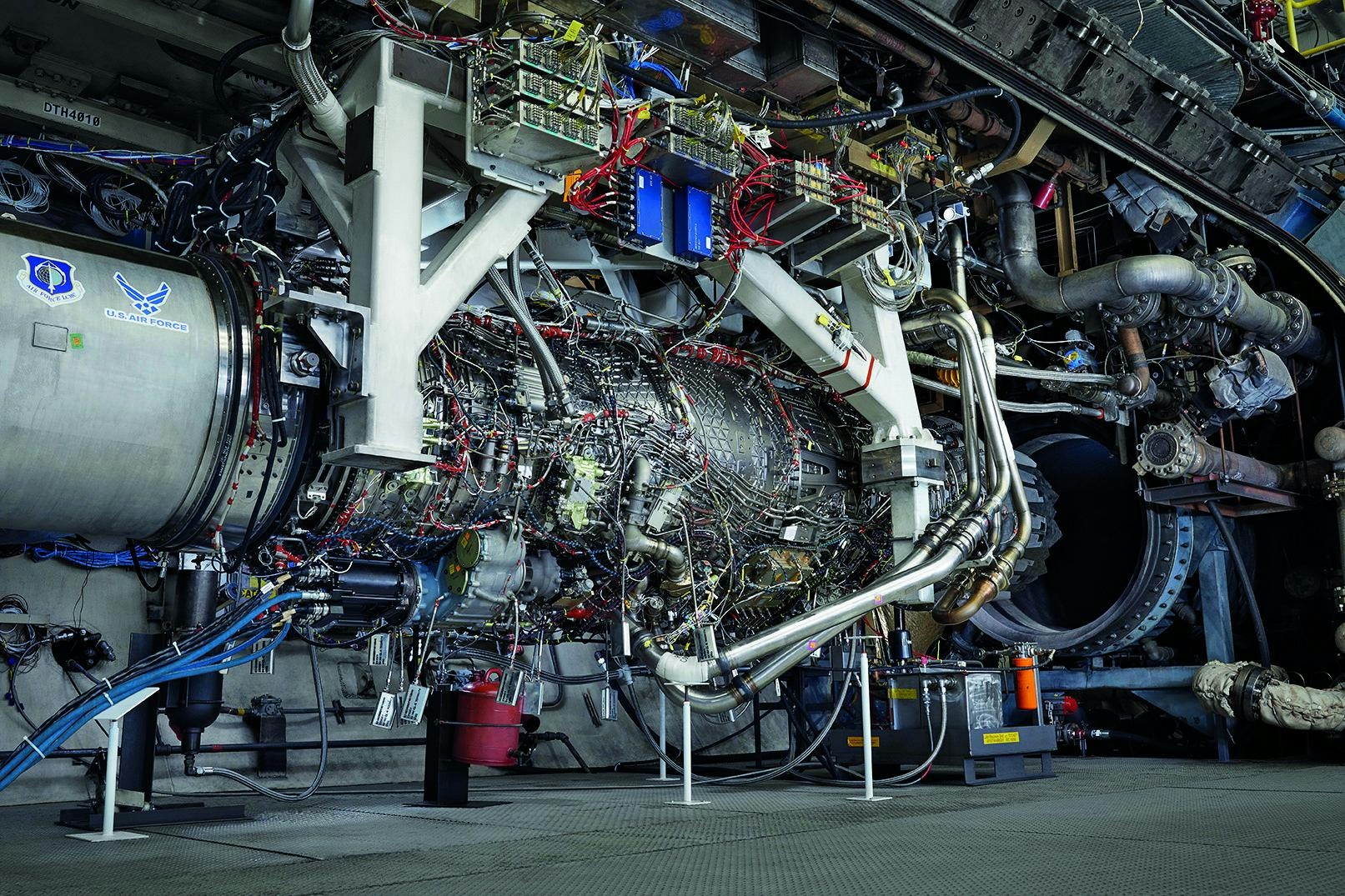
Identifying the most revolutionary commercial aircraft engines requires consideration of various dimensions of innovation, as well as a broad definition of what constitutes a commercial aircraft engine. This overview encompasses early piston engines, turboprops, and jet engines, including both technology demonstrators and widely produced models. As the industry embarks on the development of the next generation of aero engines, it confronts not only technical hurdles but also significant economic and competitive pressures that will shape future advancements.
Wright J-4/J-5 "Whirlwind" Piston Engine (1920s)
The Wright Whirlwind family, particularly the J-5 model, represented a pivotal advancement in aviation by introducing the first truly reliable air-cooled radial engines for commercial aircraft. Manufactured by Wright Aeronautical, which later became Curtiss-Wright, these engines addressed the critical issue of in-flight failures and overheating that plagued earlier designs. The Whirlwind’s reliability made passenger air travel more practical and safe, powering iconic aircraft such as the Fokker F.VII and the Ford Trimotor. Most notably, it enabled Charles Lindbergh’s historic nonstop transatlantic flight in the Spirit of St. Louis. This breakthrough established a new benchmark for engine dependability, laying the groundwork for subsequent innovations like the Pratt & Whitney Wasp and Wright Cyclone series.
Pratt & Whitney Wasp Series (1920s–1940s)
Building on the foundation set by the Whirlwind, the Pratt & Whitney Wasp series emerged as one of the most influential air-cooled radial piston engines in commercial aviation. Founded by Frederick B. Rentschler after his departure from Wright Aeronautical in 1925, Pratt & Whitney developed the R-1340 Wasp and its successors, including the R-1830. These engines featured a two-row radial design that delivered increased power without adding undue complexity or weight. Throughout the 1930s and 1940s, the Wasp series became central to commercial aviation, solidifying Pratt & Whitney’s position as a leading engine manufacturer.
Industry Challenges and Future Directions
The commercial aviation sector today faces formidable challenges as it prepares for a new era of propulsion technology. Maintenance costs for standard engines can reach up to €200,000 per month per aircraft, highlighting the pressing need for innovation. With the global commercial fleet expected to double by 2044, a comprehensive replacement cycle for propulsion systems is inevitable, intensifying competition among engine manufacturers.
In response, Pratt & Whitney continues to invest in ducted-fan technology, while GE Aerospace advances hybrid-electric propulsion systems. The market is also shaped by the influence of major airframe manufacturers. Despite recent setbacks, Boeing is anticipated to leverage its industrial and political clout to maintain a significant role in the sector. Meanwhile, Embraer has reported improvements in Pratt & Whitney’s PW1900G engine turnaround times and spare parts availability, enhancing operator confidence and reducing the risk of aircraft groundings due to engine issues.
As the industry evolves, the legacy of breakthrough engines such as the Whirlwind and Wasp series underscores that technological revolutions are driven not only by innovation but also by the capacity to address practical operational challenges. The forthcoming generation of revolutionary engines is expected to emerge at the nexus of reliability, efficiency, and adaptability to shifting market demands.

Etihad Airways Suspends Airbus A380 Flights on Key Route

Aditya Birla Group Seeks Approval for Aircraft Leasing in GIFT City

Qatar Airways Highlights Innovation and Connectivity at Arabian Travel Market 2026

Hong Kong's Five-Year Plan Includes Andrew Fan's Aircraft Parts Processing Hub Proposal

ACIA Aero Leasing Delivers ATR72-600 to Air Nostrum

RTX Appoints Jill Albertelli as Head of Pratt & Whitney

TAT Technologies Joins Beyond Aero Hydrogen Aircraft Program

AURAK Study Highlights Barriers to Air Taxi Adoption in Emerging Economies

Xiamen Air Selects Altitude for 787 Maintenance at Heathrow

Etihad and Swissport Extend Global Partnership
