
حوّل رؤى الذكاء الاصطناعي إلى أفعال منسّقة

الرائج الآن
Categories
Six Aircraft With the Largest Passenger Capacity
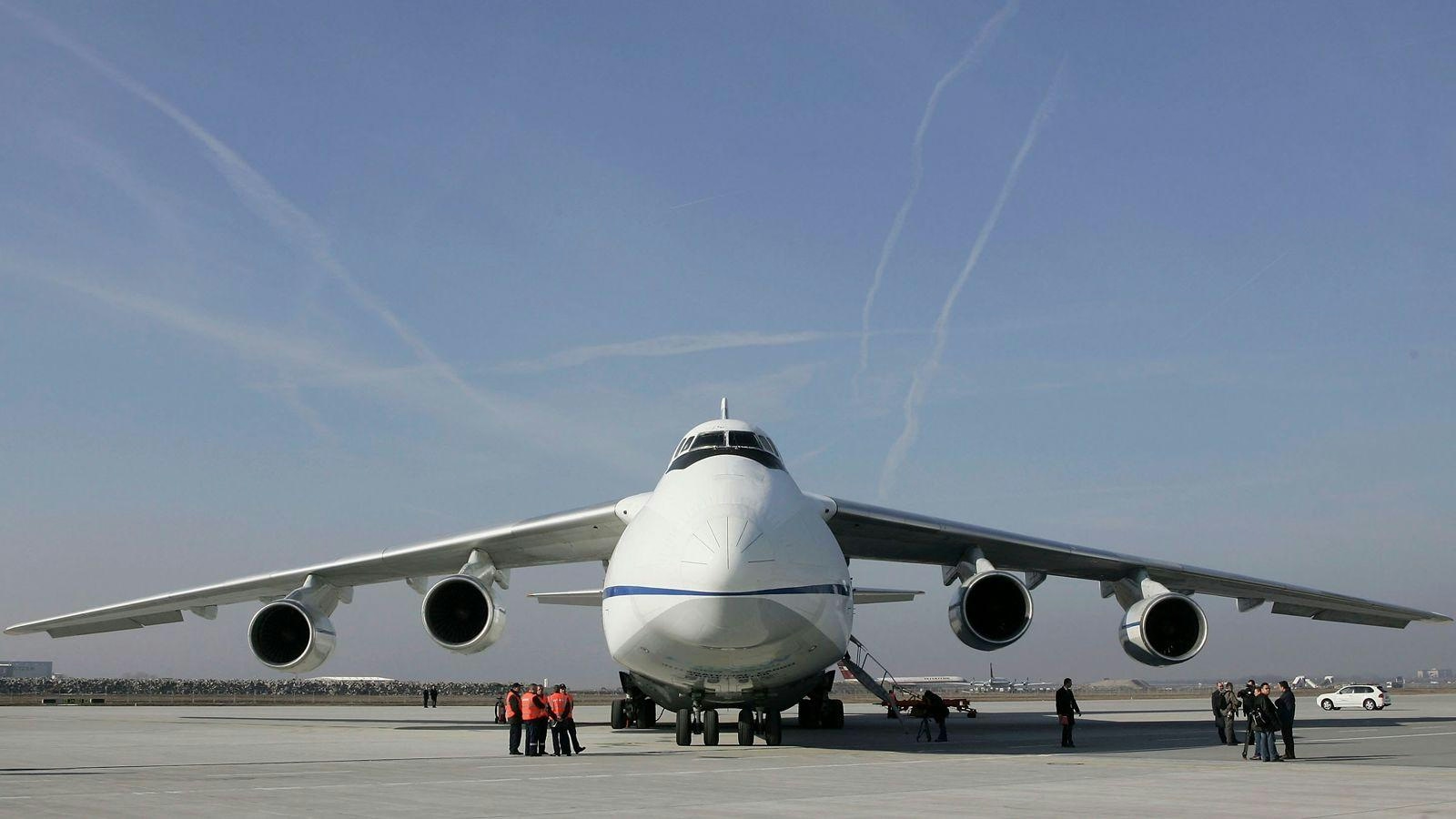
Six Aircraft With the Largest Passenger Capacity
Global air travel demand continues to drive airlines toward larger, more efficient aircraft, with passenger capacity emerging as a critical focus in 2026. According to the International Air Transport Association (IATA), industry-wide passenger traffic increased by 3.8% year-on-year in January 2026, reaching 774 billion revenue passenger kilometers (RPK). Although this growth represents a slowdown from December’s 5.8% increase, demand still outpaced capacity, which rose by 3.5%. Aircraft are operating at higher load factors than ever before, both domestically and internationally, while global seat capacity is projected to expand by 5.2% in the coming months—the fastest growth rate since April 2024. This surge reflects airlines’ preparations for sustained demand, particularly on long-haul international routes.
Industry Challenges and Market Dynamics
The push for larger aircraft occurs amid significant challenges within the aviation sector. United Airlines, for instance, is advancing a record fleet upgrade despite a $400 million increase in fuel costs in April 2026. While the carrier remains optimistic due to strong booking trends, elevated oil prices are causing some airlines to reconsider aircraft retirements and adjust fleet strategies. Boeing’s industrial reset has shown signs of recovery with a profitable 2025, yet ongoing geopolitical tensions—especially with China—continue to threaten delivery schedules and order books. Additionally, the conflict in Iran has reshaped the global airline landscape, with Turkish Airlines gaining market share at the expense of Qatar Airways, as airspace restrictions and competition from Asian carriers alter route dynamics.
In this context, airlines are increasingly reliant on high-capacity aircraft to maximize operational efficiency and profitability, particularly where airport slot availability is constrained. The following six aircraft stand out for their exceptional passenger-carrying capabilities in commercial aviation today.
Airbus A330-900neo: Up to 460 Passengers
The Airbus A330-900neo is among the most capable twin-engine widebody jets currently in production. Airbus states that the aircraft can accommodate up to 460 passengers in a high-density configuration, although it typically seats around 310 in a three-class layout. Delta Air Lines is the largest operator of this model. With a range of approximately 7,200 nautical miles, the A330-900neo competes directly with the Boeing 787-9, offering higher seat capacity and incorporating advanced materials. Its design facilitates fleet modernization with minimal retraining and maintenance investment, making it an attractive option for airlines seeking efficiency and flexibility.
Airbus A350-1000: Up to 480 Passengers
The Airbus A350-1000 is the largest variant in the A350 family, capable of seating between 375 and 400 passengers in a standard three-class configuration, or up to 480 in high-density layouts. Introduced by Qatar Airways in 2018, the aircraft features the Airspace cabin concept, which includes wider seats, larger windows, and enhanced cabin comfort tailored for ultra-long-haul flights. Powered by Rolls-Royce Trent XWB-97 engines, the A350-1000 has become a modern successor to the Airbus A380 on many routes, delivering comparable range with improved fuel efficiency and lower operating costs.
As airlines navigate volatile fuel prices, shifting geopolitical landscapes, and evolving competition—including the emergence of electric air taxis from companies such as Joby Aviation—the role of high-capacity aircraft remains vital. These jets enable carriers to meet robust demand, adapt to market disruptions, and sustain profitability in an increasingly complex global aviation environment.

Etihad Airways Suspends Airbus A380 Flights on Key Route

Aditya Birla Group Seeks Approval for Aircraft Leasing in GIFT City

Qatar Airways Highlights Innovation and Connectivity at Arabian Travel Market 2026

Hong Kong's Five-Year Plan Includes Andrew Fan's Aircraft Parts Processing Hub Proposal

ACIA Aero Leasing Delivers ATR72-600 to Air Nostrum

RTX Appoints Jill Albertelli as Head of Pratt & Whitney

TAT Technologies Joins Beyond Aero Hydrogen Aircraft Program

AURAK Study Highlights Barriers to Air Taxi Adoption in Emerging Economies

Xiamen Air Selects Altitude for 787 Maintenance at Heathrow

Etihad and Swissport Extend Global Partnership
