
حوّل رؤى الذكاء الاصطناعي إلى أفعال منسّقة

الرائج الآن
Categories
The Airbus Model: Successes in Civil Aviation and Challenges in Defense and Innovation
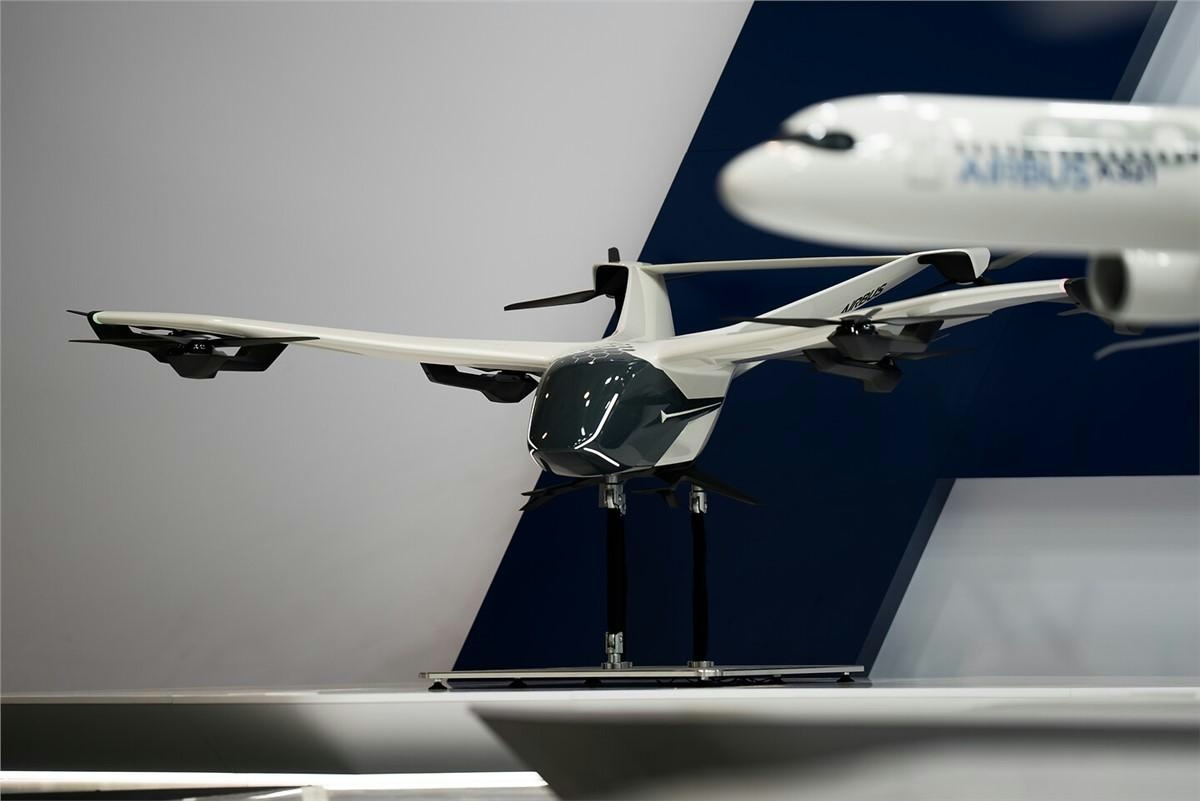
The Airbus Model: Successes in Civil Aviation and Challenges in Defense and Innovation
Governance and Industrial Leadership in European Defense Programs
The Future Air Combat System (FCAS) program represents one of Europe’s most ambitious defense projects, testing the continent’s ability to design and manage highly complex combat systems. At the heart of its development lies a critical debate over governance: whether Europe should rely on clear industrial leadership or adopt a shared model inspired by Airbus’s success in civil aviation. This question transcends organizational preferences, directly influencing the program’s technical, financial, and operational outcomes. Insights drawn from recent European defense projects such as Eurofighter, A400M, Eurodrone, and the A330 MRTT, alongside Airbus’s civil aviation experience, provide valuable lessons for the New Generation Fighter (NGF) and future military systems.
Airbus’s Civil Aviation Success: A Model of Structured Governance
Airbus’s achievements in civil aviation are founded on a disciplined industrial model characterized by early, centralized technical architecture and rigorous certification processes overseen by authorities such as the European Union Aviation Safety Agency (EASA) and the Federal Aviation Administration (FAA). This governance framework has fostered stability, predictability, and efficiency, enabling Airbus to standardize platforms and maintain a competitive edge globally. The A350 program exemplifies how controlled innovation and streamlined decision-making can deliver projects on time and within budget.
Nevertheless, recent challenges have exposed vulnerabilities within this model. Airbus has encountered significant issues, including a major software defect affecting approximately 6,000 A320-family aircraft and quality concerns related to fuselage panels on several dozen jets. These problems have contributed to a sharp decline in Airbus’s stock price—dropping by as much as 9 to 10 percent—and have raised concerns about the company’s heavy dependence on the A320, which accounts for the majority of its sales and profits. Despite robust demand and a record order backlog, investor confidence has waned amid doubts over Airbus’s ability to meet its ambitious 2025 targets. This skepticism is compounded by competitive pressures, notably Boeing’s strategic acquisitions of Spirit AeroSystems and Aerostructures, which may alter the competitive landscape.
Challenges in Defense and Innovation: Limits of the Airbus Model
Defense programs differ fundamentally from civil aviation projects, as they must reconcile diverse national requirements, sovereignty considerations, and the integration of sensitive capabilities such as weapons systems and electronic warfare. These complexities necessitate greater architectural coherence and adaptability to evolving threats. Applying a governance model designed for the regulated and relatively stable environment of civil aviation reveals inherent limitations when transferred to defense contexts.
The challenges intensify in highly innovative sectors—including drones, electric vertical takeoff and landing vehicles (eVTOLs), reusable launch vehicles, and satellite constellations—where risk aversion and fragmented decision-making can hinder rapid iteration and technological breakthroughs. This dynamic has contributed to Airbus’s position as a follower in several emerging segments, as more agile competitors have taken the lead.
Insights from ArianeGroup and the Future of European Aerospace
The experience of ArianeGroup, the joint venture between Airbus and Safran, further illustrates how robust, centralized governance structures can become constraints amid industry disruption. As Europe advances programs like FCAS and NGF, striking a balance between structured governance and the need for agility and innovation remains a central challenge.
Despite these obstacles, Airbus continues to be recognized for its contributions to sustainable aviation, as evidenced by its recent accolades at the ATI Aerospace Technology & Innovation Awards 2025. The company’s ongoing commitment to net-zero aviation highlights its capacity for innovation, even as it navigates operational and strategic headwinds.
While the Airbus model has delivered remarkable success in civil aviation, its application to defense and cutting-edge innovation demands careful adaptation to address the unique requirements of these sectors.

Etihad Airways Suspends Airbus A380 Flights on Key Route

Aditya Birla Group Seeks Approval for Aircraft Leasing in GIFT City

Qatar Airways Highlights Innovation and Connectivity at Arabian Travel Market 2026

Hong Kong's Five-Year Plan Includes Andrew Fan's Aircraft Parts Processing Hub Proposal

ACIA Aero Leasing Delivers ATR72-600 to Air Nostrum

RTX Appoints Jill Albertelli as Head of Pratt & Whitney

TAT Technologies Joins Beyond Aero Hydrogen Aircraft Program

AURAK Study Highlights Barriers to Air Taxi Adoption in Emerging Economies

Xiamen Air Selects Altitude for 787 Maintenance at Heathrow

Etihad and Swissport Extend Global Partnership
