
حوّل رؤى الذكاء الاصطناعي إلى أفعال منسّقة

الرائج الآن
Categories
The Future of Urban Air Mobility: eVTOL Taxis, Personal Air Travel, and Cargo Drones by 2026
The Future of Urban Air Mobility: eVTOL Taxis, Personal Air Travel, and Cargo Drones by 2026
The global market for flying cars is on the cusp of significant expansion, with forecasts projecting growth from US$117.4 million in 2025 to an estimated US$1.39 billion by 2033. This surge, driven by a compound annual growth rate (CAGR) of 36.3% between 2026 and 2033, underscores the accelerating development of next-generation urban air mobility (UAM) technologies.
Market Drivers and Industry Momentum
Urban air mobility is increasingly viewed as a viable solution to the growing problem of congestion in densely populated cities, offering rapid, point-to-point transportation alternatives. Advances in electric propulsion, autonomous flight systems, and vertical take-off and landing (VTOL) technology are bringing concepts such as electric VTOL (eVTOL) taxis, personal air vehicles, and cargo drones closer to commercial deployment.
Investor enthusiasm is intensifying, attracted by the sector’s high growth potential and the opportunity to participate in an emerging market. Strategic collaborations between aerospace manufacturers and technology companies, combined with supportive government policies and regulatory frameworks, are accelerating progress. The emphasis on sustainable transportation and the potential to disrupt conventional mobility paradigms further enhance the appeal of flying cars as both an investment and a strategic priority for industry leaders.
Key Industry Developments and Regional Progress
Several prominent companies are shaping the urban air mobility landscape, including Aeromobil, Airbus, Joby Aviation, Pal-V International, Samson Motorworks, Cartivator, Urban Aeronautics, Volocopter GmbH, and Moller International.
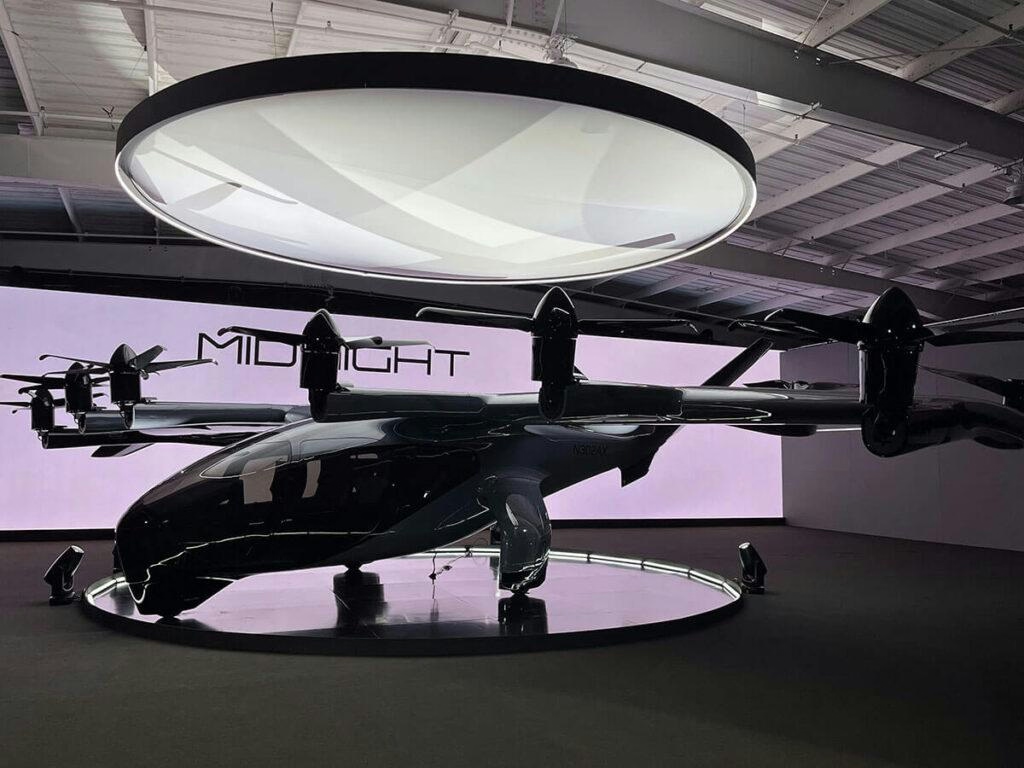
In the United States, Joby Aviation made significant strides in October 2025 by advancing its eVTOL aircraft toward Federal Aviation Administration (FAA) certification, expanding flight tests in California with improvements in battery efficiency and noise reduction tailored for urban environments. The previous month, Archer Aviation completed additional piloted test flights of its "Midnight" eVTOL model and reinforced partnerships with major airlines to support future air taxi services. Boeing, through its subsidiary Wisk Aero, continued to develop fully electric autonomous air vehicles, focusing on enhanced artificial intelligence navigation systems for urban passenger transport.
In the Asia Pacific region, Japan’s SkyDrive Inc. achieved a milestone in October 2025 by successfully testing its SD-05 flying car, marking notable progress in the region’s UAM initiatives. Meanwhile, Southeast Asia has witnessed growing adoption, with companies such as EHang commencing commercial operations in Thailand, signaling expanding regional interest and market penetration.
Challenges to Widespread Adoption
Despite these advancements, significant obstacles remain before urban air mobility can be widely adopted by 2026. Integrating eVTOL aircraft and cargo drones into existing airspace presents complex challenges that require comprehensive regulatory frameworks and technological standardization. The FAA’s approval of eight pilot programs for electric air taxis across 26 U.S. states represents a critical step forward, yet the industry must establish uniform standards to prevent fragmented and incompatible systems.
Ensuring safety, operational efficiency, and interoperability will depend heavily on the development of standardized robotic and navigation technologies. Regulatory complexities, airspace management, and the need for scalable, future-proof solutions continue to be central concerns as the sector advances toward commercialization.
Outlook
As urban air mobility approaches commercial viability, the coming years will be characterized by ongoing innovation, evolving regulatory landscapes, and strategic partnerships. The flying cars market stands poised to transform urban transportation, heralding a new era of mobility contingent upon successfully addressing the technical and regulatory challenges that lie ahead.

Etihad Airways Suspends Airbus A380 Flights on Key Route

Aditya Birla Group Seeks Approval for Aircraft Leasing in GIFT City

Qatar Airways Highlights Innovation and Connectivity at Arabian Travel Market 2026

Hong Kong's Five-Year Plan Includes Andrew Fan's Aircraft Parts Processing Hub Proposal

ACIA Aero Leasing Delivers ATR72-600 to Air Nostrum

RTX Appoints Jill Albertelli as Head of Pratt & Whitney

TAT Technologies Joins Beyond Aero Hydrogen Aircraft Program

AURAK Study Highlights Barriers to Air Taxi Adoption in Emerging Economies

Xiamen Air Selects Altitude for 787 Maintenance at Heathrow

Etihad and Swissport Extend Global Partnership
