
حوّل رؤى الذكاء الاصطناعي إلى أفعال منسّقة

الرائج الآن
Categories
The Liberty V12 Aircraft Engine Was Designed in a Hotel Room and Built by Lincoln
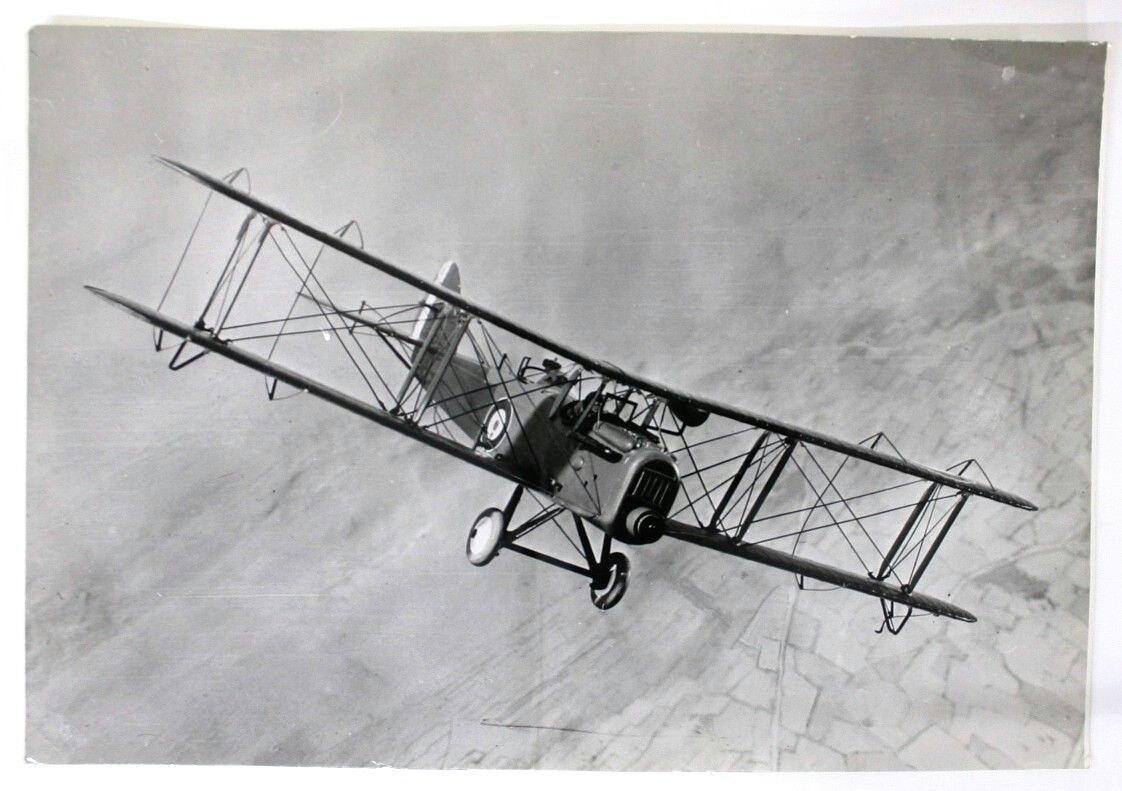
The Liberty V12 Aircraft Engine: From Hotel Room Design to Lincoln Manufacturing
In 1917, as the United States entered World War I, President Woodrow Wilson committed to an ambitious goal: the delivery of 11,000 aircraft to support the war effort. Achieving this target demanded not only accelerated production but also the development of a new aircraft engine that could be manufactured efficiently and at scale. To meet this challenge, Congress established the Aircraft Production Board on May 16, 1917, appointing Howard E. Coffin—an engineer and co-founder of the Hudson Motor Car Company—as its head.
Rapid Development Under Pressure
Coffin swiftly assembled a team tasked with creating an engine that would outperform the Rolls-Royce Eagle in both power and weight, while remaining cost-effective and straightforward to produce. The responsibility fell to two engineers: Elbert J. Hall, founder of the Hall-Scott Motor Car Company, and Jesse G. Vincent, head of engineering at Packard. Under intense time constraints, Hall and Vincent were confined to just a few days at the New Willard Hotel in Washington, D.C., to devise a viable design.
Drawing on Packard’s racing engines and the French Lorraine-Dietrich V8, the engineers initially proposed a modular V8 engine. Their design, however, was scalable from four to twelve cylinders. Ultimately, the twelve-cylinder configuration was chosen for its superior power output, resulting in the Liberty 12 Model A V12 (L-12) engine in 1918. This engine featured a 27-liter displacement and produced 400 horsepower at 1,800 rpm. Later that year, a turbo-supercharged variant equipped with a General Electric supercharger increased output to 449 horsepower at 1,940 rpm. British-built Havilland DH-4 aircraft fitted with the Liberty engine became known as "Liberty Planes."
Industry Skepticism and Market Challenges
Despite its innovative design and rapid development, the Liberty V12 encountered significant challenges in a competitive aviation market. Established engine manufacturers viewed the new entrant with skepticism, particularly given its unconventional origins—conceived in a hotel room and produced by Lincoln, an automotive company rather than a traditional aviation firm. Regulatory scrutiny compounded these concerns, as the imperative to demonstrate reliability and performance was paramount in an industry where safety and efficiency were critical.
Market reactions reflected this uncertainty, with some stakeholders questioning whether the Liberty V12 could match the proven track records of established competitors. In response, rival manufacturers began developing their own advanced engine designs and closely monitored the Liberty’s performance, sparking a wave of innovation throughout the aviation industry.
The Liberty V12’s story remains one of rapid innovation under extraordinary circumstances, illustrating both the potential and the challenges of introducing disruptive technology into a field where trust and reliability are essential. Its legacy endures as a significant technical achievement and a catalyst for further advancements in aircraft engine development.

Etihad Airways Suspends Airbus A380 Flights on Key Route

Aditya Birla Group Seeks Approval for Aircraft Leasing in GIFT City

Qatar Airways Highlights Innovation and Connectivity at Arabian Travel Market 2026

Hong Kong's Five-Year Plan Includes Andrew Fan's Aircraft Parts Processing Hub Proposal

ACIA Aero Leasing Delivers ATR72-600 to Air Nostrum

RTX Appoints Jill Albertelli as Head of Pratt & Whitney

TAT Technologies Joins Beyond Aero Hydrogen Aircraft Program

AURAK Study Highlights Barriers to Air Taxi Adoption in Emerging Economies

Xiamen Air Selects Altitude for 787 Maintenance at Heathrow

Etihad and Swissport Extend Global Partnership
