
حوّل رؤى الذكاء الاصطناعي إلى أفعال منسّقة

الرائج الآن
Categories
The Rear-Fan Engine Behind the Crash of the World's Fastest Airliner
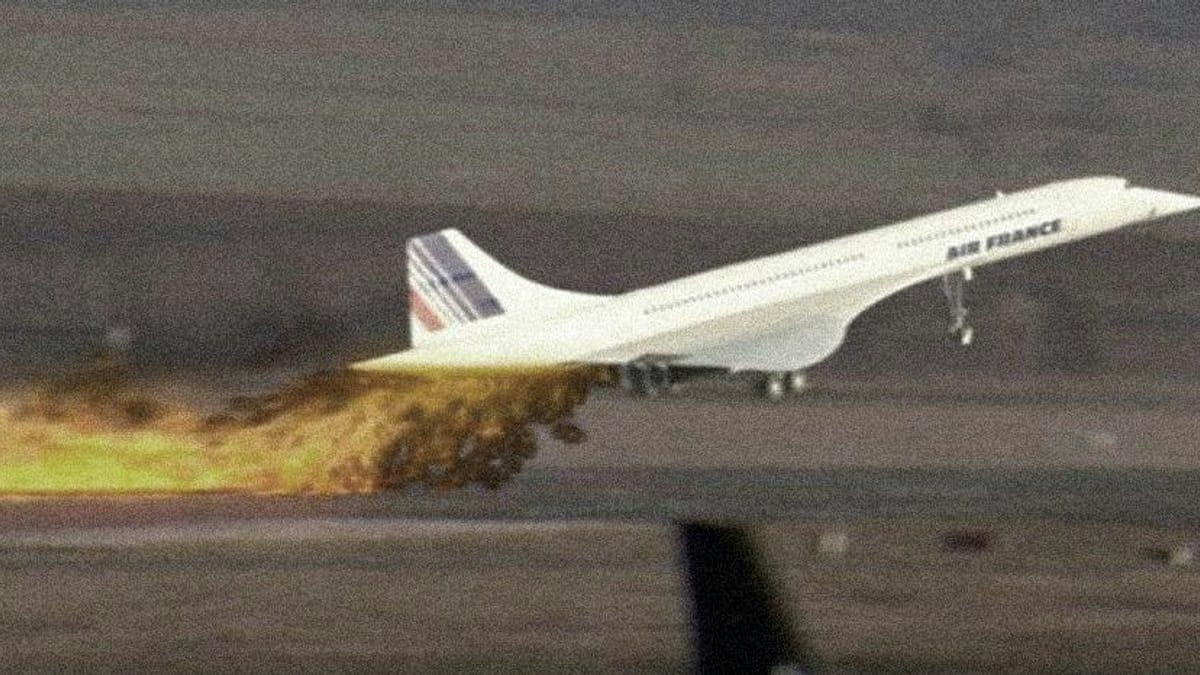
The Rear-Fan Engine Behind the Crash of the World’s Fastest Airliner
Innovation Amidst Aviation’s Formative Years
During the late 1950s and early 1960s, commercial aviation stood at a crossroads, with competing engineering philosophies shaping its future trajectory. While some manufacturers pursued supersonic airliners such as the Concorde, others experimented with novel engine designs, including aft-fan turbofans. This period of innovation and uncertainty bears resemblance to contemporary debates surrounding blended wing bodies, open-fan engines, and hybrid propulsion systems.
General Dynamics’ Convair division took a distinctive approach with its Convair 880 and 990 airliners, emphasizing speed over passenger capacity and operational economy. The Convair 990 Coronado, introduced between 1961 and 1963, was engineered to surpass its competitors—the Boeing 707 and Douglas DC-8—by cruising 25 to 35 miles per hour faster. Despite this speed advantage, the aircraft accommodated fewer passengers and faced challenges related to higher operating costs. Responding to American Airlines’ demand for improved fuel efficiency, Convair developed a stretched variant of the 880, increasing seating capacity from 88 to as many as 121 passengers.
The Rear-Fan Engine: Innovation and Challenges
Central to the Convair 990’s design was its unconventional General Electric CJ805-23 engine. Departing from the prevalent front-fan turbofan configuration, the CJ805-23 employed a rear-mounted fan, aiming to merge the fuel efficiency of turbofans with the high performance of turbojets. While innovative, this rear-fan architecture introduced significant technical complexities. Managing airflow within the engine proved challenging, and maintenance demands increased, leading to persistent reliability issues.
These technical difficulties extended beyond engineering theory into regulatory and operational realities. Aviation authorities in both Europe and the United States intensified scrutiny of rear-fan engines, particularly concerned about the risk of dual in-flight shutdowns. Such incidents raised serious safety alarms, prompting heightened oversight. Airlines, in turn, reevaluated their engine configurations, especially on older aircraft models like the Airbus A330 and Boeing 777, where oil pump malfunctions led some carriers to de-pair certain engines as a risk mitigation strategy.
Market Impact and Legacy
The operational drawbacks of the Convair 990 ultimately eclipsed its speed advantage. Both the aircraft and its rear-fan engines failed to secure a lasting foothold in the commercial aviation market. Meanwhile, competitors such as Boeing and Douglas, equipped with Pratt & Whitney’s more conventional and dependable engines, consolidated their dominance. This episode also intensified competition within the aircraft fan frame sector, motivating industry leaders including Safran Aircraft Engines, GE Aerospace, Pratt & Whitney, and Rolls-Royce to accelerate the development of safer and more efficient engine technologies.
Although GE Aerospace is now the world’s largest jet engine manufacturer, its commercial aviation presence in the 1960s was largely limited to the Convair 880 and 990, with a primary focus on military aviation. Pratt & Whitney, by contrast, powered the majority of major airliners during that era. The failure of the Convair 990 and its rear-fan engine underscored the inherent risks of prioritizing speed and unconventional technology at the expense of reliability and efficiency—a cautionary lesson that continues to influence the evolution of commercial aviation.
BBN Airlines Becomes IATA Member
FAA Orders Breeze Airways and Delta to Inspect Airbus A220 Fuel Hoses

Philippine Aviation Navigates Expansion and Costs Amid Fuel Price Volatility
On April 26, 1971, an SR-71 Blackbird Flew Over 15,000 Miles in 10.5 Hours, Limited by Liquid Nitrogen Supply
Boeing 747 Airframe Valued Less Than One Landing Gear Component
Morphing Aircraft Skin Improves Safety and Fuel Efficiency

BRICS Nations Commit to Enhanced Cooperation on Sustainable Transport and Green Aviation
CFM Turbine Upgrade Doubles LEAP Engine Service Life in Harsh Conditions
CFM Upgrade Doubles LEAP Engine Lifespan in Harsh Climates

Sonoma County Board of Supervisors Revisits Controversial Government Office Deal
