
حوّل رؤى الذكاء الاصطناعي إلى أفعال منسّقة

الرائج الآن
Categories
Trends and Outlook for Solar-Powered UAVs Through 2033
Trends and Outlook for Solar-Powered UAVs Through 2033
The solar-powered unmanned aerial vehicle (UAV) market is experiencing significant growth, driven by increasing demand for unmanned aerial surveillance, expanding defense modernization programs, and a global emphasis on sustainable aviation. According to IMARC Group, the market reached a valuation of USD 401 million in 2024 and is projected to nearly double to USD 867.3 million by 2033, representing a compound annual growth rate (CAGR) of 8.5% from 2025 to 2033.
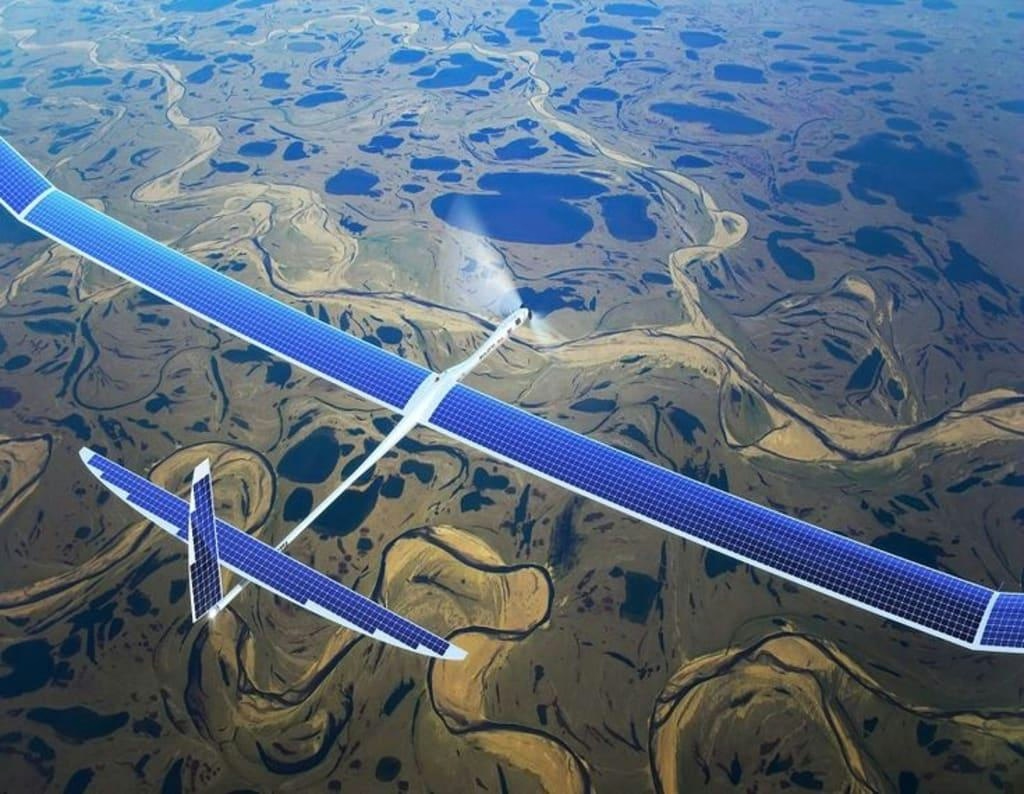
Solar-powered UAVs are revolutionizing long-endurance aerial operations by utilizing solar energy to sustain flight for extended periods, often lasting several days. This capability makes them particularly suitable for missions where traditional fuel-powered aircraft are limited by cost and endurance constraints. The market is primarily segmented by drone type, with fixed-wing models dominating due to their superior aerodynamic efficiency. Missions covering distances greater than 300 kilometers constitute the largest range category, while defense applications remain the primary sector. Semi-autonomous operation is the prevalent mode of control, with ongoing innovation focused on propulsion systems and airframe design.
Key Growth Drivers
The defense and military sectors are at the forefront of solar-powered UAV adoption. Defense agencies worldwide are increasingly deploying these platforms for long-range surveillance, intelligence gathering, and communication relay missions, thereby reducing dependence on fuel resupply logistics. Significant investments have been made by the U.S. Department of Defense and NASA in advanced UAV propulsion research. A notable example is the Defense Advanced Research Projects Agency’s (DARPA) ANCILLARY program, which awarded Northrop Grumman a contract in July 2023 to develop autonomous vertical takeoff and landing (VTOL) uncrewed aircraft. The United States alone has registered over 855,000 drones, including more than 316,000 for commercial use, underscoring the critical role of government investment in market expansion.
Commercial and agricultural sectors are also embracing solar-powered UAVs as cost-effective alternatives for various applications such as crop monitoring, pest detection, fertilizer spraying, solar panel inspection, and large-scale mapping. In January 2024, Sphere Drones introduced HubX, a self-sustaining mobile drone platform designed for remote aerial data collection. Similarly, Garuda Aerospace’s multifunctional agricultural drone, capable of pesticide spraying and pipeline inspection, exemplifies the rapid growth of commercial applications in this domain.
Research and development efforts continue to push the boundaries of UAV endurance and capability. India’s National Aerospace Laboratories achieved a significant milestone with a high-altitude pseudo-satellite (HAPS) solar UAV capable of over ten days of continuous flight. NewSpace Research and Technologies’ HAPS completed a 21-hour maiden flight in late 2023, while the Indian Institute of Technology Kanpur’s ‘Maral’ solar surveillance drone highlights the impact of government-supported academic research on advancing next-generation UAV technologies.
Market Trends and Challenges
A prominent trend within the sector is the development of High-Altitude Pseudo-Satellites (HAPS), which are solar UAVs engineered for stratospheric operations lasting weeks or even months. Despite promising advancements, the industry faces several challenges, including technological limitations related to battery efficiency and energy storage, regulatory and safety concerns, and competition from conventional fuel-powered drones. These obstacles have spurred increased investment in research and development, as well as strategic partnerships with technology firms. Market players are responding by advancing battery technologies and forming alliances to enhance their competitive positions.
Outlook Through 2033
The outlook for solar-powered UAVs remains optimistic despite existing challenges. Ongoing improvements in solar energy capture and battery storage technologies, combined with growing demand for efficient and sustainable aerial platforms, are expected to drive substantial market growth through 2033. As governments and industries prioritize greener and longer-endurance solutions, solar-powered UAVs are set to become indispensable assets across defense, commercial, and research sectors worldwide.

Etihad Airways Suspends Airbus A380 Flights on Key Route

Aditya Birla Group Seeks Approval for Aircraft Leasing in GIFT City

Qatar Airways Highlights Innovation and Connectivity at Arabian Travel Market 2026

Hong Kong's Five-Year Plan Includes Andrew Fan's Aircraft Parts Processing Hub Proposal

ACIA Aero Leasing Delivers ATR72-600 to Air Nostrum

RTX Appoints Jill Albertelli as Head of Pratt & Whitney

TAT Technologies Joins Beyond Aero Hydrogen Aircraft Program

AURAK Study Highlights Barriers to Air Taxi Adoption in Emerging Economies

Xiamen Air Selects Altitude for 787 Maintenance at Heathrow

Etihad and Swissport Extend Global Partnership
