
حوّل رؤى الذكاء الاصطناعي إلى أفعال منسّقة

الرائج الآن
Categories
United Airlines CEO Urges U.S. to Support Sustainable Aviation Fuel Like Solar Energy
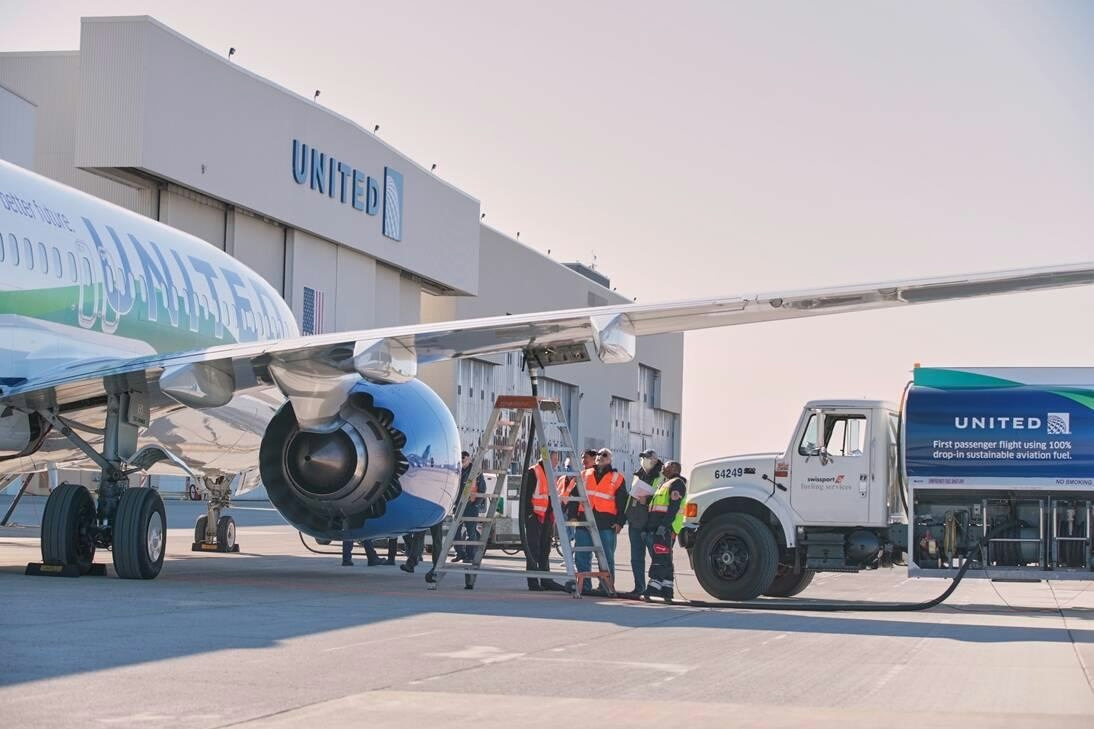
United Airlines CEO Calls for U.S. Support of Sustainable Aviation Fuel
United Airlines CEO Scott Kirby has long been aware of the realities of climate change, tracing his concern back to his time as a cadet at the Air Force Academy. Reflecting on forecasts from the 1980s, Kirby recalled predictions of diminished snowfall on the Western Slope and the eventual drying of the Colorado River. Today, those early warnings have materialized, with the Western Slope and adjacent Utah counties emerging as some of the most significant climate hotspots along the river, experiencing temperature increases exceeding 2 degrees Celsius. The Colorado River’s flow has been severely impacted by warming-driven evaporation, reduced precipitation, and shrinking snowpack. This summer, water levels in critical reservoirs such as Lake Powell and Lake Mead have plummeted to historic lows, underscoring the urgency of the crisis.
Advocating for Sustainable Aviation Fuel
In response to these environmental challenges, Kirby has urged the U.S. government to provide strong and sustained support for sustainable aviation fuel (SAF). He drew a parallel between the current need for SAF investment and the early government backing that helped solar energy become commercially viable. “We need the same kind of commitment to SAF that we saw with solar,” Kirby stated, emphasizing the aviation sector’s responsibility in combating climate change.
Despite its potential, SAF currently represents less than 1% of the global jet fuel supply. Its expansion is hindered by high production costs and limited availability. Kirby criticized Europe’s approach to SAF, arguing that mandates alone are insufficient without substantial funding and policy incentives to reduce costs and increase supply. “Europe’s mandates alone aren’t enough. We need real investment to bring costs down and supply up,” he asserted.
Industry Challenges and the Path Forward
The aviation industry faces mounting pressure to decarbonize, yet the path forward remains uncertain. Market analysts warn of continued volatility, driven by fluctuating jet fuel prices and inconsistent travel demand, creating a challenging environment for airlines. While many competitors have yet to articulate clear strategies, there is a growing consensus that alternative fuels like SAF are essential to achieving long-term climate objectives.
Kirby’s comments highlight the critical need for coordinated action. “If we want to preserve our rivers, our snowpack, and our way of life, we have to invest in solutions now,” he said. As climate change continues to intensify across the American West, the debate over funding and scaling sustainable aviation fuel is poised to become increasingly urgent.

Etihad Airways Suspends Airbus A380 Flights on Key Route

Aditya Birla Group Seeks Approval for Aircraft Leasing in GIFT City

Qatar Airways Highlights Innovation and Connectivity at Arabian Travel Market 2026

Hong Kong's Five-Year Plan Includes Andrew Fan's Aircraft Parts Processing Hub Proposal

ACIA Aero Leasing Delivers ATR72-600 to Air Nostrum

RTX Appoints Jill Albertelli as Head of Pratt & Whitney

TAT Technologies Joins Beyond Aero Hydrogen Aircraft Program

AURAK Study Highlights Barriers to Air Taxi Adoption in Emerging Economies

Xiamen Air Selects Altitude for 787 Maintenance at Heathrow

Etihad and Swissport Extend Global Partnership
