
حوّل رؤى الذكاء الاصطناعي إلى أفعال منسّقة

الرائج الآن
Categories
U.S. Tariffs Affect Aviation Industry Growth and Costs
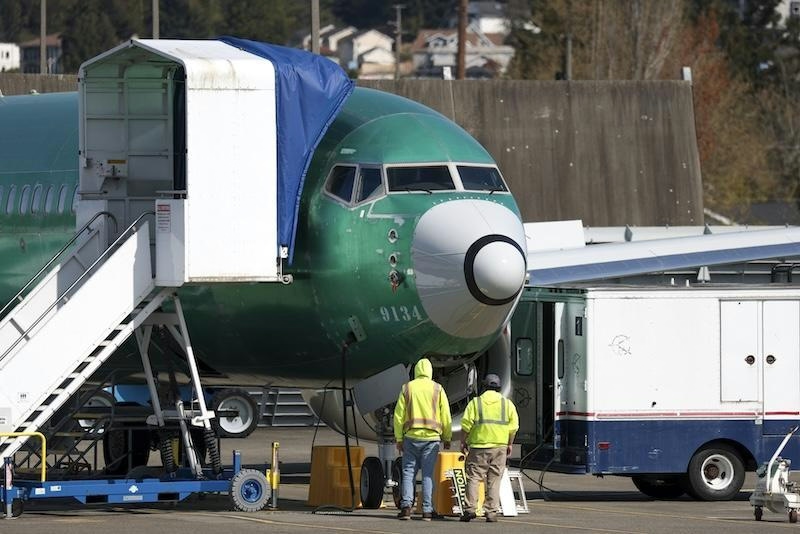
U.S. Tariffs Disrupt Aviation Industry Growth and Cost Stability
The U.S. aviation industry is currently grappling with significant uncertainty stemming from renewed tariff increases and ongoing legal disputes. These developments are disrupting growth trajectories and destabilizing costs in a sector that depends heavily on long-term planning and globally integrated supply chains. The Trump administration’s imposition of broad tariffs under a 1970s emergency statute, including a 10% duty on all imports under Section 122 of the Trade Act of 1974, has complicated aircraft production, fleet investment, and maintenance planning for manufacturers, suppliers, and airlines alike.
Globalized Supply Chains and Cost Volatility
Aircraft manufacturing is inherently globalized. Commercial jets assembled in the United States, such as those produced by Boeing, incorporate engines, avionics, landing gear, composites, and electronic systems sourced from multiple countries. Components frequently cross international borders multiple times before final assembly, rendering the industry particularly vulnerable to frequent tariff adjustments. Even when final assembly occurs domestically, key subsystems and advanced materials often originate abroad, meaning tariffs can increase costs at every level of the supply chain.
For manufacturers like Boeing and suppliers supporting Airbus operations in the U.S., fluctuating import duties disrupt supplier contracts and complicate pricing agreements that are typically negotiated years in advance. Aircraft programs operate on multi-decade timelines, with parts ordered long before delivery. Sudden changes in trade policy introduce cost volatility that is difficult to hedge, undermining the predictability essential for sustained investment.
Impact on Airlines and Market Competitiveness
Airlines and lessors are similarly affected by tariff volatility. Stable input pricing is critical for purchasing new aircraft, planning maintenance cycles, and forecasting operating expenses. Tariffs on spare parts and critical systems increase maintenance, repair, and overhaul costs, squeezing margins in an industry already characterized by thin profitability and high capital intensity. Even modest increases in parts pricing can cascade into higher lease rates, adjusted fleet plans, or delayed deliveries.
While some aircraft were initially exempt from the new tariffs, the prospect of future duties remains uncertain. The Supreme Court’s recent ruling that President Trump exceeded his authority in imposing broad tariffs under emergency powers has further compounded this unpredictability. Should tariff policies be revised, rolled back, or restructured, manufacturers and operators will likely need to recalibrate supply contracts, sourcing strategies, and financial forecasts once again.
The competitive landscape is also evolving. Embraer, for instance, has benefited from tariff exemptions, gaining an advantage over rivals such as Bombardier and Dassault. However, ongoing investigations into Brazil’s trade practices and the potential for additional tariffs under Sections 301 and 232 of the Trade Act of 1974 and the Trade Expansion Act of 1962 continue to pose risks for all industry players.
Market responses indicate that tariffs could erode corporate profit margins and increase consumer costs. Although tax refunds from the One Big Beautiful Act of 2025 may mitigate some effects, the broader impact of tariff volatility remains a structural challenge to growth, cost control, and global competitiveness in the aviation sector. In an industry where efficiency and predictability are paramount, ongoing trade policy uncertainty represents more than a political issue—it constitutes a fundamental obstacle to sustainable progress.

Etihad Airways Suspends Airbus A380 Flights on Key Route

Aditya Birla Group Seeks Approval for Aircraft Leasing in GIFT City

Qatar Airways Highlights Innovation and Connectivity at Arabian Travel Market 2026

Hong Kong's Five-Year Plan Includes Andrew Fan's Aircraft Parts Processing Hub Proposal

ACIA Aero Leasing Delivers ATR72-600 to Air Nostrum

RTX Appoints Jill Albertelli as Head of Pratt & Whitney

TAT Technologies Joins Beyond Aero Hydrogen Aircraft Program

AURAK Study Highlights Barriers to Air Taxi Adoption in Emerging Economies

Xiamen Air Selects Altitude for 787 Maintenance at Heathrow

Etihad and Swissport Extend Global Partnership
