
Orchestrate AI insights into action

Trending
Categories
Advanced Air Mobility Reshapes Eastern North Carolina
Advanced Air Mobility Reshapes Eastern North Carolina
A New Era of Aviation Innovation
More than a century after the Wright Brothers’ pioneering flight, eastern North Carolina is emerging once again as a hub of aviation innovation, this time driven by advanced air mobility and unmanned aircraft systems (UAS). As drone technology advances rapidly, the region is positioned to experience transformative changes in transportation, emergency response, and everyday life.
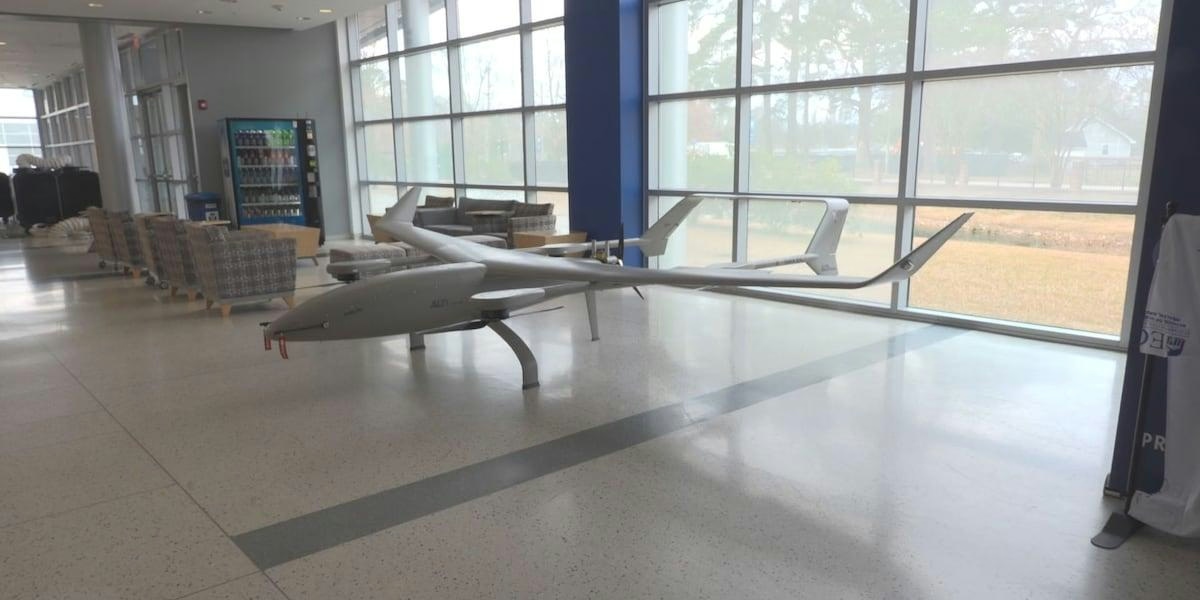
Elizabeth City State University (ECSU) plays a central role in this evolution. It hosts North Carolina’s only four-year FAA-authorized degree program dedicated to unmanned aircraft systems. Within ECSU’s Unmanned Aircraft Systems Research and Design Lab, students engage in designing, building, and 3D-printing drones, gaining practical experience through both simulated and real-world flight operations. Their projects increasingly emphasize applications in emergency response and search and rescue, supported by partnerships with agencies such as the Department of Homeland Security, which underscore the expanding role of drones in disaster management.
Student Charli Brooks highlighted the technological capabilities of these drones, noting their extended battery life and advanced imaging features, including various radar systems. Fellow student Isabela Lujan emphasized the humanitarian impact, stating, “We use those drones to help people in need and save them.”
Collaborative Efforts and Expanding Capabilities
ECSU is also a key participant in a new statewide partnership involving the North Carolina Department of Transportation, N.C. A&T, and N.C. State University. This coalition has established a University Transportation Center of Excellence aimed at developing infrastructure guidelines to accommodate the anticipated increase in drone traffic. The collaboration seeks to address critical questions about the safe and logical integration of drones into North Carolina’s airspace. Kevin Kupietz, chair of ECSU’s Department of Aviation and Emergency Management, articulated the challenge: “How do we lay out the infrastructure for the future to proceed, in a logical manner?”
To support these initiatives, ECSU is expanding its facilities with a new aviation building and experimenting with advanced drone models, including those with wingspans of up to 16 feet capable of flights lasting as long as 10 hours. Kupietz remarked on the expanding potential of drone technology, observing, “Every time that we think we’ve found all of the uses for drones, we find like 10, 15 more new uses.”
Challenges and Future Prospects
Despite the promising developments, the path forward for advanced air mobility in eastern North Carolina is not without obstacles. Regulatory challenges, safety concerns, and technological limitations continue to pose significant hurdles. Market responses have been characterized by cautious optimism, with investors and stakeholders closely monitoring the sector’s maturation. Industry players are responding with a mix of competition and collaboration, particularly in addressing shared issues such as safety standards and airspace management.
Notable industry milestones, such as Pivotal’s recent attainment of AS9100D certification, highlight a growing focus on quality management that may influence market dynamics and organizational positioning within this rapidly evolving field.
Looking ahead, ECSU’s Dr. Chandra Asthana envisions even more ambitious projects, including research into flying cars. “We have got a grant on which we are working on flying cars. It’s going to be a reality,” he stated. Dr. Asthana added that accelerating innovation is enabling achievements once thought impossible: “Things that were not possible earlier, we are making possible.”
From drones to flying cars, eastern North Carolina is once again taking flight, navigating both the promise and complexities of advanced air mobility.

Etihad Airways Suspends Airbus A380 Flights on Key Route

Aditya Birla Group Seeks Approval for Aircraft Leasing in GIFT City

Qatar Airways Highlights Innovation and Connectivity at Arabian Travel Market 2026

Hong Kong's Five-Year Plan Includes Andrew Fan's Aircraft Parts Processing Hub Proposal

ACIA Aero Leasing Delivers ATR72-600 to Air Nostrum

RTX Appoints Jill Albertelli as Head of Pratt & Whitney

TAT Technologies Joins Beyond Aero Hydrogen Aircraft Program

AURAK Study Highlights Barriers to Air Taxi Adoption in Emerging Economies

Xiamen Air Selects Altitude for 787 Maintenance at Heathrow

Etihad and Swissport Extend Global Partnership
