
Orchestrate AI insights into action

Trending
Categories
Airbus Lowers Delivery Forecast Amid Problems with Best-Selling Jet
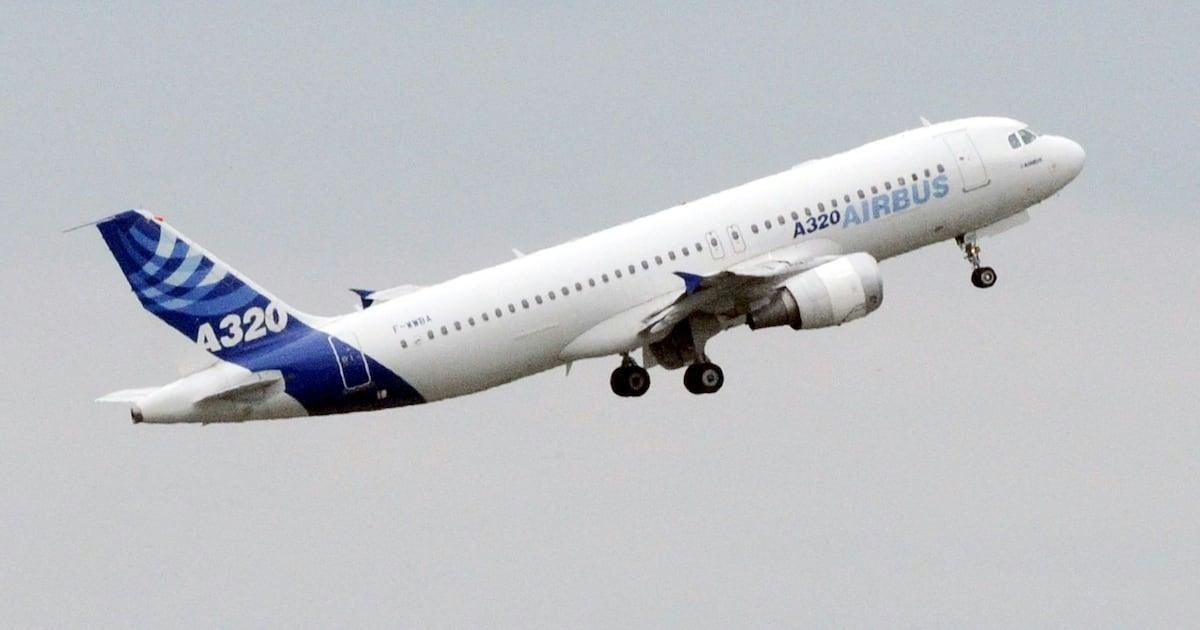
Airbus Lowers Delivery Forecast Amid A320 Quality Concerns
Airbus has revised downward its commercial aircraft delivery target for 2025, attributing the adjustment to supplier quality issues affecting its flagship A320 narrow-body jets. The European aerospace manufacturer now anticipates delivering 790 aircraft this year, a reduction from its earlier projection of 820, as announced in a statement on Wednesday.
Quality Issues Impacting the A320 Family
The revised forecast follows the identification of a quality defect involving fuselage panels on the A320 family, compounded by a recent software malfunction that affected approximately 6,000 A320 aircraft globally. These combined challenges resulted in the temporary grounding of a significant portion of Airbus’s narrow-body fleet and prompted a sharp market reaction, with the company’s shares dropping as much as 10% before recovering.
Airbus attributed the delivery shortfall to a “recent supplier quality issue on fuselage panels” that disrupted the production and delivery schedule of the A320 series. The problematic panels, manufactured by Sofitec Aero in Seville, were found to have incorrect thickness due to errors in the stretching and milling processes. These external skin panels are positioned at the front of the aircraft, behind the cockpit and adjacent to the two forward doors.
According to a company presentation referenced by Reuters, 628 aircraft require inspection, including 168 already in service. While all potentially affected aircraft will undergo examination, not all will necessitate further corrective measures. Airbus emphasized that all newly produced panels now comply with required standards and that the quality issue has been identified and contained.
The Significance of the A320 and Market Implications
The A320 family remains Airbus’s most popular model and a cornerstone of global aviation, with over 19,000 orders to date. As of October, the A320 Neo variant alone had secured more than 11,300 orders from 150 airline customers worldwide. Key operators in the Middle East and surrounding regions include Air Arabia, Etihad Airways, Qatar Airways, Saudi carriers flyadeal and flynas, Turkish Airlines, and Indigo. Notably, last month flydubai, previously an all-Boeing operator, signed a preliminary agreement to acquire 150 Airbus A321 Neo jets, with options for an additional 100 aircraft, in a deal valued at $24 billion. Deliveries under this agreement are scheduled to commence in 2031.
Despite these operational setbacks, Airbus has maintained its financial guidance, targeting an adjusted EBIT of approximately €7 billion ($8.1 billion) and free cash flow before customer financing of around €4.5 billion. The company is set to release its commercial aircraft orders and deliveries data for November on Friday.
Airbus’s prompt response to the fuselage panel quality issues and software glitch, coupled with its reaffirmed financial outlook, helped stabilize its share price following the initial decline. The company continues to collaborate closely with suppliers and airline customers to mitigate disruptions and uphold the safety and reliability standards of its aircraft.

Etihad Airways Suspends Airbus A380 Flights on Key Route

Aditya Birla Group Seeks Approval for Aircraft Leasing in GIFT City

Qatar Airways Highlights Innovation and Connectivity at Arabian Travel Market 2026

Hong Kong's Five-Year Plan Includes Andrew Fan's Aircraft Parts Processing Hub Proposal

ACIA Aero Leasing Delivers ATR72-600 to Air Nostrum

RTX Appoints Jill Albertelli as Head of Pratt & Whitney

TAT Technologies Joins Beyond Aero Hydrogen Aircraft Program

AURAK Study Highlights Barriers to Air Taxi Adoption in Emerging Economies

Xiamen Air Selects Altitude for 787 Maintenance at Heathrow

Etihad and Swissport Extend Global Partnership
