
Orchestrate AI insights into action

Trending
Categories
Airbus Receives New Order for A350-1000
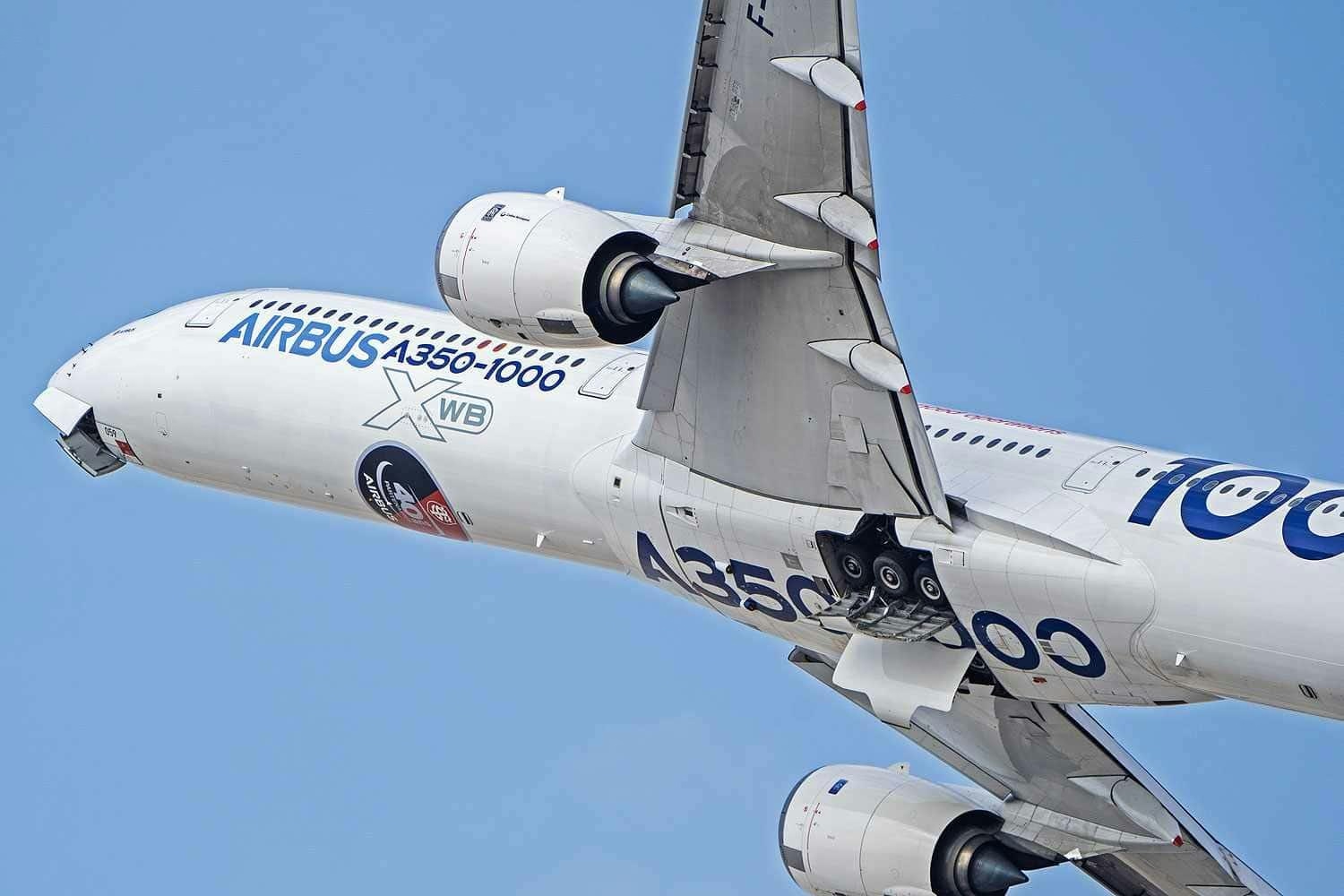
Airbus Secures New Order for A350-1000 Amid Industry Dynamics
Airbus has announced a new order for eight A350-1000 aircraft, its largest twin-aisle model, as part of its November 2025 orders and deliveries update. The purchase, placed on November 14 by an undisclosed customer, raises the total A350-1000 commitments for the year to 77. In addition to this widebody order, the same client also acquired two A320neo jets, bringing the year-to-date total for that model to 102 aircraft as of November 30.
The practice of undisclosed orders is common within the aviation sector, often fueling speculation regarding the buyer’s identity. Such anonymity typically reflects ongoing fleet planning, strategic repositioning, or the involvement of aircraft lessors whose end customers have yet to be publicly identified. A recent example includes Etihad Airways, whose commitment to multiple Airbus models—including the A350-1000—was initially recorded under an undisclosed customer before being officially confirmed.
Renewed Momentum for the A350 Program and Market Context
With these latest transactions, Airbus’s net orders for 2025 have reached 700 aircraft after accounting for 97 cancellations from a gross total of 797. This strong order activity coincides with a growing airline interest in widebody jets, driven by the demand for more efficient and higher-capacity aircraft.
The A350-1000 program has gained renewed momentum, with Airbus actively exploring the feasibility of a stretched variant, informally dubbed the A350-2000 or A350 Stretch. Unveiled at the 2025 Dubai Airshow, this potential model aims to fill the market gap between the current A350-1000 and Boeing’s 777X family. Airbus CEO Christian Scherer has acknowledged increasing interest from global carriers—notably beyond Emirates—in a new high-capacity aircraft, particularly as the industry moves away from four-engine designs and lacks a true superjumbo replacement.
Nonetheless, developing a stretched A350 presents considerable challenges. Airbus must address the technical complexities involved in lengthening the airframe, ensure compliance with stringent certification and safety standards, and adapt to evolving customer requirements. The competitive environment is intensifying, with Boeing actively promoting its 777X variants and some airlines, including Emirates, expressing caution about committing to new Airbus models.
Market responses have been varied. While carriers such as Etihad Airways and Philippine Airlines have demonstrated enthusiasm for the A350-1000, others remain cautious, carefully evaluating their options amid ongoing industry shifts. Concurrently, Airbus is managing operational challenges, including an urgent software recall affecting the A320 family due to solar radiation interference, highlighting the broader difficulties aircraft manufacturers face as they innovate and expand their product offerings.
As Airbus advances its widebody strategy and contemplates new developments, the coming months will be pivotal in determining the future trajectory of its flagship A350 program and its competitive standing in the long-haul market.

Etihad Airways Suspends Airbus A380 Flights on Key Route

Aditya Birla Group Seeks Approval for Aircraft Leasing in GIFT City

Qatar Airways Highlights Innovation and Connectivity at Arabian Travel Market 2026

Hong Kong's Five-Year Plan Includes Andrew Fan's Aircraft Parts Processing Hub Proposal

ACIA Aero Leasing Delivers ATR72-600 to Air Nostrum

RTX Appoints Jill Albertelli as Head of Pratt & Whitney

TAT Technologies Joins Beyond Aero Hydrogen Aircraft Program

AURAK Study Highlights Barriers to Air Taxi Adoption in Emerging Economies

Xiamen Air Selects Altitude for 787 Maintenance at Heathrow

Etihad and Swissport Extend Global Partnership
