
Orchestrate AI insights into action

Trending
Categories
Boeing Model 81 Trainer Swaps Engines
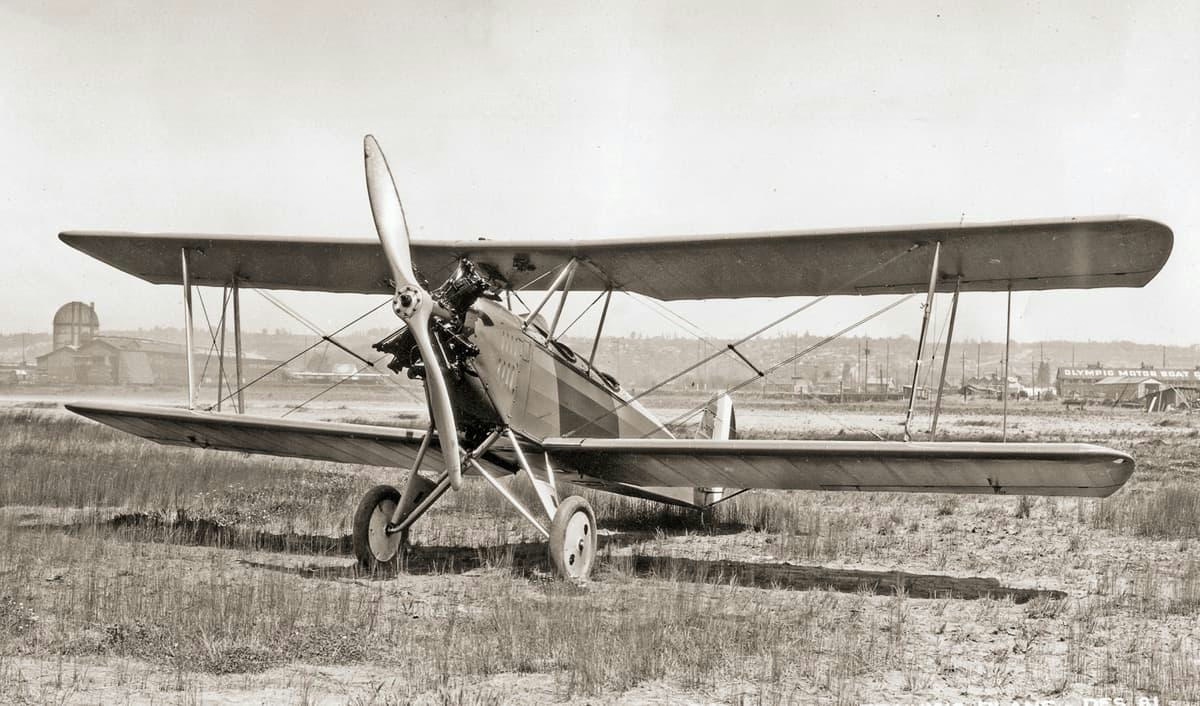
Boeing Model 81 Trainer Undergoes Multiple Engine Replacements Amid Early Aviation Challenges
In the late 1920s, Boeing’s Model 81 biplane trainer emerged as a focal point for engine experimentation during a period of rapid innovation in aviation. Constructed using the era’s standard methods—steel tubing frames, wooden spars and ribs, and fabric coverings—the Model 81 was designed to be adaptable, allowing Boeing to test various powerplants in pursuit of improved performance and military contracts. This shift came after the company’s earlier Model 64 failed to meet expectations, prompting Boeing to intensify efforts with the Model 81 in 1928 to maintain its competitive position.
Early Engine Trials and Navy Evaluation
The initial Model 81 was powered by an unconventional four-cylinder, air-cooled Fairchild-Caminez engine arranged in an X-configuration, delivering 125 horsepower at a notably low 1,000 rpm. Boeing experimented with both two- and four-blade propellers to optimize efficiency. However, the engine’s design introduced significant torque and vibration issues, undermining its reliability. Despite these challenges, Boeing sold a Model 81 equipped with the Fairchild-Caminez engine to the U.S. Navy for $8,300. Designated the XN2B-1, the aircraft was delivered in June 1928. By January 1929, the Navy replaced the problematic engine with a more conventional five-cylinder Wright J-6 (R-540) radial engine, which enhanced performance but did not lead to additional orders.
Continued Modifications and Training Use
Boeing persisted in refining the Model 81’s powerplant configurations. Another variant, the Model 81A, was fitted with a 145-horsepower Axelson engine and first took flight in December 1928. This version was assigned to the Boeing School of Aeronautics in Oakland, California, where it underwent further modification with a 115-horsepower Axelson engine, resulting in the Model 81B. Subsequently, the 81B was upgraded with a 165-horsepower Wright J-6-5 radial engine, although this change did not warrant a new model designation. The Boeing School of Aeronautics operated one of the two Model 81 trainers from its Oakland base, utilizing the aircraft primarily for pilot instruction.
Broader Implications for Boeing’s Innovation Strategy
The iterative engine swaps and design adaptations of the Model 81 exemplify Boeing’s early commitment to technical experimentation amid evolving market demands. This pattern of innovation remains relevant today, as the company faces ongoing pressures to develop new narrowbody aircraft and secure partnerships with advanced engine manufacturers. Current challenges, including delays in the 777X program now pushed to 2027, have raised concerns about Boeing’s market confidence and financial outlook. Meanwhile, Airbus’s recent overtaking of Boeing in aircraft deliveries has intensified the competitive landscape, underscoring the urgency for Boeing to accelerate innovation and cultivate strategic collaborations, potentially with engine producers such as Rolls-Royce.
The history of the Model 81’s engine replacements thus reflects a longstanding tension within Boeing between advancing technology and meeting commercial expectations—a dynamic that continues to influence the company’s trajectory in the global aviation industry.

Etihad Airways Suspends Airbus A380 Flights on Key Route

Aditya Birla Group Seeks Approval for Aircraft Leasing in GIFT City

Qatar Airways Highlights Innovation and Connectivity at Arabian Travel Market 2026

Hong Kong's Five-Year Plan Includes Andrew Fan's Aircraft Parts Processing Hub Proposal

ACIA Aero Leasing Delivers ATR72-600 to Air Nostrum

RTX Appoints Jill Albertelli as Head of Pratt & Whitney

TAT Technologies Joins Beyond Aero Hydrogen Aircraft Program

AURAK Study Highlights Barriers to Air Taxi Adoption in Emerging Economies

Xiamen Air Selects Altitude for 787 Maintenance at Heathrow

Etihad and Swissport Extend Global Partnership
