
Orchestrate AI insights into action

Trending
Categories
Brazil Regulator Expects Embraer Flying Taxi Certification by 2027
Brazil Regulator Expects Embraer Flying Taxi Certification by 2027
Certification Timeline and Industry Challenges
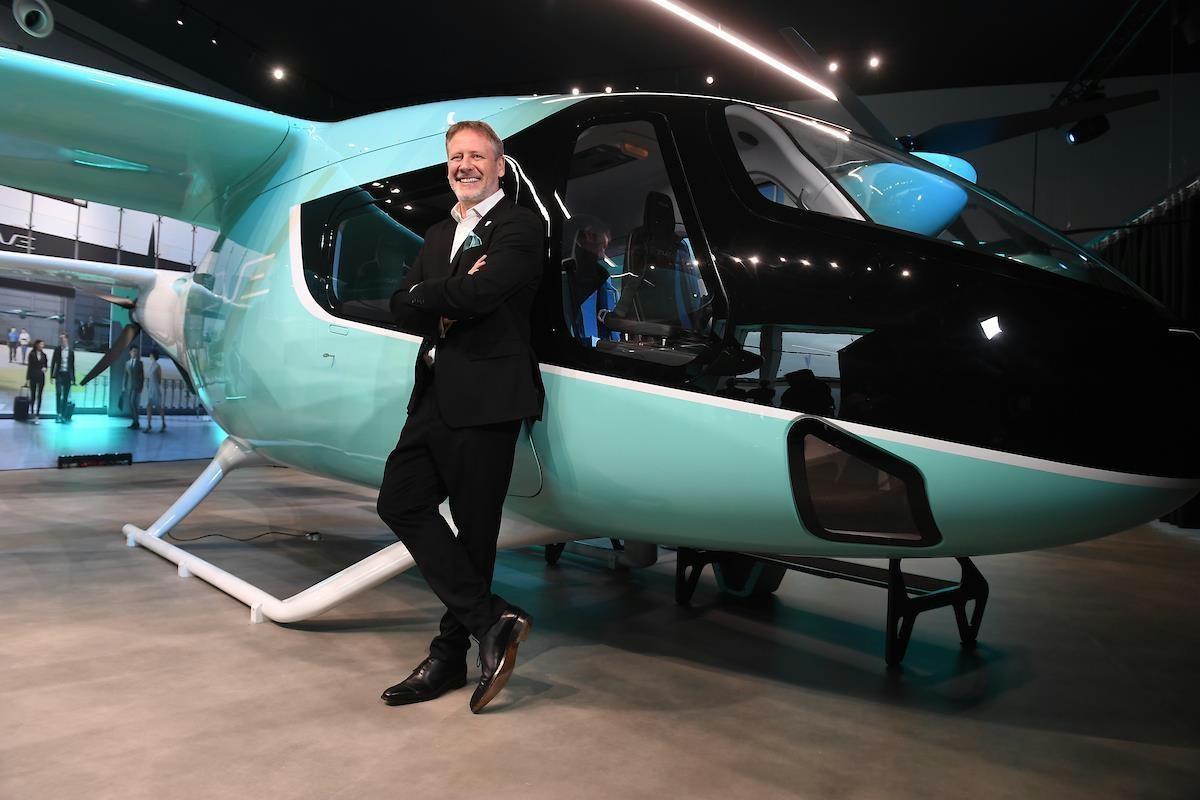
Brazil’s civil aviation authority (ANAC) anticipates that Embraer’s electric flying taxi will receive certification by 2027, although there is optimism for an earlier approval. Tiago Faierstein, ANAC’s newly appointed president, expressed a desire to achieve certification as soon as 2026, contingent on the readiness of Embraer’s technology. Speaking at the International Civil Aviation Organization’s Innovation Fair in Montreal, Faierstein emphasized that certification remains the regulator’s foremost priority, while acknowledging that the timeline depends heavily on the maturity of the electric vertical take-off and landing (eVTOL) aircraft being developed by Embraer’s subsidiary, Eve.
Eve’s eVTOL is designed for short urban trips and has garnered nearly 3,000 preorders from approximately 28 customers across nine countries, positioning it as a significant player in the emerging flying taxi market. However, the project has already experienced a delay, with the expected entry into service pushed back by a year to 2027. Faierstein highlighted that certification is only one aspect of the broader challenge, noting the necessity of developing supporting infrastructure such as vertiports, reliable power grids, and sophisticated air traffic management systems to enable commercial operations.
Market Dynamics and Regulatory Coordination
The eVTOL sector faces considerable uncertainties beyond certification. Despite substantial investment from Brazil’s state development bank BNDES, Embraer, and international partners including United Airlines and BAE Systems, the industry contends with funding volatility, limited operational experience, and evolving regulatory frameworks. These factors present risks not only for Embraer but for the wider market, which is still in its nascent stages.
Competitors in the space are also confronting significant obstacles. UK-based Vertical Aerospace has announced ambitious plans to manufacture 900 flying taxis annually by 2035 but continues to grapple with capital acquisition and scaling challenges. Hyundai’s Supernal has temporarily halted its program, and analysts warn that many pre-production eVTOL companies may not survive due to economic, technical, and regulatory barriers.
Meanwhile, Embraer and Dassault Falcon Jet maintain a focus on business aviation, supported by global wealth growth, although supply chain constraints persist as a concern. As Eve advances toward certification, ANAC is actively working to harmonize regulations on an international scale. The agency plans to collect operational data within Brazil before collaborating with the United Nations’ International Civil Aviation Organization (ICAO) and other countries to establish common standards, facilitating future cross-border operations.
Embraer’s CEO, Francisco Gomes Neto, recently reaffirmed the company’s commitment to a late 2027 service entry, underscoring the team’s dedication to meeting this timeline. Nonetheless, the broader industry continues to navigate a complex landscape marked by economic and regulatory uncertainties as it strives to bring flying taxis to market.

Etihad Airways Suspends Airbus A380 Flights on Key Route

Aditya Birla Group Seeks Approval for Aircraft Leasing in GIFT City

Qatar Airways Highlights Innovation and Connectivity at Arabian Travel Market 2026

Hong Kong's Five-Year Plan Includes Andrew Fan's Aircraft Parts Processing Hub Proposal

ACIA Aero Leasing Delivers ATR72-600 to Air Nostrum

RTX Appoints Jill Albertelli as Head of Pratt & Whitney

TAT Technologies Joins Beyond Aero Hydrogen Aircraft Program

AURAK Study Highlights Barriers to Air Taxi Adoption in Emerging Economies

Xiamen Air Selects Altitude for 787 Maintenance at Heathrow

Etihad and Swissport Extend Global Partnership
