
Orchestrate AI insights into action

Trending
Categories
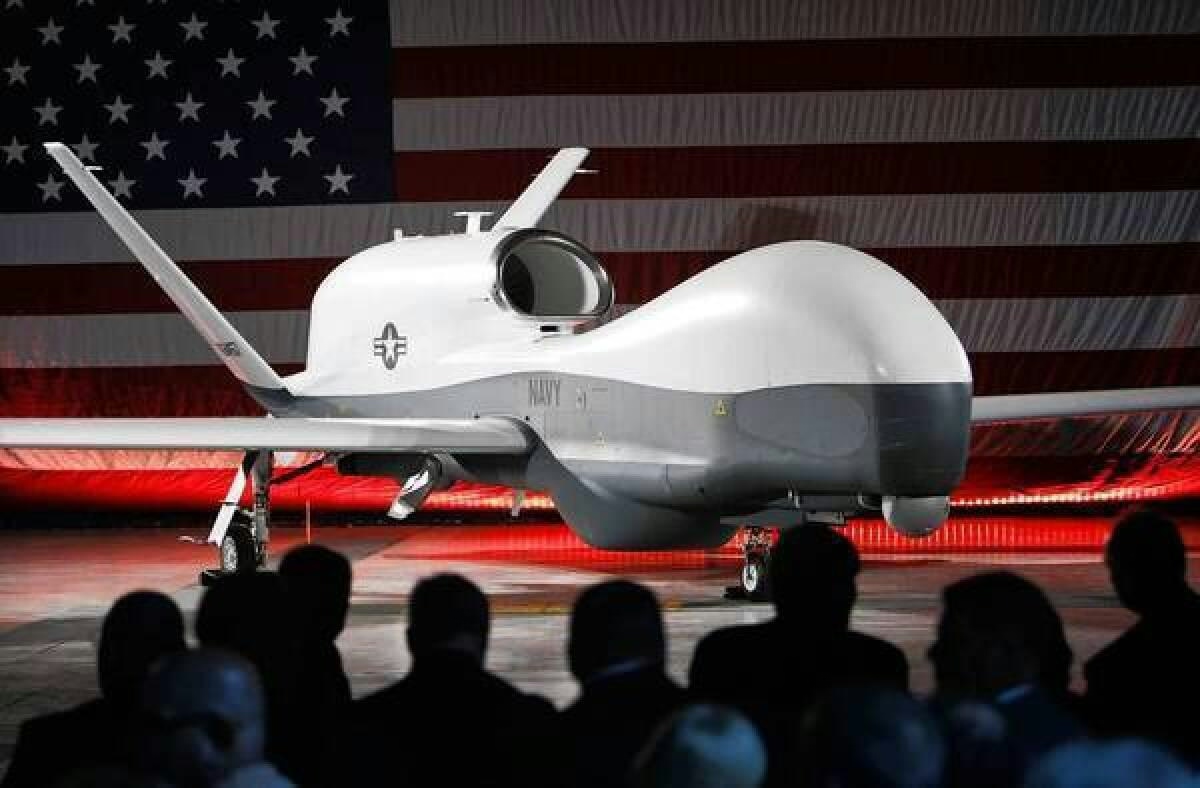
Chinese Scientists Overcome Design Challenges That Ended US Navy Drone Program
Chinese Scientists Overcome Design Challenges That Ended US Navy Drone Program
Breakthrough in Stealth Aircraft Design
Chinese aerospace engineers have developed a pioneering software platform that addresses a critical challenge in stealth aircraft design—one that previously contributed to the cancellation of the US Navy’s X-47B drone program. Led by Huang Jiangtao at the China Aerodynamics Research and Development Centre, the team created a system capable of managing hundreds of design variables simultaneously without increasing computational demands. This achievement overcomes a longstanding limitation in aviation engineering, often referred to as the “curse of dimensionality,” which has historically restricted the number of variables that can be optimized concurrently.
Published in the peer-reviewed journal Acta Aeronautica et Astronautica Sinica, the research details how this innovation enables designers to balance complex trade-offs among stealth, aerodynamics, and propulsion more effectively. The US Navy’s X-47B, despite its notable successes in carrier landings and autonomous aerial refueling, was ultimately discontinued in 2015 due to unresolved conflicts arising from these design constraints.
Application and Implications
The Chinese team demonstrated the software’s capabilities by applying it to the X-47B’s design, optimizing 740 variables related to flight drag, radar signature, and engine thrust, all while preserving airflow stability. This platform allows for more precise shaping of critical components such as wing leading edges and engine inlet ducts, which are vital for both aerodynamic efficiency and radar evasion.
This advancement emerges amid growing scrutiny of US drone capabilities. A recent four-day test in Alaska revealed significant performance shortcomings in US military drones and the companies responsible for their production, underscoring a widening technological gap with China. These findings have intensified calls within the US defense sector for increased investment and innovation to address these deficiencies.
Industry analysts highlight that the United States is also contending with internal challenges, including persistent design and integration problems in classified aerospace programs. Lockheed Martin, for instance, recently reported losses amounting to $1.6 billion linked to such issues, raising concerns about the capacity of US defense contractors to maintain technological parity with rapid foreign advancements.
Strategic Context and Future Outlook
China’s progress in aerospace software is part of a broader strategic effort to position itself as a leader in advanced military technologies. Alongside developments in design optimization, the country is advancing in other cutting-edge fields such as electromagnetic rail gun technology, intensifying the global competition for technological dominance.
As China continues to enhance its design tools and expand its aerospace capabilities, the global balance in military aviation technology appears to be shifting. The response from US defense agencies and industry stakeholders will be crucial in determining the pace and effectiveness with which the United States can close this emerging gap.

Etihad Airways Suspends Airbus A380 Flights on Key Route

Aditya Birla Group Seeks Approval for Aircraft Leasing in GIFT City

Qatar Airways Highlights Innovation and Connectivity at Arabian Travel Market 2026

Hong Kong's Five-Year Plan Includes Andrew Fan's Aircraft Parts Processing Hub Proposal

ACIA Aero Leasing Delivers ATR72-600 to Air Nostrum

RTX Appoints Jill Albertelli as Head of Pratt & Whitney

TAT Technologies Joins Beyond Aero Hydrogen Aircraft Program

AURAK Study Highlights Barriers to Air Taxi Adoption in Emerging Economies

Xiamen Air Selects Altitude for 787 Maintenance at Heathrow

Etihad and Swissport Extend Global Partnership
