
Orchestrate AI insights into action

Trending
Categories
Comparing the Costs of the Boeing 787 and Airbus A330neo
Comparing the Costs of the Boeing 787 and Airbus A330neo
The commercial aviation industry has been shaped by the enduring rivalry between Boeing and Airbus, whose competition has established a near-duopoly since the 1990s. Within the mid-sized widebody segment, the Boeing 787 Dreamliner and Airbus A330neo families stand as the principal contenders, each striving to capture market share among airlines seeking an optimal balance of range, efficiency, and cost.
Cost Considerations Beyond the Price Tag
When airlines decide to acquire new aircraft, the sticker price represents only a fraction of the overall financial equation. Critical factors such as order volume, leasing arrangements, and long-term operating expenses significantly influence purchasing decisions. Both the 787 and A330neo are favored for their competitive range capabilities and operational economics. However, evolving market dynamics and technological advancements continue to shape airline preferences and procurement strategies.
Development and Design: A Brief Overview
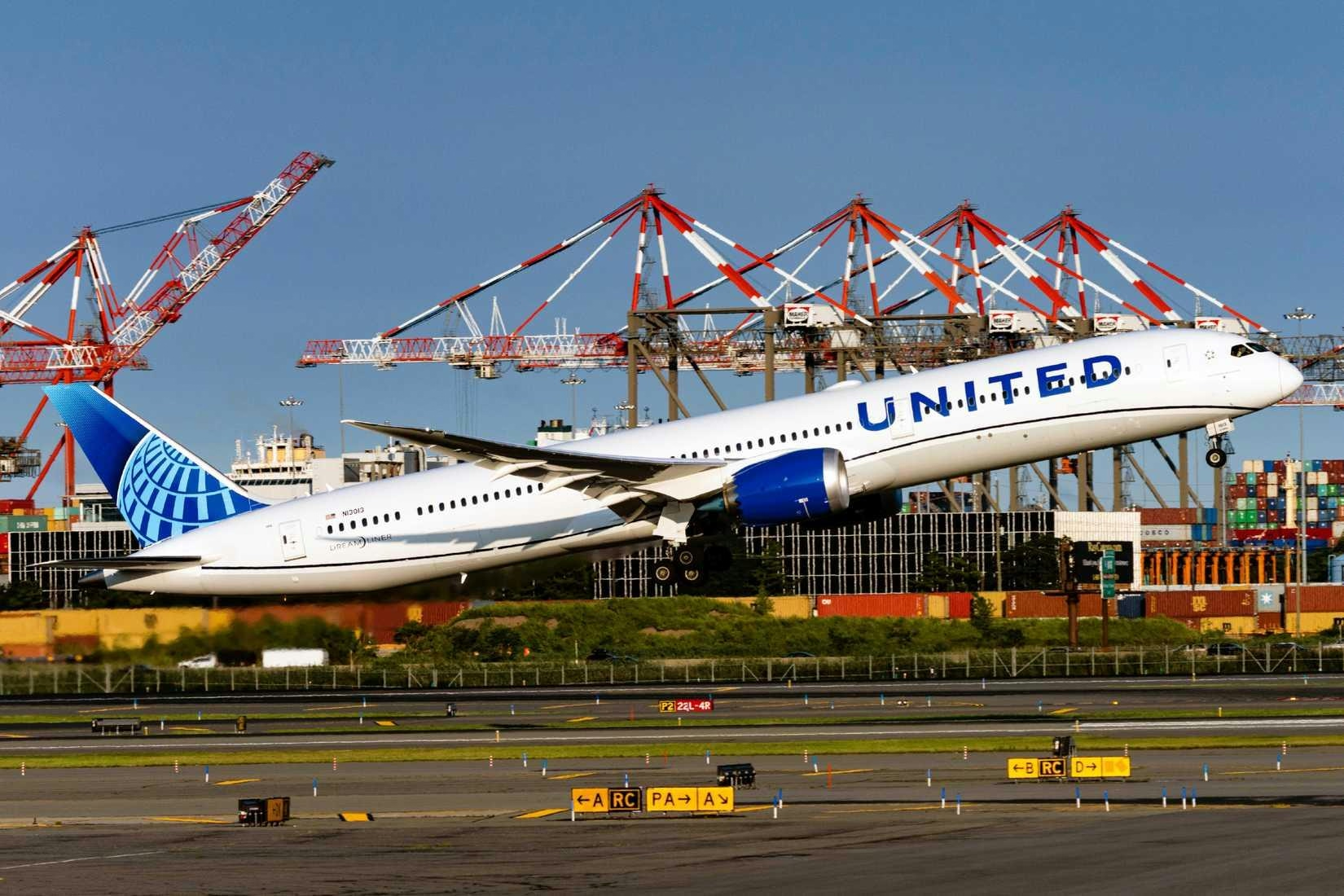
Boeing initiated the 787 Dreamliner program in 2004 with the objective of achieving a 20% reduction in fuel consumption compared to the 767. The Dreamliner’s pioneering use of composite materials—accounting for 50% of its airframe—and its advanced engine technology set new benchmarks for efficiency in commercial aviation. The 787 family comprises three variants: the 787-8, an entry-level model priced at approximately $248 million; the 787-9, the most popular variant offering the longest range of 8,500 nautical miles at $293 million; and the 787-10, which provides the largest passenger capacity of up to 375 seats, priced around $338 million. The total development cost of the program is estimated at $32 billion.
In response, Airbus initially contemplated an updated version of the A330 but ultimately launched the A350 program following market feedback. Nevertheless, sustained airline interest in a re-engined A330 for mid-range routes led to the introduction of the A330neo at the 2014 Farnborough Airshow. Equipped with two Rolls-Royce Trent 7000 engines, the A330neo delivers a 14% improvement in fuel burn per seat compared to its predecessor. The A330neo family includes the A330-800neo, which offers a longer range of 8,100 nautical miles and is priced at approximately $260 million, and the A330-900neo, which accommodates up to 465 passengers and costs around $296 million. Unlike the 787, the A330neo’s development cost was considerably lower—about $2 billion—reflecting its status as an upgraded rather than a clean-sheet design.
Shifting Market Dynamics
Recent developments have begun to alter the competitive landscape between these aircraft families. Rolls-Royce has expressed increasing confidence in its Trent 1000 XE engine, citing successful upgrades on the A330neo as evidence of its ability to compete effectively against the Boeing 787. This technological progress is influencing airline procurement decisions. For instance, Etihad Airways’ recent order for both the A330-900neo and A350-1000 aircraft indicates a strategic preference for Airbus products, as airlines seldom operate both the 787 and a combination of A330/A350 aircraft simultaneously.
Furthermore, Airbus’s A320 has surpassed Boeing’s 737 in annual deliveries, signaling a broader shift in market momentum beyond the widebody segment. Concurrently, AirAsia’s plan to retire its A330 fleet within the next five to six years highlights the ongoing contest for dominance in both the widebody and narrowbody markets.
Conclusion
Although the list prices for the Boeing 787 and Airbus A330neo are broadly comparable—ranging from $248 million to $338 million depending on the variant—actual transaction prices are typically subject to negotiation. Airlines must carefully evaluate not only acquisition costs but also operational efficiency, engine performance, and evolving market trends when selecting between these two flagship aircraft families.

Etihad Airways Suspends Airbus A380 Flights on Key Route

Aditya Birla Group Seeks Approval for Aircraft Leasing in GIFT City

Qatar Airways Highlights Innovation and Connectivity at Arabian Travel Market 2026

Hong Kong's Five-Year Plan Includes Andrew Fan's Aircraft Parts Processing Hub Proposal

ACIA Aero Leasing Delivers ATR72-600 to Air Nostrum

RTX Appoints Jill Albertelli as Head of Pratt & Whitney

TAT Technologies Joins Beyond Aero Hydrogen Aircraft Program

AURAK Study Highlights Barriers to Air Taxi Adoption in Emerging Economies

Xiamen Air Selects Altitude for 787 Maintenance at Heathrow

Etihad and Swissport Extend Global Partnership
