
Orchestrate AI insights into action

Trending
Categories
Explained: How GE Became a Jet Engine Manufacturer
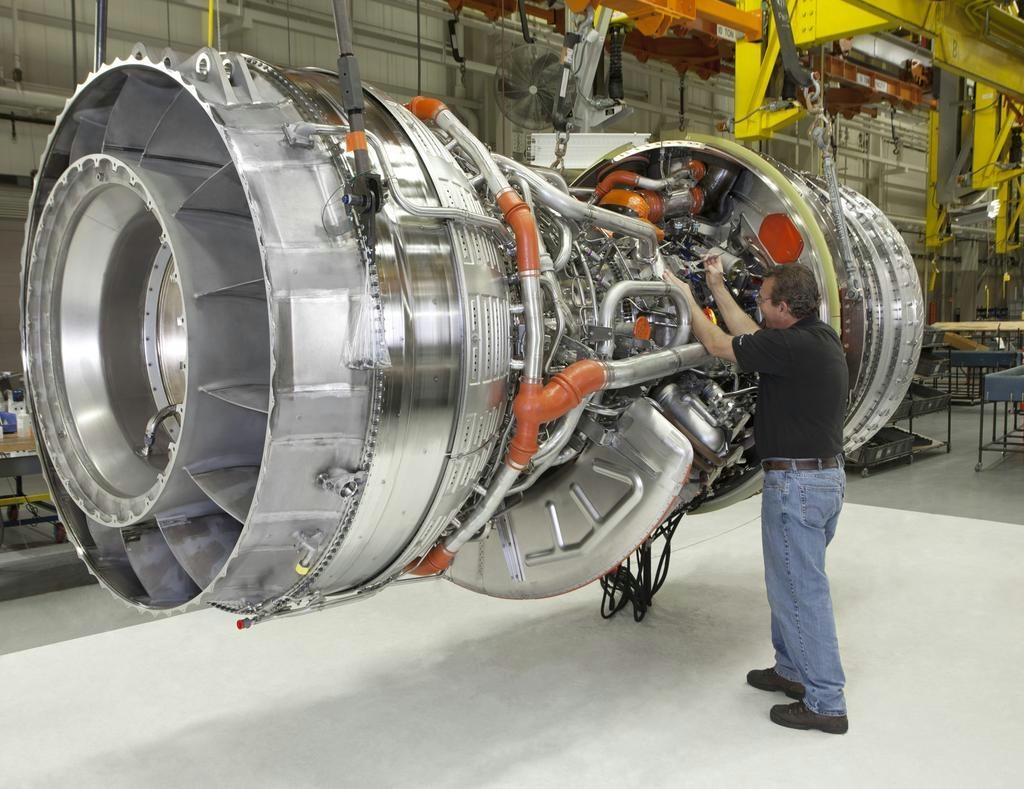
Explained: How GE Became a Jet Engine Manufacturer
DALLAS — General Electric (GE), now a name synonymous with jet engines, embarked on its journey far from the aviation sector. Founded in 1892 and closely associated with Thomas Edison, GE initially concentrated on electrical equipment, power systems, and heavy industrial machinery. Aviation was not part of its original business scope. However, over the decades, the company’s focus shifted, culminating in the establishment of GE Aerospace as an independent public company on April 2, 2024, following a spin-off from the original GE. Despite this recent corporate restructuring, GE’s involvement in aviation dates back to the 1940s, with the “GE Aerospace” division first emerging in the 1960s.
From Electrical Engineering to Aviation Innovation
GE’s foray into aviation began during World War I, not with jet engines but with the development of turbo-superchargers. At that time, military aircraft relied on piston engines that suffered significant power loss at high altitudes due to thinner air. The U.S. government turned to GE’s engineering expertise to address this challenge. GE engineers successfully developed a 350-horsepower turbo-supercharged Liberty engine, demonstrating that forced induction could effectively restore engine power at altitude.
This transition into aviation was a logical extension of GE’s existing capabilities. By the early 20th century, the company had established itself as a leader in heavy industrial engineering, with extensive experience in steam turbines, high-temperature metallurgy, precision machining, and large-scale manufacturing. These competencies were directly transferable to the production of advanced aircraft components, setting the stage for GE’s deeper involvement in aviation technology.
Pioneering America’s Jet Engine Industry
World War II accelerated GE’s ambitions in aviation. In 1942, the U.S. Army Air Forces commissioned GE to produce an American version of the British Whittle W.1X turbojet engine. The result was the I-A engine, the first operational jet engine manufactured in the United States, assembled at GE’s Massachusetts facility. This achievement marked a significant milestone, laying the foundation for the American jet engine industry.
By the late 1940s, GE introduced the J-47 gas turbine engine, which became the most widely produced jet engine of the early jet age. The J-47 powered iconic aircraft such as the F-86 Sabre and fueled rapid expansion at GE, including the establishment of new factories and a growing workforce dedicated to aviation technology.
Commercial Expansion and Contemporary Challenges
GE entered the commercial jet engine market in the 1960s with the CF6 engine, which first flew on the DC-10 in 1971. The CF6’s success solidified GE’s position as a major player in commercial aviation, with the engine subsequently powering a broad range of aircraft models.
Today, GE Aerospace operates in a highly dynamic and competitive environment. The company faces ongoing challenges in maintaining supply chain efficiency amid industry-wide constraints and ensuring the reliability of its LEAP engines, which are currently under regulatory scrutiny. Competition is intensifying, with established rivals such as Honeywell developing new engine families, while emerging companies like Venus Aerospace are advancing rotating detonation rocket engine technology to capture market share in next-generation propulsion systems.
Despite these pressures, market sentiment toward GE Aerospace remains optimistic. Strong demand for commercial jet engines and aftermarket services, coupled with significant new orders and upward revisions to earnings forecasts, have bolstered the company’s outlook. As the propulsion market continues to evolve, GE’s longstanding legacy of innovation and industrial expertise remains central to its ongoing role in shaping the future of aviation.

Etihad Airways Suspends Airbus A380 Flights on Key Route

Aditya Birla Group Seeks Approval for Aircraft Leasing in GIFT City

Qatar Airways Highlights Innovation and Connectivity at Arabian Travel Market 2026

Hong Kong's Five-Year Plan Includes Andrew Fan's Aircraft Parts Processing Hub Proposal

ACIA Aero Leasing Delivers ATR72-600 to Air Nostrum

RTX Appoints Jill Albertelli as Head of Pratt & Whitney

TAT Technologies Joins Beyond Aero Hydrogen Aircraft Program

AURAK Study Highlights Barriers to Air Taxi Adoption in Emerging Economies

Xiamen Air Selects Altitude for 787 Maintenance at Heathrow

Etihad and Swissport Extend Global Partnership
