
Orchestrate AI insights into action

Trending
Categories
GCAP Advances with New Agreements on Sensor Technology
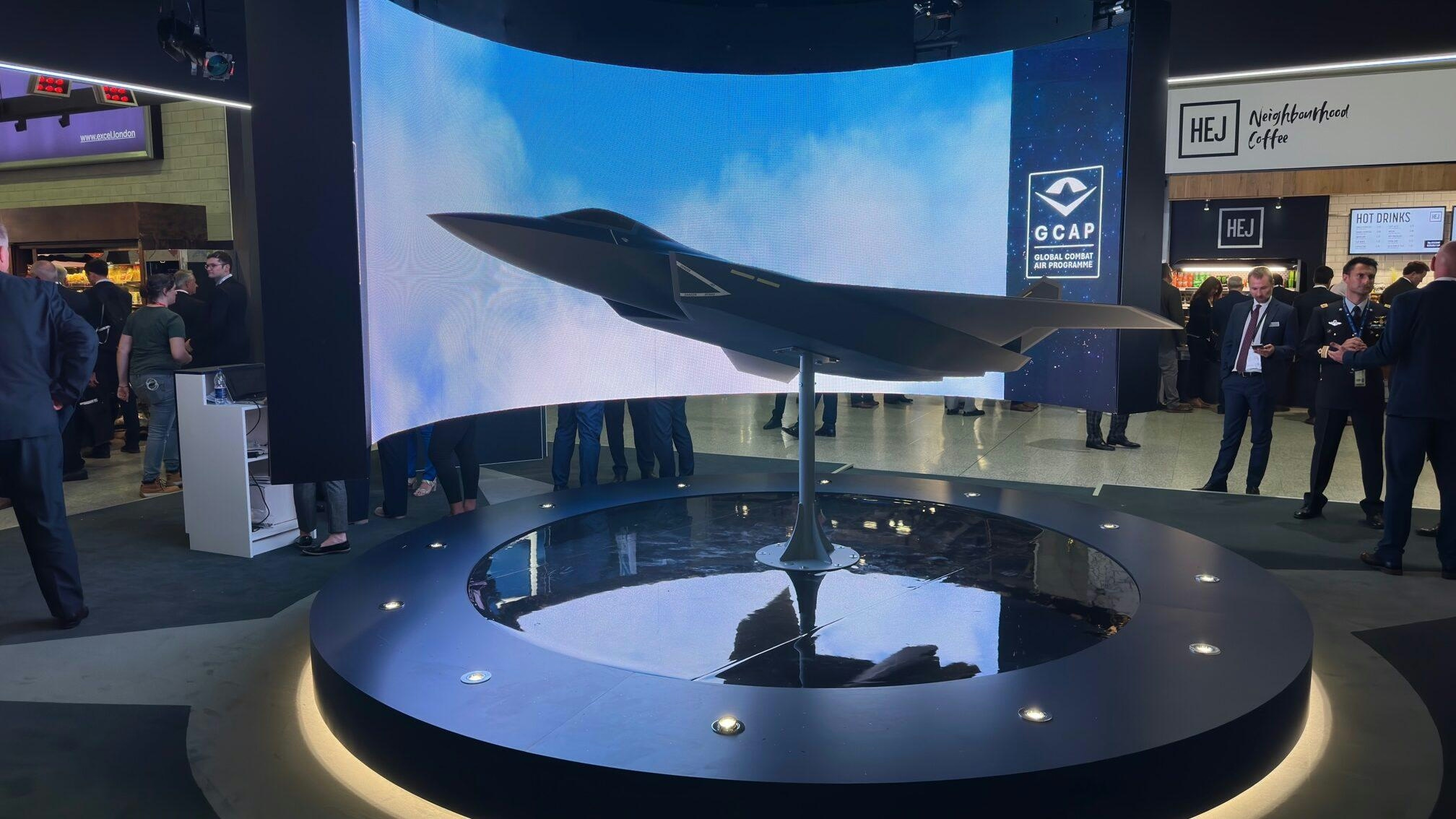
GCAP Advances with New Agreements on Sensor Technology
The Global Combat Air Programme (GCAP) demonstrated significant progress at the DSEI exhibition in London on 9 September, marked by new agreements focused on the development of advanced sensors and engines for the next-generation fighter aircraft. This trilateral initiative, involving Italy, Japan, and the United Kingdom, continues to advance despite uncertainties in the wider European defense environment.
Formation of the GCAP Electronics Evolution Consortium
At DSEI, the partners announced the establishment of the GCAP Electronics Evolution consortium (G2E), which will be responsible for the integrated sensing and communications systems of the future fighter. The consortium is equally shared among the three nations, represented by Leonardo and ELT Group from Italy, Mitsubishi Electric from Japan, and Leonardo UK from the United Kingdom. Andrew Howard, Leonardo UK’s director for future combat air and interim G2E general manager, emphasized the collaborative nature of the effort, noting that after two years of negotiating workshare arrangements—balancing corporate and national interests—the partners have reached a well-balanced agreement. He highlighted that the consortium is now poised to intensify its collaborative engineering efforts.
The consortium is entering the design and development phase, with joint teams focusing on four critical areas. Radar development will be co-led by Japan and the UK, while Italy will take charge of infrared search and track technology. Alberto De Arcangelis, senior vice-president for future business at ELT Group, remarked that the programme is accelerating its work. The GCAP aims to achieve operational capability by 2035, with a first funded proposal expected soon to Edgewing, the industrial joint venture tasked with delivering the fighter. This proposal will cover 12 to 18 months of initial development work.
Progress in Propulsion and Industrial Collaboration
On the propulsion front, Avio Aero, IHI, and Rolls-Royce are transitioning from national contracts to a fully integrated international collaboration model. This shift is laying the foundation for the detailed design and development of GCAP’s new engine. The partners report advancements in the engine demonstrator, including innovations in additive manufacturing, cooling systems, and high-pressure compressor design. Recent trilateral reviews have approved the demonstrator design, and hardware procurement is underway. A notable milestone includes testing a revolutionary combustor developed through advanced additive layer manufacturing, which allows for higher turbine operating temperatures while enhancing durability and sustainability.
Atsushi Sato, president of IHI’s aero engine, space, and defense business area, stated that the engine being developed will deliver unmatched performance for GCAP and strengthen the shared industrial base of the three nations.
GCAP’s Position Amid European Defense Challenges
GCAP’s steady progress contrasts with potential challenges facing the €100 billion Future Combat Air System (FCAS) project in Europe. Industrial disputes threaten to fragment FCAS into competing national initiatives, risking delays in research and development funding and potentially diminishing Airbus’s market share in European defense. This instability may lead Germany and Spain to reconsider their involvement, possibly shifting their focus toward the UK-Italy-Japan GCAP or U.S. alternatives such as the F-35. In this context, GCAP’s ongoing momentum and deepening multinational collaboration stand out as a model of effective defense cooperation, even as the broader market landscape remains uncertain.

Etihad Airways Suspends Airbus A380 Flights on Key Route

Aditya Birla Group Seeks Approval for Aircraft Leasing in GIFT City

Qatar Airways Highlights Innovation and Connectivity at Arabian Travel Market 2026

Hong Kong's Five-Year Plan Includes Andrew Fan's Aircraft Parts Processing Hub Proposal

ACIA Aero Leasing Delivers ATR72-600 to Air Nostrum

RTX Appoints Jill Albertelli as Head of Pratt & Whitney

TAT Technologies Joins Beyond Aero Hydrogen Aircraft Program

AURAK Study Highlights Barriers to Air Taxi Adoption in Emerging Economies

Xiamen Air Selects Altitude for 787 Maintenance at Heathrow

Etihad and Swissport Extend Global Partnership
