
Orchestrate AI insights into action

Trending
Categories
How the 787 Dreamliner Challenges Airbus in the Commercial Jet Market
How the 787 Dreamliner Challenges Airbus in the Commercial Jet Market
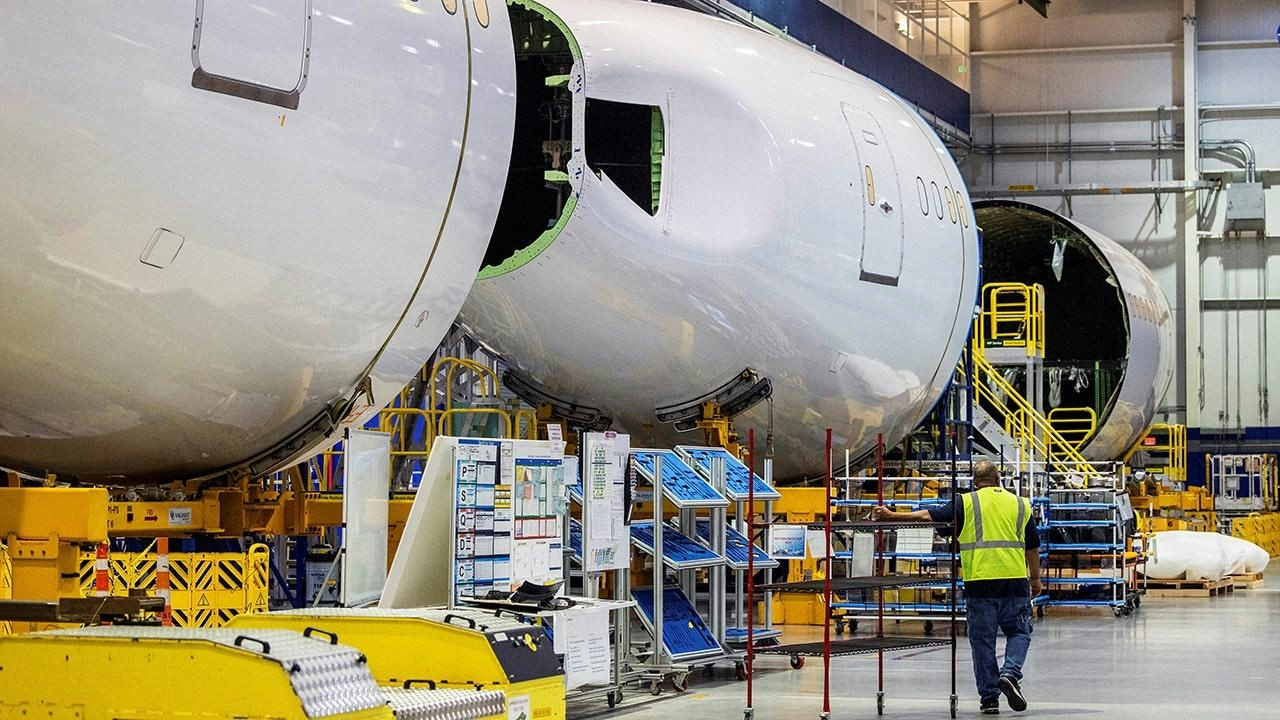
The Boeing 787 Dreamliner has established itself as a pivotal element in Boeing’s widebody aircraft portfolio, surpassing other models—including the delayed 777X—in popularity among long-haul carriers. Renowned for its advanced engineering, innovative composite construction, and operational efficiency, the Dreamliner is widely regarded as one of the most adaptable twin-aisle airliners currently in service. Despite Boeing’s recent difficulties, notably with the 737 MAX crisis and the extended certification process for the 777X, the 787 remains a significant success story for the company.
Expanding Production Amid Strong Demand
In response to growing global demand, Boeing is committing $1 billion to expand Dreamliner production at its South Carolina facility. Stephanie Pope, President and CEO of Boeing Commercial Airplanes, underscored the strategic importance of this investment, stating, “We continue to see strong demand for the 787 Dreamliner family and its market-leading efficiency and versatility. We are making this significant investment today to ensure Boeing is ready to meet our customers' needs in the years and decades ahead.” This expansion reflects Boeing’s confidence in the Dreamliner’s continued relevance and its role in meeting the evolving requirements of international airlines.
Competition from Airbus and Market Dynamics
Despite Boeing’s efforts, the company faces robust competition from Airbus, particularly through its A350 family. The A350 was developed as a direct response to the Dreamliner’s market success and competes closely with the 787-10 and other Boeing widebody models. However, the Dreamliner’s earlier market entry and its unique positioning between larger narrowbodies and entry-level widebodies have given it a substantial advantage in order volume.
As of now, the Boeing 787 Dreamliner has amassed approximately 2,277 total orders with around 1,229 deliveries since entering service in 2011. In comparison, the Airbus A350 has secured about 1,447 orders and delivered roughly 682 aircraft since its 2015 debut. The Dreamliner’s sales nearly double those of the A350, underscoring its appeal to airlines prioritizing operational flexibility and fuel efficiency. Its introduction set new industry benchmarks for fuel economy and passenger comfort, standards that the A350 and other subsequent widebody designs have sought to meet or surpass.
Industry Challenges and Financial Implications
While Boeing has encountered notable financial and engineering setbacks in recent years, the company continues to wield considerable industrial and political influence. This is reflected in recent market trends, where Boeing’s stock has experienced gains driven by a 2026 cash flow commitment and increased production rates for both the 737 and 787 models. Conversely, Airbus has confronted its own challenges, including technical difficulties with its A320 family, which have contributed to stock declines and reduced delivery targets.
The 787 Dreamliner’s blend of efficiency, versatility, and timely market introduction has enabled Boeing to sustain a strong position in the competitive widebody segment. Both Boeing and Airbus continue to navigate complex industry headwinds, but the Dreamliner remains a critical asset in Boeing’s commercial aviation strategy.

Etihad Airways Suspends Airbus A380 Flights on Key Route

Aditya Birla Group Seeks Approval for Aircraft Leasing in GIFT City

Qatar Airways Highlights Innovation and Connectivity at Arabian Travel Market 2026

Hong Kong's Five-Year Plan Includes Andrew Fan's Aircraft Parts Processing Hub Proposal

ACIA Aero Leasing Delivers ATR72-600 to Air Nostrum

RTX Appoints Jill Albertelli as Head of Pratt & Whitney

TAT Technologies Joins Beyond Aero Hydrogen Aircraft Program

AURAK Study Highlights Barriers to Air Taxi Adoption in Emerging Economies

Xiamen Air Selects Altitude for 787 Maintenance at Heathrow

Etihad and Swissport Extend Global Partnership
