
Orchestrate AI insights into action

Trending
Categories
Skift Global Forum Video: In-Flight Wi-Fi as a Catalyst for Travel Innovation
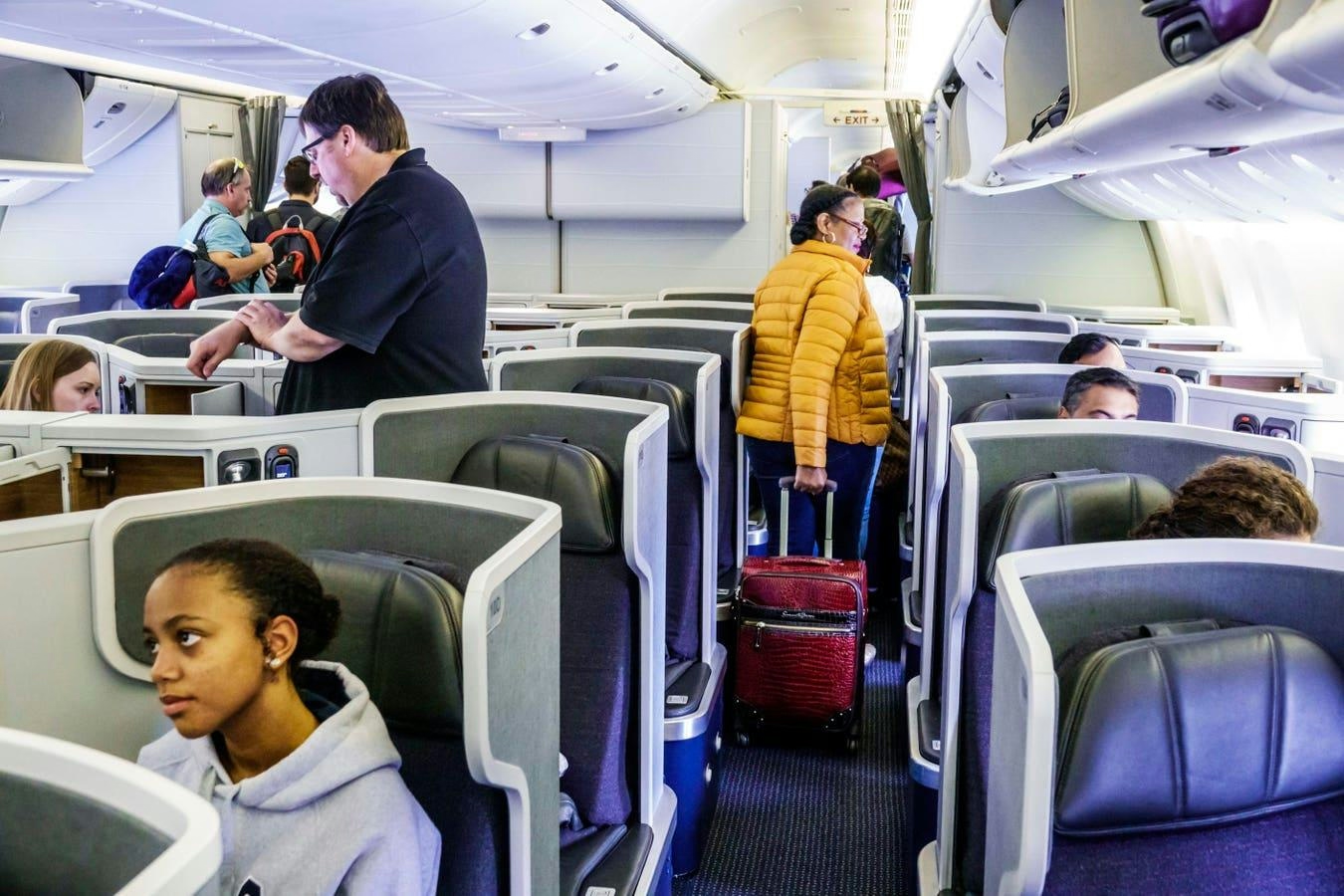
In-Flight Wi-Fi Emerges as a Catalyst for Travel Innovation
Two decades ago, air travel was synonymous with a digital hiatus: passengers had no access to emails, streaming services, or social media, relying instead on books, magazines, or rest. Today, the expectation for seamless internet connectivity at cruising altitude has become standard, with airlines increasingly evaluated on the quality of their in-flight Wi-Fi offerings.
At the Skift Global Forum 2025, Meherwan Polad, senior vice president and chief commercial officer of Viasat, underscored this evolution. He noted that while the technology enabling in-flight connectivity has existed for some time, the critical advancement lies in the capacity to provide free, reliable internet access to all passengers simultaneously without system failures. Viasat currently powers Wi-Fi on over 4,000 aircraft worldwide, with more than 1,000 offering what Polad describes as “full, fast, and free” internet. He anticipates that within three years, the majority of commercial aircraft will provide complimentary connectivity, serving upwards of a billion passengers annually.
Transforming the Passenger Experience and Airline Strategy
The advent of in-flight Wi-Fi has fundamentally altered the nature of air travel. Polad reflected on the past, recalling that business activities would effectively pause once passengers boarded a plane, with the most pressing decision being a choice between peanuts or pretzels. Today, passengers routinely conduct significant business transactions mid-flight, with some closing seven-figure deals while airborne.
For travelers, in-flight connectivity enables a seamless extension of their home and office environments, facilitating streaming, communication, and work. For airlines, it represents a strategic asset to enhance customer loyalty, improve net promoter scores, and unlock new revenue opportunities. Polad emphasized that connectivity should not be viewed as an end in itself but rather as a means to drive loyalty, profitability, and competitive advantage.
The Rise of Location-Based Advertising and Emerging Challenges
One of the most promising developments in in-flight Wi-Fi is the emergence of dynamic, location-based advertising. Brands now have the ability to engage passengers through contextual and privacy-compliant targeting, leveraging flight paths and real-time events on the ground. Polad highlighted a campaign during the Boston Marathon where athletic brands capitalized on this unique opportunity to reach a captive audience. This approach has since expanded, with technology companies targeting attendees at the Consumer Electronics Show and global brands preparing for the 2026 FIFA World Cup. Even business-to-business firms are utilizing flights to connect with high-value travelers en route to major conferences. Polad described this as an unprecedented opportunity for brands to engage with passengers in ways previously unavailable.
Despite these advances, the industry faces significant challenges. Upgrading and maintaining sophisticated in-flight connectivity systems demands substantial investment, and delivering consistent service across diverse aircraft fleets remains complex. Airlines must also contend with cybersecurity risks that threaten passenger data security.
The competitive landscape is evolving as airlines increasingly view in-flight Wi-Fi as a key differentiator. Competitors are enhancing their offerings and exploring innovative solutions, including the integration of artificial intelligence to personalize and elevate the travel experience. Discussions at the Skift Global Forum highlighted AI’s transformative potential in reshaping both passenger experiences and operational efficiencies, positioning technologies like in-flight Wi-Fi at the forefront of travel innovation in the coming decade.
Collaborative Approaches to Connectivity Solutions
Polad emphasized that Viasat seeks to be more than a mere service provider, working closely with airlines to develop connectivity solutions tailored to each carrier’s brand identity and passenger expectations. He explained that some airlines may opt to offer free internet access to all passengers supported by advertising, while others might prefer a hybrid model where full access is paid for or subsidized through sponsored content.
As airlines and technology providers navigate these opportunities and challenges, in-flight Wi-Fi is set to become a foundational element of travel innovation, transforming not only how passengers fly but also how they connect, work, and engage with the world above the clouds.

Etihad Airways Suspends Airbus A380 Flights on Key Route

Aditya Birla Group Seeks Approval for Aircraft Leasing in GIFT City

Qatar Airways Highlights Innovation and Connectivity at Arabian Travel Market 2026

Hong Kong's Five-Year Plan Includes Andrew Fan's Aircraft Parts Processing Hub Proposal

ACIA Aero Leasing Delivers ATR72-600 to Air Nostrum

RTX Appoints Jill Albertelli as Head of Pratt & Whitney

TAT Technologies Joins Beyond Aero Hydrogen Aircraft Program

AURAK Study Highlights Barriers to Air Taxi Adoption in Emerging Economies

Xiamen Air Selects Altitude for 787 Maintenance at Heathrow

Etihad and Swissport Extend Global Partnership
