
Orchestrate AI insights into action

Trending
Categories
The Fastest Boeing Jet Currently in Service
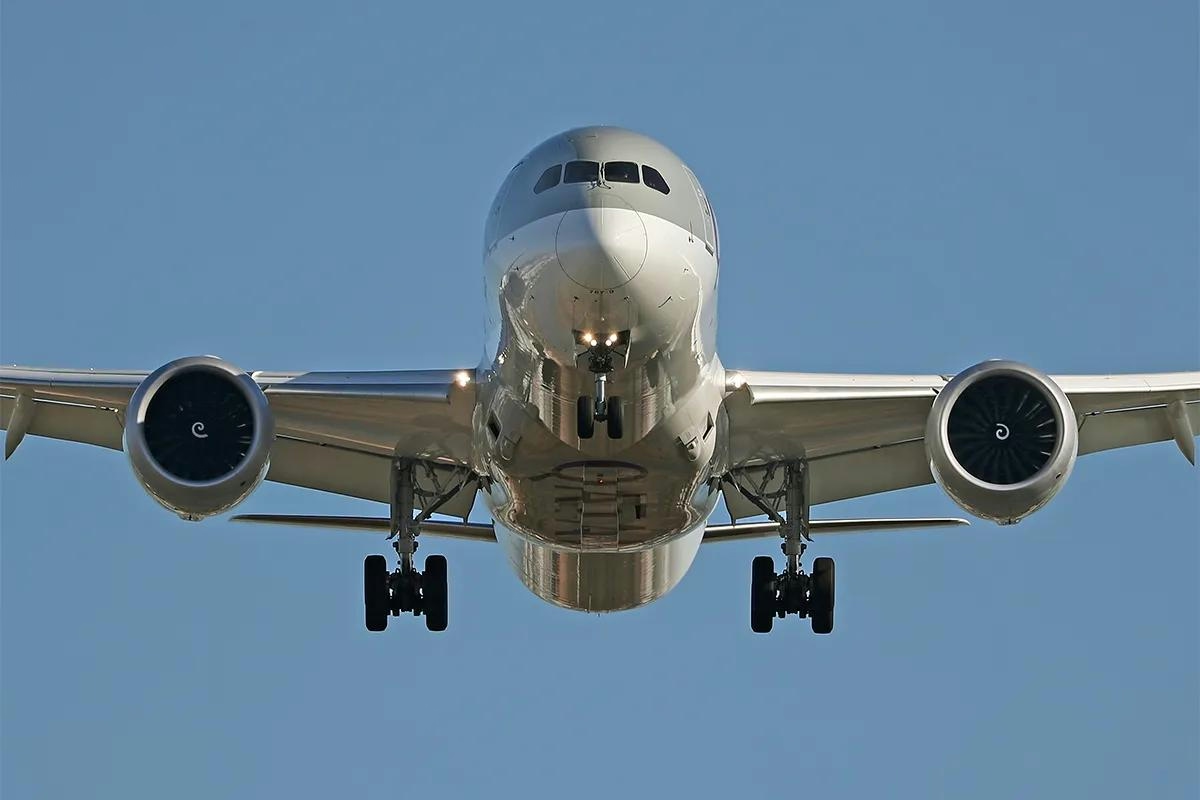
The Fastest Boeing Jet Currently in Service
The Boeing 747-8 Intercontinental: A Legacy of Speed and Efficiency
The Boeing 747-8 Intercontinental (747-8I) holds the distinction of being the fastest Boeing passenger jet currently in operational service, routinely cruising at speeds between Mach 0.85 and 0.86, equivalent to approximately 570 mph (915 km/h) at cruising altitude. Known as the “Queen of the Skies,” the 747-8I continues the legacy of the iconic 747 family by combining substantial size, extended range, and enhanced fuel efficiency. These attributes make it a preferred choice for airlines aiming to optimize the economics of long-haul routes.
Introduced in 2011 and entering service with Lufthansa in 2012, the 747-8I was developed as a significant upgrade to the 747-400. Boeing extended the fuselage, redesigned the wing structure, and modernized the upper deck layout to improve passenger comfort and operational performance. A key innovation was the integration of the GEnx engine, derived from the 787 Dreamliner’s powerplant but specifically optimized for the 747-8. This engine not only enhanced fuel economy but also substantially reduced noise levels. The aircraft features dual chevrons and sound-absorbing liners that lower takeoff noise, while simplified flaps contribute to quieter landings. Boeing reports that the 747-8 is 15 decibels quieter than the International Civil Aviation Organization’s (ICAO) Stage 4/Chapter 4 noise limits.
Aerodynamic refinements further distinguish the 747-8I from its predecessors. Unlike the 747-400’s winglets, the 747-8I employs a deeper, thicker wing with raked wingtips, which improves fuel efficiency and reduces drag at high speeds. The scalloped trailing edges on the engine nacelles, a design first introduced on the 787, smooth airflow and contribute to noise reduction. Each GEnx engine produces approximately 66,500 pounds of thrust, enabling the aircraft to carry heavier payloads while maintaining its high cruise speed.
Emerging Competition and Industry Challenges
While the 747-8I has long been recognized as Boeing’s fastest passenger jet, the Boeing 787 Dreamliner now matches its top speed, cruising at around Mach 0.85. The Dreamliner’s advanced composite airframe, superior fuel efficiency, and state-of-the-art avionics have made it a popular choice among airlines operating long-haul routes. This has reinforced Boeing’s reputation for producing high-speed, efficient widebody aircraft that meet evolving market demands.
Despite these technological achievements, Boeing faces significant challenges. Reports from December 2025 indicate concerns regarding the company’s delivery targets and cash flow, which have contributed to market uncertainty. Boeing’s stock has experienced volatility amid delivery delays, safety concerns, and difficulties integrating new technologies. Meanwhile, competitors are capitalizing on these setbacks by advancing their own technological capabilities and strengthening their market positions, intensifying competition in the high-speed, long-haul aviation sector.
Both the Boeing 747-8I and the 787 Dreamliner exemplify the company’s commitment to speed and innovation, each capable of cruising at Mach 0.85. As Boeing navigates operational and financial pressures, these aircraft remain central to its strategic efforts and the broader contest among global aerospace leaders.

Etihad Airways Suspends Airbus A380 Flights on Key Route

Aditya Birla Group Seeks Approval for Aircraft Leasing in GIFT City

Qatar Airways Highlights Innovation and Connectivity at Arabian Travel Market 2026

Hong Kong's Five-Year Plan Includes Andrew Fan's Aircraft Parts Processing Hub Proposal

ACIA Aero Leasing Delivers ATR72-600 to Air Nostrum

RTX Appoints Jill Albertelli as Head of Pratt & Whitney

TAT Technologies Joins Beyond Aero Hydrogen Aircraft Program

AURAK Study Highlights Barriers to Air Taxi Adoption in Emerging Economies

Xiamen Air Selects Altitude for 787 Maintenance at Heathrow

Etihad and Swissport Extend Global Partnership
