
Orchestrate AI insights into action

Trending
Categories
The New Aircraft Poised to Replace a Leading Narrowbody Model
The New Aircraft Poised to Replace a Leading Narrowbody Model
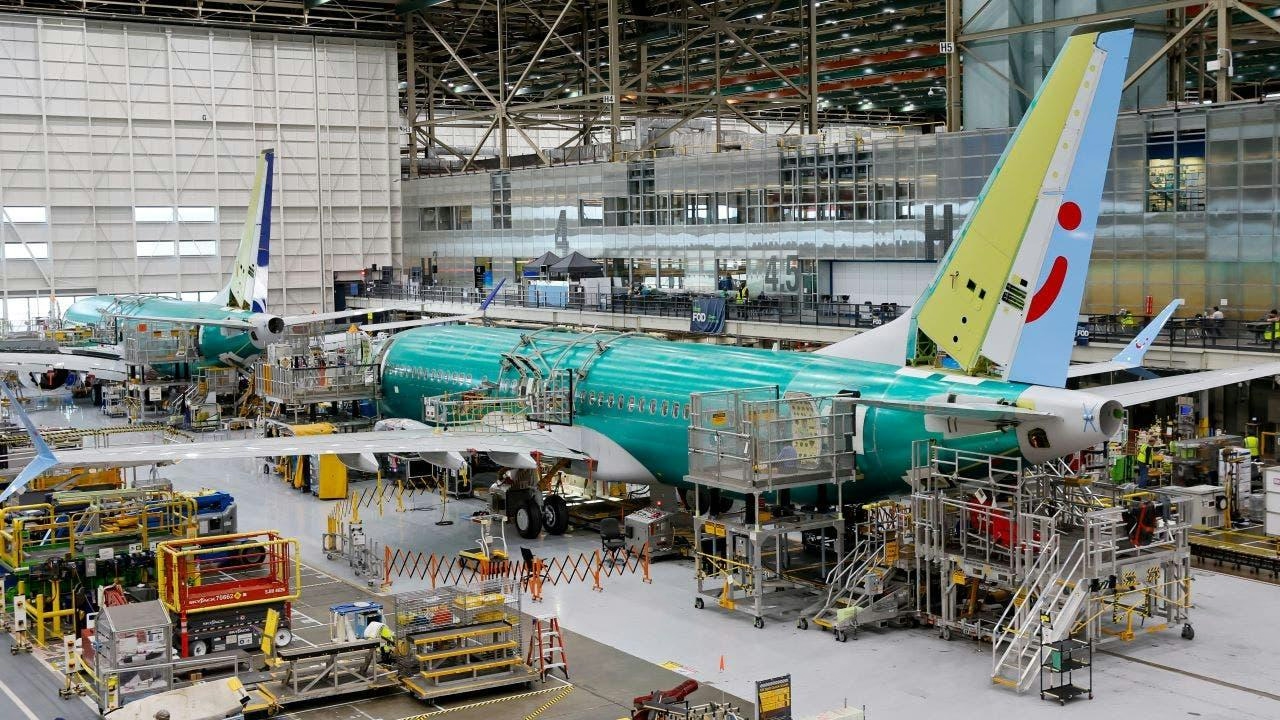
When Boeing ceased production of the 757 in 2004, it marked the end of an era for a uniquely versatile aircraft. Known as the “flying pencil” due to its long and slender fuselage, the 757 established a distinctive role in commercial aviation. It was capable of operating from short, hot runways at full capacity, crossing the Atlantic with the range and comfort typically associated with smaller widebody aircraft, and efficiently serving busy domestic routes. For carriers such as United, Delta, and Icelandair, the 757 was the preferred solution for challenging routes that demanded capabilities beyond those of a standard narrowbody.
Two decades on, the aging 757 fleet faces increasing operational challenges. Stricter noise and environmental regulations, alongside rising fuel costs, have reshaped airline requirements. Boeing never introduced a direct successor to the 757, leaving a gap that competitors have sought to fill. Airbus has advanced its A320 family with the introduction of the long-range A321XLR, a model designed to cover many of the 757’s traditional routes while offering significantly improved fuel efficiency.
The industry’s current focus has shifted from replicating the 757’s unique characteristics to assessing whether the A321XLR can quietly assume much of its demanding workload. Meanwhile, emerging competitors such as Natilus are developing the Horizon, an aircraft promising 25% lower fuel burn and 40% more cabin space, potentially setting new standards for efficiency and passenger comfort. These developments come amid fluctuating market dynamics: Boeing’s stock has surged following a 2026 cash-flow pledge, while Airbus has reduced its delivery targets due to recent technical issues. Both manufacturers are contending with regulatory changes, production pressures, and certification timelines, as industry observers closely monitor how established players and new entrants will respond.
The Boeing 757’s Enduring Legacy
The 757-200 was a product of its time, designed when powerful engines were essential to meet performance demands. Sharing a cockpit design with the Boeing 767 but tailored for different missions, the 757-200 was equipped with robust Rolls-Royce RB211-535 or Pratt & Whitney PW2000 engines, each producing approximately 43,500 pounds of thrust. This gave the aircraft a thrust-to-weight ratio more comparable to a military jet than a typical commercial narrowbody.
For airlines, the 757-200 was a versatile workhorse. It could operate short flights, such as New York LaGuardia to Boston in the morning, and then undertake a six-hour transcontinental journey later the same day. It excelled at “hot and high” airports like Denver and Mexico City, where thin air presents significant challenges to aircraft performance. Crucially, it could perform these missions fully loaded, whereas other narrowbodies often had to reduce passenger or cargo loads.
The 757-200’s combination of range, climb performance, and payload capacity made it a formidable aircraft to replace. Any successor must match its operational reach and runway capabilities while delivering improved fuel efficiency and reduced emissions to meet contemporary economic and environmental standards.
As the last 757s continue to operate on demanding long-haul narrowbody routes, the competition to replace them is intensifying. With new models like the A321XLR and innovative challengers such as Natilus’ Horizon entering the market, the next chapter in narrowbody aviation is unfolding—one defined by efficiency, adaptability, and heightened competition.

Etihad Airways Suspends Airbus A380 Flights on Key Route

Aditya Birla Group Seeks Approval for Aircraft Leasing in GIFT City

Qatar Airways Highlights Innovation and Connectivity at Arabian Travel Market 2026

Hong Kong's Five-Year Plan Includes Andrew Fan's Aircraft Parts Processing Hub Proposal

ACIA Aero Leasing Delivers ATR72-600 to Air Nostrum

RTX Appoints Jill Albertelli as Head of Pratt & Whitney

TAT Technologies Joins Beyond Aero Hydrogen Aircraft Program

AURAK Study Highlights Barriers to Air Taxi Adoption in Emerging Economies

Xiamen Air Selects Altitude for 787 Maintenance at Heathrow

Etihad and Swissport Extend Global Partnership
