
将人工智能洞察转化为可执行行动

热门趋势
Categories
Advances in Aviation Engines Strengthen China’s Air Combat Capabilities
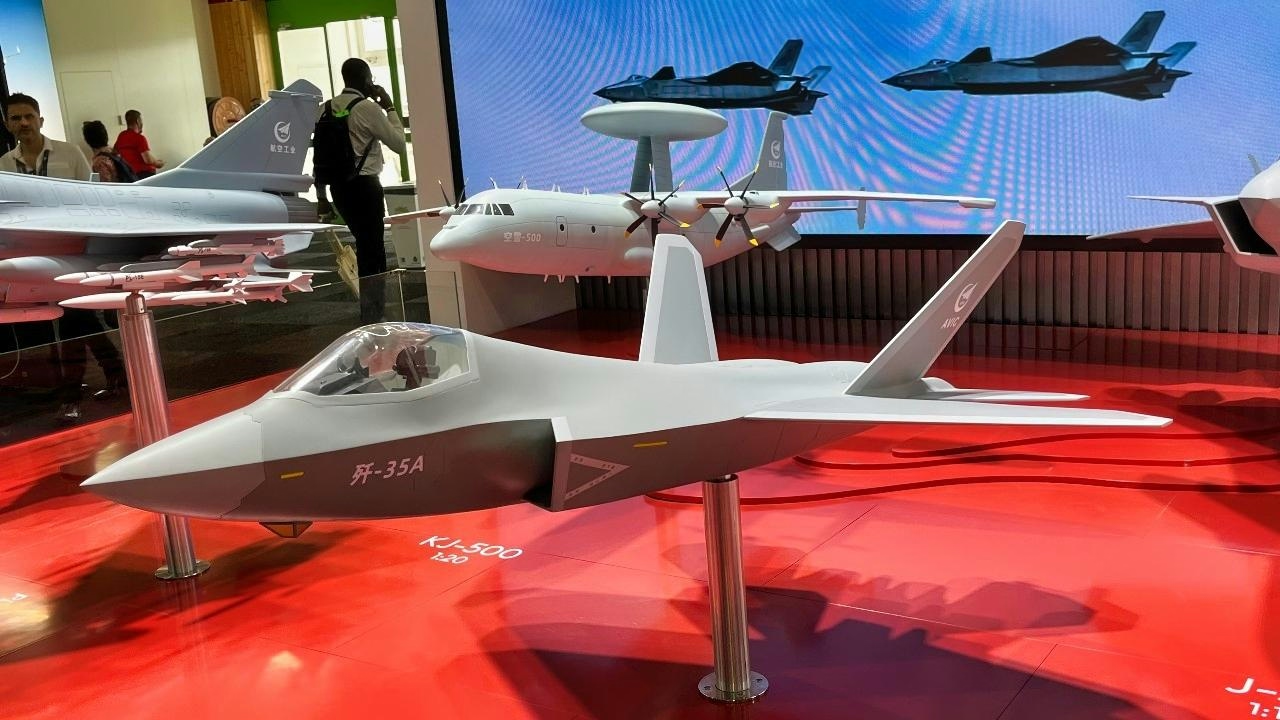
Advances in Aviation Engines Strengthen China’s Air Combat Capabilities
The rapid expansion of the People’s Liberation Army’s (PLA) air power in the 21st century is intrinsically linked to China’s significant breakthroughs in jet engine development. After enduring decades of setbacks—including the cancellation of the WS-6 and WS-8 programs—China has made substantial progress with the WS-10 engine. This engine now forms the cornerstone of a new generation of propulsion systems deployed across both aviation and naval platforms. Spearheaded by the People’s Liberation Army Air Force (PLAAF), this achievement represents a multibillion-dollar effort to master one of the most technically challenging aspects of military-industrial capability.
Historical Foundations and Early Challenges
China’s aviation engine program has its origins in World War II, when the country acquired Soviet fighters and bombers such as the I-5, I-16, and MiG-15. Postwar collaboration with Moscow facilitated the establishment of aircraft factories and access to a range of Soviet aircraft and jet engines, notably the MiG-21 powered by the Tumansky R-11 turbojet. However, the 1960 Sino-Soviet split abruptly terminated this cooperation, leaving China with incomplete blueprints and only partially trained engineers.
Despite these obstacles, China continued its efforts, producing thousands of MiG-17 and MiG-19 variants under the J-5 and J-6 programs, and eventually reverse-engineering the MiG-21 to develop the J-7. The Tumansky R-11 turbojet, however, proved particularly difficult to replicate. It was not until 1975 that the J-7 could reliably operate with the domestically produced WP-7 engine, which itself suffered from severe reliability issues well into the 1980s.
Western Technology and Persistent Setbacks
The 1971 Sino-American rapprochement opened new avenues, including a 1972 agreement for Boeing 707 aircraft and 40 Pratt & Whitney engines. Nevertheless, Chinese attempts to replicate these American engines were unsuccessful. Similarly, a £77 million license acquired in 1975 to produce the Rolls-Royce Spey Mk 202 engine took over three decades to bear fruit, with the Chinese-built WS-9 only powering the JH-7 and JH-7A fighter-bombers by 2010.
These repeated setbacks compelled Beijing to cancel the WS-6 and WS-8 engine projects after nearly two decades of research and development. Even the J-10 fighter program, initiated in 1988, faced significant delays as the domestic WS-10 engine struggled to meet performance standards, impeding the PLA’s broader modernization efforts.
Recent Breakthroughs and Strategic Implications
Recent advancements have markedly enhanced China’s air combat capabilities, eliciting concern among regional competitors. The confirmed delivery of General Electric engines to China underscores the country’s growing technological sophistication in aviation. This progress has led Japan to identify China’s military developments as its most significant strategic challenge, particularly amid heightened tensions surrounding Taiwan and ongoing threats from North Korea.
The evolution of aerial combat—from traditional dogfights to engagements dominated by long-range missile technology—has shifted the advantage toward larger, less detectable aircraft. This transformation has placed the U.S. Air Force’s traditional fighter inventory at a disadvantage in contemporary air superiority contests against the increasingly capable PLAAF.
China’s sustained investment in aviation engine technology, culminating in the success of the WS-10 and related systems, signifies a pivotal shift in the regional balance of power. As China narrows the technological gap with Western air forces, its enhanced propulsion capabilities are poised to play a decisive role in shaping the future of air combat in the Asia-Pacific region.

Etihad Airways Suspends Airbus A380 Flights on Key Route

Aditya Birla Group Seeks Approval for Aircraft Leasing in GIFT City

Qatar Airways Highlights Innovation and Connectivity at Arabian Travel Market 2026

Hong Kong's Five-Year Plan Includes Andrew Fan's Aircraft Parts Processing Hub Proposal

ACIA Aero Leasing Delivers ATR72-600 to Air Nostrum

RTX Appoints Jill Albertelli as Head of Pratt & Whitney

TAT Technologies Joins Beyond Aero Hydrogen Aircraft Program

AURAK Study Highlights Barriers to Air Taxi Adoption in Emerging Economies

Xiamen Air Selects Altitude for 787 Maintenance at Heathrow

Etihad and Swissport Extend Global Partnership
