
图像

将人工智能洞察转化为可执行行动

立即加入 AeroGenie 候补名单!

热门趋势

Categories

AerFin Sells CFM56-7B Engine to Major U.S. Operator
June 4, 2025By ePlane AI
AerFin Sells CFM56-7B Engine to Major U.S. Operator
0
0
AerFin
CFM56-7B
Engine Sale

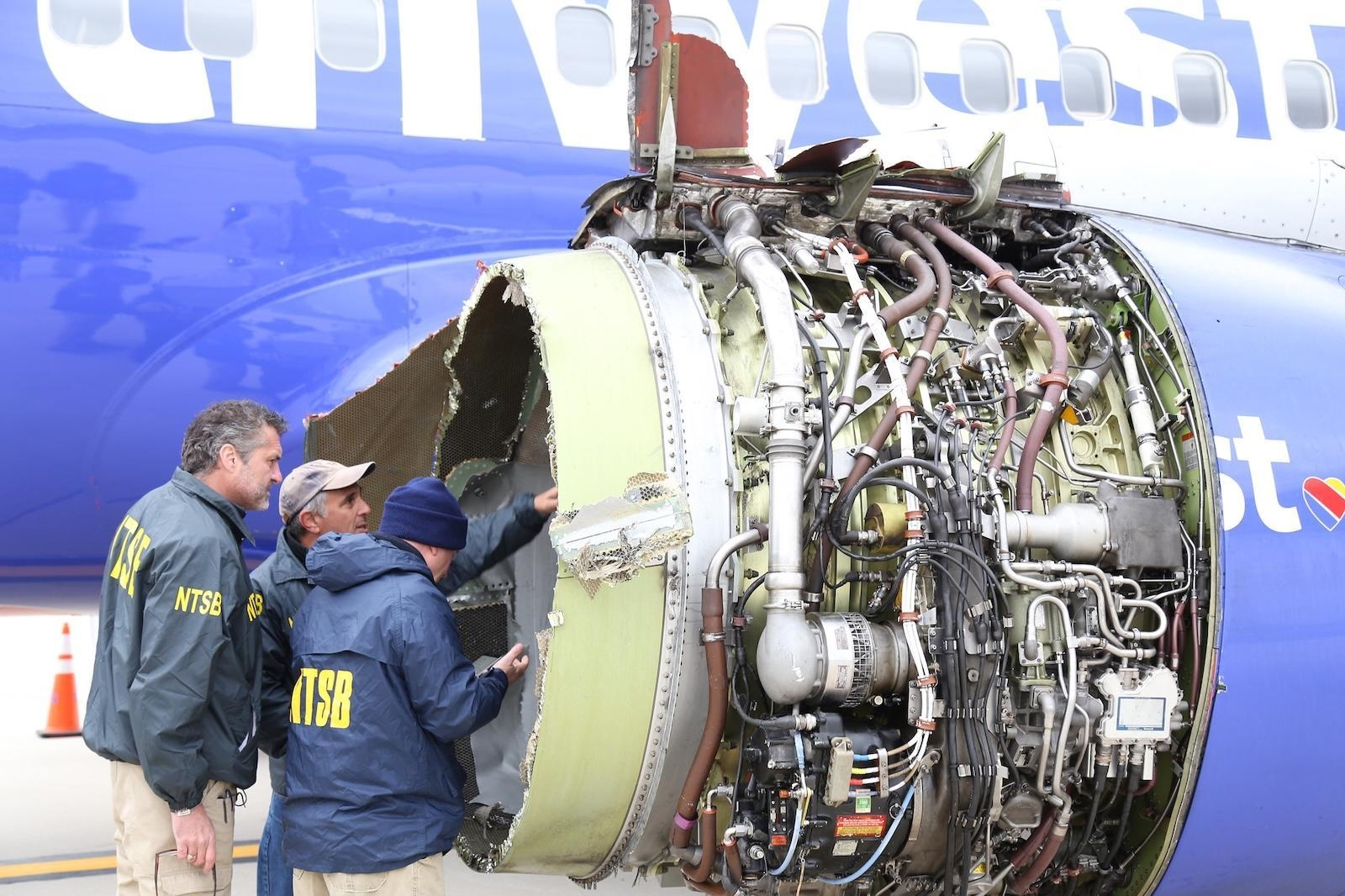
AerFin Finalizes Sale of CFM56-7B Engine to U.S. Operator

AerFin has successfully completed the sale of a serviceable CFM56-7B engine to a major, yet undisclosed, U.S. customer. The transaction underscores the company’s commitment to providing high-quality, ready-to-use assets to leading operators in the aviation sector.

Technical Excellence and Maintenance Expertise

The engine underwent a comprehensive series of technical procedures conducted by AerFin’s Maintenance, Repair, and Overhaul (MRO) team. These included a general visual inspection in accordance with Service Bulletin SP110, a thrust rating adjustment achieved through an ID plug modification, and the replacement of critical Line Replaceable Units (LRUs). Such meticulous attention to detail ensures that the engine meets stringent operational standards and is fully prepared for immediate deployment.

Auvinash Narayen, Chief Investment Officer at AerFin, emphasized the significance of the sale, stating, “This transaction demonstrates our ability to deliver value quickly and effectively for major operators around the world. It also highlights the strength of our MRO team, whose expertise ensures every engine we deliver is supported with the highest standards of technical oversight. We’re proud to support our customers with dependable, service-ready assets that keep their fleets flying with confidence.”

Certification and Maintenance Capabilities

In addition to this sale, AerFin has recently expanded its Part 145 certifications under EASA, CAA, and FAA authorities. These enhancements bolster the company’s Engine MRO Lite maintenance capabilities specifically for CFM56-5B and CFM56-7B engines, reinforcing AerFin’s position as a trusted provider of comprehensive engine support services.

More news
AZAL Reaffirms Choice of Leap-1A Engines, Signaling Confidence in CFM Technology

AZAL Reaffirms Choice of Leap-1A Engines, Signaling Confidence in CFM Technology

AZAL Reaffirms Commitment to Leap-1A Engines, Demonstrating Confidence in CFM Technology Azerbaijan Airlines (AZAL) has reaffirmed its commitment to CFM International’s Leap-1A engines, signaling continued confidence in the manufacturer’s technology and service capabilities. The announcement was made during a ceremony in Hamburg marking the delivery of AZAL’s first Airbus A321neo aircraft. The event was attended by Bruno Castola, General Manager of Airbus Programs at CFM, who expressed gratitude to AZAL for its ongoing partnership. Performance and Reliability of Leap-1A Engines Castola emphasized the advanced performance of the Leap-1A engines, which power the latest Airbus A320neo family aircraft. He highlighted a 15 percent reduction in fuel consumption compared to previous-generation engines, underscoring the economic and environmental benefits for operators. “AZAL has been operating Leap-1A engines on A320neo aircraft for almost a year now and has highly appreciated their performance,” Castola noted. The airline’s decision to select the Leap-1A once again for its expanding fleet reflects a strong trust in CFM’s technology and after-sales support. The Leap-1A engine has established itself as a mature and reliable product, with over 2,500 A320neo family aircraft delivered worldwide equipped with this engine over the past decade. Castola pointed out that the Leap-1A matches the reliability of the proven CFM56-5B engines while delivering significantly improved fuel efficiency. This achievement is the result of years of development and close collaboration with airlines, lessors, and Airbus. Industry Context and Future Outlook AZAL’s reaffirmation of the Leap-1A comes amid growing global demand for engine maintenance, repair, and overhaul (MRO) services. The surge in Leap engine deliveries has prompted industry players to expand MRO capabilities. Notably, SIA Engineering and Safran Aircraft Engines have launched a joint venture to provide dedicated MRO services for CFM’s Leap engines, while HAECO is investing in new MRO facilities in China to meet rising demand. This intensifying competition in the MRO sector may influence future support and service options for airlines such as AZAL. Meanwhile, the competitive landscape is evolving as engine manufacturers explore alternative technologies. GE Aerospace, a CFM partner, is advancing the development of hybrid-electric powertrains, which could offer future alternatives to current engine offerings. Despite these shifts, Castola reaffirmed CFM’s commitment to enhancing engine efficiency and managing maintenance costs. “Trust, respect, and mutual understanding are the foundation of our customer relationships. We'll continue to provide the high performance of the Leap-1A engines and quality support to take our partnership to the next level,” he stated. Concluding the ceremony, Castola wished Azerbaijan Airlines continued success and extended an invitation to visit CFM’s engine manufacturing center near Paris.
KM Malta Airlines and Bird Aviation Agree on Heavy Maintenance Contract

KM Malta Airlines and Bird Aviation Agree on Heavy Maintenance Contract

KM Malta Airlines and Bird Aviation Forge Three-Year Heavy Maintenance Partnership KM Malta Airlines has formalized a three-year contract with Bird Aviation to provide heavy maintenance services, including comprehensive C-checks, according to an official statement from the maintenance, repair, and operations (MRO) provider. Under this agreement, KM Malta Airlines will utilize Bird Aviation’s facilities located in Larnaca, Cyprus, for the upkeep of its fleet. Strengthening a Growing Collaboration While the two companies have previously worked together on various maintenance tasks, this contract represents their first long-term partnership. Data from ch-aviation indicates that KM Malta Airlines last entrusted one of its Airbus A320-200neo aircraft to Bird Aviation for maintenance in February 2026. The new agreement formalizes and extends this relationship, reflecting a mutual commitment to operational continuity and quality service. Navigating Industry Challenges The timing of the agreement is significant, as both KM Malta Airlines and Bird Aviation confront a series of industry-wide challenges. For KM Malta Airlines, securing timely and cost-effective maintenance is essential to sustaining operational reliability and managing expenses. The airline must also adhere to rigorous safety standards and evolving regulatory requirements, all while mitigating the risks posed by potential disruptions in the global supply chain that could affect maintenance timelines. Bird Aviation, on its part, aims to bolster its position within the highly competitive MRO sector. The company faces the task of demonstrating its capacity to deliver consistent, high-quality maintenance services that meet the demands of this contract, particularly as it competes against more established players in the market. Market Implications and Industry Response The partnership is expected to attract close attention from market analysts and investors, who will evaluate its financial and operational impact on KM Malta Airlines. Observers will assess whether the collaboration enhances the airline’s efficiency and competitive standing. Additionally, the deal may trigger strategic responses from rival maintenance providers seeking to secure similar contracts, as well as from competing airlines monitoring the development for potential advantages. Both KM Malta Airlines and Bird Aviation have expressed confidence in the long-term benefits of their partnership, emphasizing their prior cooperative experience as a strong foundation for this expanded engagement.
Airbus Increases C295 Production as Spain Receives First Search and Rescue Aircraft

Airbus Increases C295 Production as Spain Receives First Search and Rescue Aircraft

Airbus Increases C295 Production as Spain Receives First Search and Rescue Aircraft Expansion of Production and New Deliveries Airbus Defence & Space has announced an increase in the annual production rate of its C295 tactical transport aircraft, raising output from 10 to 13 units per year. This decision follows a surge in orders, notably from Spain, which recently took delivery of the first of 34 C295s it has commissioned. The delivery highlights the growing significance of the C295 in the tactical transport sector. Manufactured at Airbus’s San Pablo facility in Seville, the C295 is regarded by the company as the leading aircraft in its category. The latest delivery to the Spanish Air Force is the first C295 variant configured specifically for maritime search and rescue (SAR) operations. This aircraft is scheduled to join the 46th Wing at Gando air base in Gran Canaria shortly. Modernizing Spain’s Tactical Fleet Airbus positions the SAR-configured C295 as the natural successor to Spain’s CN235 Vigma fleet, which has been operational since 2008. The Spanish Air Force plans to replace eight CN235s with an equal number of SAR-configured C295s, which Airbus describes as offering a significant advancement in range and tactical capabilities. Additionally, Spain is expected to receive the first two of 18 C295 tactical transports later this year, under a contract signed in December 2023. Looking further ahead, Airbus intends to deliver the first C295 in a maritime patrol aircraft (MPA) configuration to Spain by 2028. This MPA variant, considered the most complex mission version of the C295 to date, is part of an order for eight such aircraft. The new MPA fleet will replace Spain’s retired Lockheed Martin P-3C Orions, enhancing the country’s anti-submarine and anti-surface warfare capabilities. Global Demand and Production Challenges The versatility of the C295 continues to drive robust international demand. Airbus reports a total of 335 aircraft ordered across 19 countries. The current production backlog includes orders for Canada, Ecuador, Morocco, and Thailand. The Royal Thai Navy, for instance, has procured C295s for surveillance missions, underscoring the platform’s adaptability. In a significant milestone, the first locally assembled C295 for the Indian Air Force recently completed its maiden flight. This aircraft is part of a 56-unit order and was assembled through a joint venture with Tata Advanced Systems at a new final assembly line in Vadodara, India. Prior to this, Airbus had delivered 16 Spanish-assembled C295s to India. Despite the positive momentum generated by increased orders and production, Airbus faces challenges in scaling up manufacturing while maintaining stringent quality standards. The company must also manage potential supply chain disruptions amid accelerated output. Industry analysts anticipate that competitors such as Boeing and Dassault may respond by enhancing their tactical transport offerings, intensifying competition within this market segment. The delivery of Spain’s first SAR-configured C295, alongside ongoing international orders, reinforces the aircraft’s strong market position. However, it also signals a period of heightened rivalry among global manufacturers vying for a larger share of the expanding tactical transport market.
Nomad Technics Completes BBJ Upgrade

Nomad Technics Completes BBJ Upgrade

Nomad Technics Completes Major BBJ Upgrade for Action Aviation Nomad Technics has successfully completed an extensive maintenance and upgrade program on a Boeing Business Jet (BBJ) for Action Aviation. The aircraft was brought to Nomad Technics’ Basel facility for a comprehensive 12-year inspection and a landing gear overhaul. Seizing the opportunity presented by the aircraft’s downtime, Action Aviation commissioned a series of significant enhancements to both the aircraft’s systems and interior. Advanced Connectivity and Interior Refurbishment One of the most notable technical upgrades was the installation of the Gogo Galileo FDX satcom system, marking one of the first such implementations on a BBJ worldwide. This enhancement significantly improves the aircraft’s connectivity capabilities, meeting the growing demand for reliable in-flight communication. The cabin also underwent a full refurbishment, with Aero Visto re-upholstering all seats and divans in a bespoke design, complemented by new carpeting supplied by Simrick to refresh the cabin’s aesthetic. The in-flight entertainment system received a comprehensive modernization. Larger, higher-resolution monitors replaced the previous screens, and a custom app-based video-on-demand streaming system was introduced to align with the client’s specific requirements. Additionally, the cabin lighting was upgraded to multi-colour LED mood lights, controllable via an app, while a new app-based moving map system was installed for display on both cabin monitors and personal devices, enhancing passenger experience and convenience. Collaborative Project Execution and Industry Implications Brigita Vildžiūnienė, Director of Sales at Nomad Technics, emphasized the collaborative nature of the project, noting that the client’s involvement from the quotation phase through to completion fostered trust and efficiency. She remarked, “The project was interesting and challenging to put together, but I think that’s something that made us win because the client saw how quickly and efficiently we can do things. Our responsiveness, honesty and transparency built trust with the customer and we carried that on throughout the project.” Thomas Gierlich, CEO of Nomad Technics, expressed gratitude towards Action Aviation and the company’s partners for entrusting them with such a large-scale project, describing the experience as “wonderful.” While the successful completion of this BBJ upgrade highlights Nomad Technics’ technical expertise and commitment to quality, it also underscores ongoing challenges. Maintaining high standards while managing production costs remains critical, particularly as customer expectations for business jet upgrades continue to rise. Positive market reception will depend on the delivery of promised enhancements, with any shortcomings potentially affecting customer satisfaction and the company’s reputation. The competitive landscape is evolving as rival maintenance providers may introduce similar upgrades to remain competitive, potentially intensifying competition and exerting price pressures within the business jet market. This environment necessitates a careful balance of innovation, quality, and cost-effectiveness for Nomad Technics moving forward. Nomad Technics AG, the maintenance division of Nomad Aviation AG based at EuroAirport in Basel, Switzerland, is an EASA Part-145 approved organization. The company specializes in maintenance, inspection, and non-routine repair work on Bombardier Global and Challenger business jets, as well as line and base maintenance for the Airbus A320 family (neo and ceo) and Boeing 737NG and MAX series aircraft.
OGMA Completes First Overhaul of C-390 Aircraft

OGMA Completes First Overhaul of C-390 Aircraft

OGMA Completes First Overhaul of C-390 Aircraft Embraer and OGMA have successfully completed the first scheduled 24-month maintenance inspection of a C-390 Millennium aircraft operated by the Hungarian Air Force. This milestone, achieved at OGMA’s facilities in Portugal, marks a significant advancement for the aircraft’s European support network. The overhaul underscores the expanding capabilities of Embraer’s maintenance infrastructure in Europe and reinforces confidence in the C-390 Millennium programme. Collaboration and Operational Significance The inspection follows a recently signed services agreement between Embraer and the Hungarian Air Force, which encompasses maintenance, logistics, and technical support for Hungary’s C-390 fleet. Brigadier General Tamás Bali PhD, Commander of the Hungarian Air Force, emphasized the importance of this achievement, stating that the maintenance completion represents a key milestone for their operations. He praised the high level of technical expertise demonstrated by the teams and highlighted the effective collaboration between the Hungarian Air Force, OGMA, and Embraer, which ensured a smooth and well-coordinated process. The Hungarian Air Force expressed strong satisfaction with both the outcome and the ongoing support provided throughout the maintenance activity. Technical Challenges and Strategic Implications The overhaul process posed several challenges for OGMA, including adherence to Embraer’s rigorous quality standards, the management of complex logistics for parts supply, and the integration of advanced maintenance technologies. Overcoming these obstacles not only showcases OGMA’s technical proficiency but also enhances Embraer’s reputation for supply chain reliability. This capability is increasingly important as additional countries, such as Greece and South Korea, prepare to join the ranks of C-390 operators. Industry analysts suggest that this successful maintenance milestone may bolster confidence among current and prospective customers regarding Embraer’s ability to provide comprehensive support for its aircraft across Europe. The expansion of the C-390’s support network occurs amid growing competition in the tactical transport market, with nations like the Czech Republic actively evaluating alternatives to maintain their operational edge. Hungary, the second NATO member to operate the C-390 Millennium, received its full fleet of two aircraft in November 2025. Since entering service in late 2024, these aircraft have demonstrated strong operational performance, supporting a diverse range of transport and military missions for the Hungarian Air Force. The completion of this first overhaul at OGMA is expected to further consolidate the C-390 Millennium’s position within the European tactical airlift sector.
Airbus Delivers First H145M Helicopter to Belgium for Defense

Airbus Delivers First H145M Helicopter to Belgium for Defense

Airbus Delivers First H145M Helicopter to Belgium, Advancing Defense Modernization Airbus Helicopters has officially delivered the first H145M helicopter to Belgium, marking a pivotal milestone in the country’s ongoing efforts to modernize its armed forces and federal police. The handover ceremony took place on June 24, 2026, at Airbus’s Donauwörth production facility in Germany, where the aircraft are manufactured. This initial delivery is part of a contract signed in 2024 through the NATO Support and Procurement Agency, designed to equip Belgian defense and law enforcement agencies with advanced multirole helicopters. Demonstrating growing confidence in the platform, Belgium has exercised an option to acquire three additional H145Ms, bringing its total order to 20 aircraft. Thomas Hein, Head of Europe Region at Airbus Helicopters, emphasized Belgium’s alignment with a broader European trend toward adopting the H145M. He described the helicopter as “the definitive European reference for military multi-mission capabilities,” noting that Belgium’s decision to expand its fleet reflects strong trust in the aircraft’s ability to address evolving security challenges. Versatility and Operational Capabilities The H145M is the military variant of the light twin-engine H145 helicopter family, which has accumulated over 8.5 million flight hours worldwide. Engineered for rapid role adaptation, the H145M can be configured for a variety of missions, including light attack operations equipped with ballistic and guided weapons as well as self-protection systems. It is also suited for special operations, featuring fast-roping equipment, and can be outfitted for hoisting and external cargo transport. The helicopter is designed for seamless integration into networked combat environments and can operate in conjunction with uncrewed aerial systems through advanced digital connectivity. Powered by two Safran Arriel 2E engines with full authority digital engine control, the H145M incorporates the Helionix digital avionics suite and a four-axis autopilot system, which collectively reduce pilot workload. Airbus asserts that the H145M possesses the lowest acoustic footprint in its class, making it the quietest military helicopter of its type. Integration Challenges and Market Implications As Belgium begins incorporating the H145M into its air force and police operations, several challenges are anticipated. These include ensuring smooth integration within existing operational frameworks, providing comprehensive pilot training, and potentially enhancing counter-unmanned aircraft system (C-UAS) capabilities to address emerging threats. This delivery is also expected to influence the broader defense helicopter market. The rising demand for versatile multirole rotorcraft may encourage other defense forces to pursue similar modernization efforts. Competitors such as Leonardo Helicopters and NHIndustries are likely to respond by advancing their own platforms and emphasizing new technological innovations to maintain market competitiveness. Global Adoption of the H145 Family The H145 helicopter family enjoys widespread use among military and law enforcement agencies worldwide. The United States Army operates nearly 500 helicopters from this family under the UH-72 Lakota designation. Germany has ordered up to 82 H145Ms, with deliveries currently underway. Additional military operators include Hungary, Serbia, Luxembourg, Thailand, Ecuador, and Honduras. Belgium’s adoption of the H145M further solidifies the platform’s reputation as a flexible and modern solution for a broad spectrum of defense and security missions across Europe and beyond.
EASA Orders A380 Wing Inspections, Increasing Scrutiny on Airbus

EASA Orders A380 Wing Inspections, Increasing Scrutiny on Airbus

EASA Mandates Urgent Inspections on Airbus A380 Wings The European Union Aviation Safety Agency (EASA) has issued an urgent directive requiring inspections of 16 Airbus A380 aircraft following the detection of cracks in a critical wing structure. The inspections focus on the wing mid-spar, a vital component within the wing box responsible for distributing flight loads. Of the affected aircraft, 15 belong to Emirates and one to Qantas, with five Emirates jets mandated to undergo inspection before their next flight. This directive follows a series of inspections conducted over the past two years that uncovered cracks in specific areas of the rear and front spars. Airbus has responded by issuing instructions for "special detailed inspections," obliging operators to report their findings directly to the manufacturer. Although EASA has not grounded the A380 fleet and maintains that there is no immediate widespread safety risk, the emergency airworthiness directive signals the gravity of the issue. Such directives are uncommon and typically reserved for significant safety concerns. Broader Challenges Facing Airbus Amid Regulatory Pressure The wing inspection order compounds a series of challenges confronting Airbus. The manufacturer continues to face supply chain disruptions, particularly shortages of Pratt & Whitney engines, which have resulted in completed aircraft remaining at production sites in Toulouse and Hamburg awaiting engine installation. These delays have slowed delivery schedules. Furthermore, Airbus is under increased regulatory scrutiny across other programs, including new maintenance requirements for certain A330 models and ongoing oversight of updates to the A320 family following concerns related to flight-control systems. Despite these operational and regulatory pressures, Airbus Chief Executive Guillaume Faury has highlighted the enduring strength of long-term demand for new aircraft, noting the absence of order cancellations even amid rising fuel costs. Faury has also cautioned that growing regulatory complexity, elevated energy prices, and administrative burdens are adversely affecting Europe’s industrial competitiveness. The aviation industry remains intensely competitive, with American Airlines reportedly considering a significant widebody aircraft order from either Boeing or Airbus to maintain parity with rivals Delta and United. As regulatory scrutiny intensifies and operational challenges persist, Airbus faces the complex task of balancing compliance demands with production efficiency and customer commitments.
Stuart Fox to Speak at WMES 2026 as IATA Operations Director

Stuart Fox to Speak at WMES 2026 as IATA Operations Director

Stuart Fox to Speak at WMES 2026 as IATA Operations Director Amid Industry Challenges Stuart Fox, Operations Director of the International Air Transport Association (IATA), is scheduled to deliver a keynote address at the World Maintenance and Engineering Symposium (WMES) 2026 in Madrid. His speech comes at a critical juncture as the aviation sector confronts significant operational and financial pressures. Financial and Operational Strains on the Aviation Industry IATA has issued a stark warning regarding the outlook for global airline profitability in 2026, projecting net profits to fall to $23 billion—nearly half of the previously forecasted $41 billion. This sharp decline is primarily driven by a $100 billion increase in fuel costs, a consequence of ongoing geopolitical tensions, notably the conflict between the United States and Iran. The fuel price surge exacerbates existing challenges such as delayed aircraft deliveries, engine reliability problems, and acute shortages of spare parts. The association reports that airlines are contending with unprecedented disruptions in maintenance and supply chains. In 2025 alone, the industry is expected to incur over $11 billion in additional costs. These include $4.2 billion in delayed fuel savings due to the continued operation of older, less fuel-efficient aircraft, $3.1 billion in increased maintenance expenses linked to aging fleets, $2.6 billion in excess engine leasing costs as engines spend extended periods in maintenance, and $1.4 billion in higher inventory costs as airlines stockpile spare parts to mitigate supply chain uncertainties. These financial burdens are diverting resources away from vital investments in network expansion, workforce development, and decarbonization initiatives. Maintenance Challenges and Fleet Constraints A recent study conducted by IATA in partnership with Emerton highlights the acute impact on single-aisle engine maintenance. In March 2025, 648 Pratt & Whitney GTF-powered aircraft—representing 28% of the global GTF fleet—were grounded awaiting engine shop visits or spare parts. This situation is expected to worsen as next-generation single-aisle fleets grow. Annual shop visits for CFM LEAP engines are projected to increase dramatically from 600–800 in 2025 to over 5,000 by 2040, while visits for Pratt & Whitney GTF engines are expected to rise from 1,000 to 2,000. Beyond maintenance, the industry faces a backlog exceeding 18,000 aircraft orders, delivery shortfalls of more than 5,000 units, and an average fleet age now surpassing 15 years. Airlines are compelled to operate less capable fleets than originally planned, striving to improve efficiency, reliability, and environmental performance under these constraints. These challenges are further compounded by production bottlenecks, certification delays, raw material shortages, labor market tightness, and rigid commercial models. IATA’s Strategic Priorities and Industry Outlook In response to these multifaceted challenges, IATA has identified four key priorities. First, enhancing supply chain visibility to enable proactive management of disruptions. Second, opening up the aftermarket to increase access to parts and services. Third, leveraging data, digitalization, and artificial intelligence to enable smarter maintenance and operational decisions. Finally, building human capacity to address labor shortages and skill gaps within the industry. IATA has also expressed concerns regarding passenger safety, urging travelers to prioritize evacuation over recording emergencies during incidents. Additionally, the association noted that growth in European air connectivity stalled in 2025, hindered by regulatory pressures, high costs of sustainable aviation fuel, and operational difficulties. As Stuart Fox prepares to address WMES 2026, the aviation industry remains focused on navigating these complex headwinds and enhancing resilience for the future.
FAA Invests $875 Million in AI to Reduce Flight Delays

FAA Invests $875 Million in AI to Reduce Flight Delays

FAA Commits $875 Million to AI-Driven Air Traffic Modernization Transforming Air Traffic Control Infrastructure The Federal Aviation Administration (FAA) has announced a significant contract valued at up to $875 million with Air Space Intelligence, aimed at modernizing the United States’ air traffic control system through artificial intelligence and predictive analytics. This 12-year initiative, revealed by U.S. Secretary of Transportation Sean Duffy alongside leading airline executives, represents one of the largest federal investments in AI within the transportation sector to date. The U.S. airspace system is under increasing strain as passenger numbers have surged from approximately 60 million annually in 1960 to nearly one billion today. Despite this dramatic growth, much of the air traffic management infrastructure remains reliant on technology developed in the 1960s. This outdated framework struggles to accommodate current demands, resulting in frequent delays, congestion, and costly disruptions for both airlines and travelers. Advancing Predictive Capabilities with AI Central to the FAA’s modernization plan is the replacement and upgrade of critical components, including radar systems, software, hardware, and telecommunications networks. The integration of AI-driven predictive technology is designed to transition air traffic management from a reactive model to a proactive one. According to the FAA, the current National Airspace System (NAS) has limited capacity to anticipate the impact of forecasted flights and unplanned events such as adverse weather or runway closures. This reactive approach contributes to bottlenecks that ripple across the national airspace. The new Flow Management Data and Services platform will serve as the technological core of the Air Traffic Control System Command Center. By leveraging AI to analyze extensive data sets—ranging from weather conditions to airport capacity—that are currently dispersed across multiple systems, the FAA aims to optimize airspace utilization, balance traffic demand with available capacity, and mitigate the cascading delays that have long challenged the system. Industry Challenges and Outlook Despite the promise of this ambitious modernization, integrating advanced AI into a system that has evolved incrementally over decades presents considerable challenges. Airlines have expressed concerns regarding the system’s ability to effectively resolve flight conflicts and the pace at which the new technology can be implemented to yield tangible improvements. Industry analysts suggest that the FAA’s investment may encourage competitors to adopt similar AI-driven solutions, potentially accelerating innovation throughout the aviation sector. The announcement has also generated optimism among investors, who view modernization as a pathway to enhanced operational efficiency and reliability. Beyond the goal of reducing delays, the FAA anticipates that the AI-enhanced system will improve safety by better managing flight congestion and reducing the risk of runway incidents. If successful, this initiative could establish a new global benchmark for air traffic management, influencing market dynamics and shaping traveler expectations for years ahead.
ACI Europe Recognizes Leading Airports for Innovation, Sustainability, and Passenger Service

ACI Europe Recognizes Leading Airports for Innovation, Sustainability, and Passenger Service

ACI Europe Recognizes Leading Airports for Innovation, Sustainability, and Passenger Service At the ACI EUROPE Annual Congress held in Prague, the 2026 Best Airport Awards were presented to airports demonstrating exceptional performance in operational efficiency, passenger service, and environmental, social, and governance (ESG) criteria. These accolades arrive at a critical juncture for the aviation industry, which continues to grapple with rising operational costs, geopolitical uncertainties, and the imperative transition toward sustainable practices. Award Winners and Innovations Among the distinguished recipients, Helsinki Airport was honored with the Digital Transformation Award for its cutting-edge operational platform, now deployed across 20 airports. Stuttgart Airport received the Eco-Innovation Award after achieving a remarkable 97.6% reduction in CO₂ emissions from its apron fleet. Vasil Levski Sofia Airport earned the HR Excellence Award for its pioneering application of artificial intelligence in workforce management. Additionally, Dr. Holger Schulz of airsight GmbH was recognized with the World Business Partner accolade for his enduring contributions to the aviation sector. In the principal airport size categories, Wrocław Airport was named the best airport handling fewer than five million passengers. Riga International Airport secured the award for the 5–10 million passenger segment, while Venice Marco Polo Airport led the 10–25 million category. Vienna International Airport was recognized as the top airport in the 25–40 million passenger bracket. Rome Fiumicino Airport extended its winning streak in the over 40 million passengers category, with judges highlighting its leadership in innovation, AI-driven operations, and passenger experience. The awards were adjudicated by a panel of eminent aviation experts representing institutions such as the European Commission, EUROCONTROL, EASA, SESAR, and ACI World. Industry Challenges and Market Dynamics These achievements come amid significant challenges facing the European aviation market. The sector is witnessing increased consolidation, exemplified by Lufthansa’s recent acquisition of majority control in ITA, reflecting a broader trend toward market concentration. Airports are also confronting intensified competitive pressures following the first annual decline in European airport passenger traffic since 2021. In response, industry players are prioritizing the maintenance of connectivity and economic resilience. ACI Europe has issued warnings regarding new state aid regulations that could jeopardize the viability of regional airports, potentially undermining connectivity across the continent. As airports pursue excellence in innovation and sustainability, they must simultaneously navigate evolving market conditions and regulatory frameworks. Despite these headwinds, the ACI EUROPE Best Airport Awards underscore the sector’s steadfast commitment to enhancing passenger service, operational efficiency, and environmental stewardship, reaffirming the vital role airports play in Europe’s connectivity and economic vitality.
line









