
将人工智能洞察转化为可执行行动

热门趋势
Categories
Airbus Announces Further Delays in A350 Deliveries
Airbus Announces Further Delays in A350 Deliveries
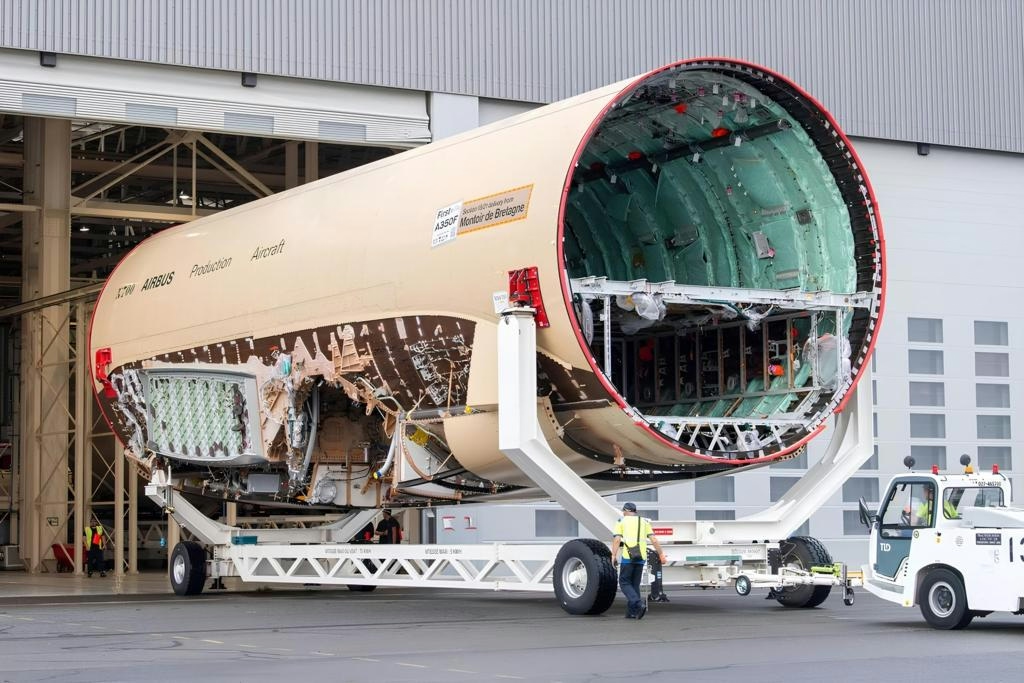
Airbus has notified several airline customers of additional delays in the delivery of its A350 aircraft, attributing the setbacks to persistent supply chain disruptions at former Spirit AeroSystems facilities now under Airbus’s management. The European aerospace manufacturer recently communicated that ongoing operational challenges at the Kinston, North Carolina plant—acquired from Spirit AeroSystems following Boeing’s reacquisition of its former division—are impeding the production and delivery of key A350 fuselage sections.
Operational Challenges at Kinston Facility
Industry insiders reveal that staffing shortages and transition-related difficulties at the Kinston site have significantly hindered Airbus’s efforts to stabilize production. A number of employees have reportedly returned to Boeing-affiliated Spirit operations amid the restructuring, further complicating Airbus’s plans to ramp up output. These issues arise as Airbus targets the delivery of 870 aircraft this year, with a substantial portion of this volume expected from its narrowbody aircraft lines.
The A350 program, however, faces distinct challenges. Early 2024 deliveries were notably slow, with only one A350-900 delivered in January, two in February, and a modest increase to eight in March. Despite these production hurdles, demand for the widebody aircraft remains strong, evidenced by 35 new orders in the first quarter, including 15 A350-900s and 30 A350 freighters (A350Fs). During the company’s first-quarter earnings call in April, CEO Guillaume Faury reiterated Airbus’s commitment to increasing A350 production to 12 aircraft per month by 2028.
Broader Production and Market Impacts
The delays affecting the A350 are part of a wider set of challenges for Airbus. The company has also encountered a panel quality issue impacting A320neo-family production, alongside an administrative delay that postponed the transfer of nearly 20 aircraft to China. These setbacks have heightened concerns among airlines already enduring extended wait times for widebody aircraft, as both Airbus and Boeing grapple with certification processes and production stability. Airbus has announced plans to realign production and delivery schedules by the end of June to mitigate these issues.
The market has responded to the news with Airbus shares declining 2.9% in early European trading, while aerospace peers such as Safran and BAE Systems experienced gains.
Impact on the A350 Freighter Variant
The production delays have also affected the new freighter variant, the Airbus A350F. Supply chain disruptions at the Spirit facilities have pushed the A350F’s entry into service back by two years from the original 2025 target. In 2023, Airbus postponed the program to 2026, and early last year, the timeline slipped further to the second half of 2027 due to ongoing supply chain challenges, including those at the Kinston plant. Despite these setbacks, Airbus maintains that the A350F’s first flight and delivery remain on track for 2027.
With revenue closely linked to aircraft deliveries, these ongoing production difficulties continue to exert pressure on Airbus’s financial performance. The company’s ability to stabilize its supply chain and meet delivery commitments will be closely monitored by customers and investors in the coming months.

Etihad Airways Suspends Airbus A380 Flights on Key Route

Aditya Birla Group Seeks Approval for Aircraft Leasing in GIFT City

Qatar Airways Highlights Innovation and Connectivity at Arabian Travel Market 2026

Hong Kong's Five-Year Plan Includes Andrew Fan's Aircraft Parts Processing Hub Proposal

ACIA Aero Leasing Delivers ATR72-600 to Air Nostrum

RTX Appoints Jill Albertelli as Head of Pratt & Whitney

TAT Technologies Joins Beyond Aero Hydrogen Aircraft Program

AURAK Study Highlights Barriers to Air Taxi Adoption in Emerging Economies

Xiamen Air Selects Altitude for 787 Maintenance at Heathrow

Etihad and Swissport Extend Global Partnership
