
将人工智能洞察转化为可执行行动

热门趋势
Categories
Alibaba Opens Qwen App to Partners in Collaboration with China Eastern Airlines
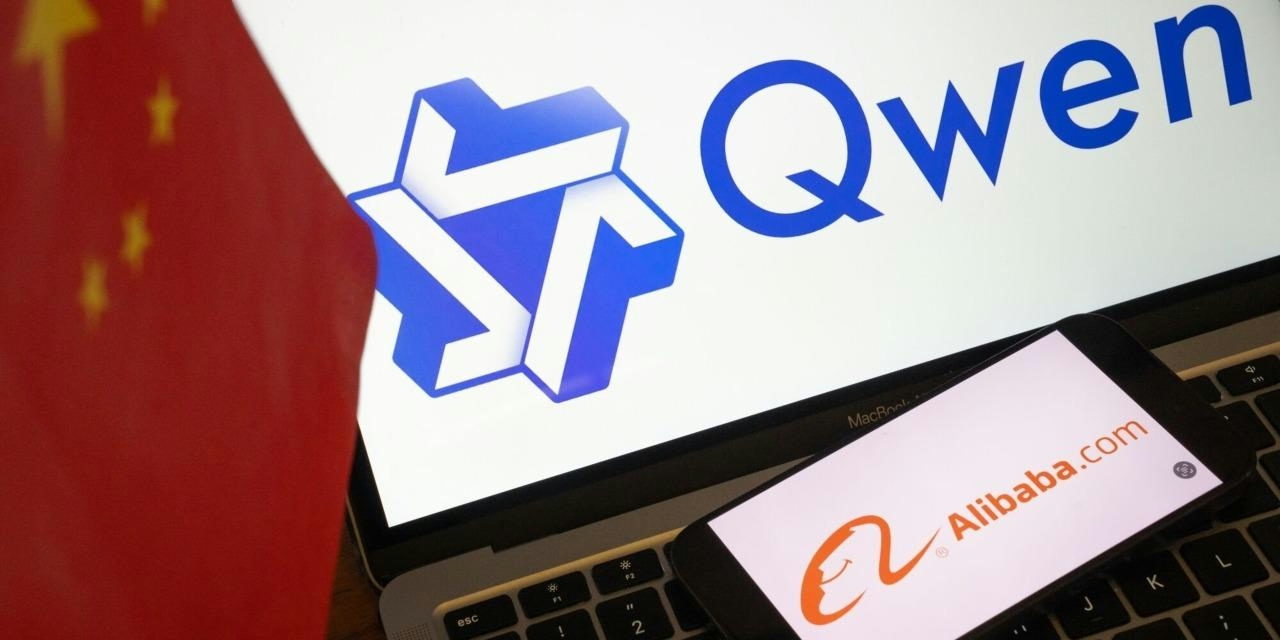
Alibaba Expands Qwen AI App Through Partnership with China Eastern Airlines
Alibaba Group Holding has announced a significant milestone for its flagship consumer artificial intelligence application, Qwen, by establishing its first external partnership with China Eastern Airlines. This collaboration marks a strategic effort to extend Qwen’s agentic capabilities beyond Alibaba’s internal ecosystem, integrating the app into practical, real-world services. Through this partnership, users can now manage the entire flight booking process—including searching for flights, purchasing tickets, selecting seats, and completing check-in—via a single, natural-language chat interface. The app also functions as a proactive intelligent assistant, anticipating user needs and offering relevant suggestions throughout the process.
Expanding Use Cases and Strategic Vision
Alibaba has indicated that the Qwen app will soon broaden its scope to include airline loyalty programs and additional travel-related services. The company plans to onboard more partners both within and outside its ecosystem, aiming to deepen the app’s real-world applications and strengthen Alibaba’s foothold in applied artificial intelligence. Wu Jia, president of the Qwen app, emphasized the significance of this expansion, stating that integrating China Eastern Airlines represents the first time the app’s agentic capabilities are accessible to external partners, thereby enhancing everyday convenience for a wider user base.
This partnership underscores Alibaba’s broader strategy to accelerate adoption of its comprehensive AI stack, which encompasses infrastructure, cloud services, foundational models, and applications tailored for both enterprise and consumer markets. Earlier this year, Alibaba committed to investing 380 billion yuan (approximately US$55.6 billion) in AI and cloud technologies over three years, having already allocated more than 120 billion yuan to the sector in the preceding four quarters.
Competitive Landscape and Market Response
Despite Alibaba’s ambitious plans, the company faces intense competition in the AI chatbot arena from other leading Chinese technology firms such as Tencent and ByteDance, both of which have established strong positions with their own AI products. To attract and retain users, Alibaba has employed aggressive marketing tactics, including promotional incentives like free milk tea for orders placed through the Qwen chatbot, a strategy that mirrors similar campaigns by its rivals.
Market reactions to the collaboration between Alibaba and China Eastern Airlines have been mixed, reflecting the nascent stage of AI chatbot integration within the airline industry. Industry analysts suggest that competitors are likely to respond by intensifying their promotional efforts and enhancing their AI capabilities to protect or grow their market share.
As Alibaba opens Qwen to external partners, the company is placing considerable emphasis on real-world applications and strategic collaborations as key differentiators in China’s increasingly competitive AI landscape.

Etihad Airways Suspends Airbus A380 Flights on Key Route

Aditya Birla Group Seeks Approval for Aircraft Leasing in GIFT City

Qatar Airways Highlights Innovation and Connectivity at Arabian Travel Market 2026

Hong Kong's Five-Year Plan Includes Andrew Fan's Aircraft Parts Processing Hub Proposal

ACIA Aero Leasing Delivers ATR72-600 to Air Nostrum

RTX Appoints Jill Albertelli as Head of Pratt & Whitney

TAT Technologies Joins Beyond Aero Hydrogen Aircraft Program

AURAK Study Highlights Barriers to Air Taxi Adoption in Emerging Economies

Xiamen Air Selects Altitude for 787 Maintenance at Heathrow

Etihad and Swissport Extend Global Partnership
