
将人工智能洞察转化为可执行行动

热门趋势
Categories
Artificial Intelligence in Aviation Security and Risk Management
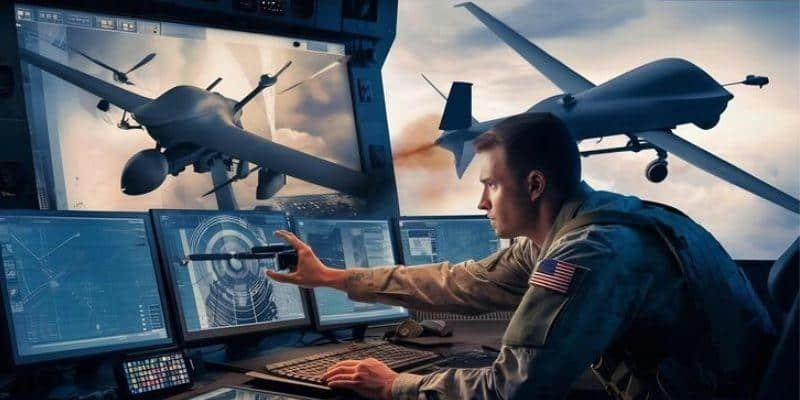
Artificial Intelligence Reshapes Aviation Security and Risk Management
Aviation security and risk assessment operate within a landscape marked by constant uncertainty and an uncompromising demand for precision. Managing millions of passengers, assets, and digital interactions daily, airports, airlines, and air traffic control systems confront increasingly complex challenges. Traditional security frameworks, which rely heavily on manual oversight and static, rule-based protocols, are proving inadequate in addressing the scale and intricacy of modern aviation operations. In this context, Artificial Intelligence (AI) is revolutionizing the sector by introducing data-driven methodologies that enhance threat identification, risk prediction, and decision-making processes.
Enhancing Security Operations Through AI
AI significantly bolsters aviation security by continuously processing vast datasets drawn from a multitude of sources. Through pattern recognition and anomaly detection, AI systems reduce dependence on rigid rules and minimize false alarms, enabling security personnel to concentrate on genuine threats. Unlike human operators, AI provides uninterrupted surveillance, a critical advantage in high-traffic environments where fatigue can impair vigilance. This synergy between AI and human expertise results in improved accuracy, accelerated response times, and heightened operational efficiency.
Expanding Capabilities in Threat Detection and Prevention
One of AI’s most transformative applications lies in real-time surveillance and biometric identity verification. AI-powered systems analyze live video feeds from terminals, runways, and restricted areas to detect unusual movements, unauthorized access, or abnormal crowd behavior. Unlike conventional cameras, these intelligent systems interpret contextual information, distinguishing routine activities from potential security threats and facilitating swift, precise interventions.
Moreover, AI excels in behavioral pattern recognition by analyzing both historical and real-time data to identify insider threats, suspicious passenger conduct, or coordinated security breaches. This approach enhances security measures without imposing additional friction on travelers or staff, maintaining a balance between safety and operational fluidity.
AI’s Role in Cybersecurity and Risk Assessment
As aviation increasingly integrates digital technologies, cybersecurity has become a critical element of risk management. AI plays a pivotal role by scrutinizing network traffic, system logs, and access patterns to detect early indicators of cyber threats, enabling preemptive action before breaches escalate. Continuous monitoring of interconnected systems helps uncover vulnerabilities that could precipitate cascading failures affecting operations, navigation, and passenger services.
To strengthen resilience, aviation organizations are forging partnerships with specialized software developers to deploy AI-driven security analytics, thereby enhancing visibility across complex digital ecosystems and fortifying defenses against evolving cyber risks.
Predictive Risk Assessment and Market Dynamics
Beyond immediate security concerns, AI’s predictive analytics extend to operational, environmental, and systemic risk forecasting. By integrating historical incident data, weather patterns, maintenance records, and operational metrics, AI models provide foresight that supports proactive risk mitigation strategies.
However, the rapid adoption of AI introduces new challenges. The aviation sector must contend with escalating AI-driven cyber threats, the imperative for continuous security posture management, and risks associated with unauthorized AI tool usage. These factors are influencing market dynamics, prompting heightened sensitivity to regulatory developments and evolving security policies. Industry competitors are leveraging technological advancements to optimize operations while remaining vigilant against the unintended consequences of accelerated AI integration.
The Road Ahead
Artificial Intelligence is fundamentally transforming aviation security and risk management by enabling organizations to anticipate and neutralize threats before they escalate. As the industry approaches 2026, the critical task will be to balance technological innovation with robust safeguards. The future of aviation security hinges on the sector’s capacity to harness AI’s potential effectively while managing the inherent risks that accompany its deployment.

Etihad Airways Suspends Airbus A380 Flights on Key Route

Aditya Birla Group Seeks Approval for Aircraft Leasing in GIFT City

Qatar Airways Highlights Innovation and Connectivity at Arabian Travel Market 2026

Hong Kong's Five-Year Plan Includes Andrew Fan's Aircraft Parts Processing Hub Proposal

ACIA Aero Leasing Delivers ATR72-600 to Air Nostrum

RTX Appoints Jill Albertelli as Head of Pratt & Whitney

TAT Technologies Joins Beyond Aero Hydrogen Aircraft Program

AURAK Study Highlights Barriers to Air Taxi Adoption in Emerging Economies

Xiamen Air Selects Altitude for 787 Maintenance at Heathrow

Etihad and Swissport Extend Global Partnership
