
将人工智能洞察转化为可执行行动

热门趋势
Categories
Collins Aerospace Tests Sidekick Autonomy Software on YFQ-42A for U.S. Air Force CCA Program
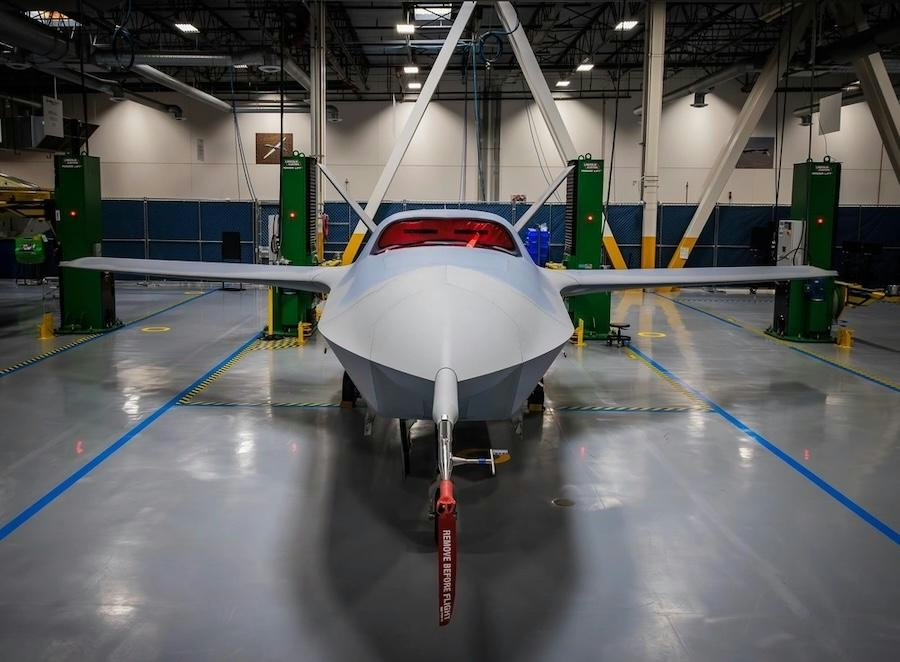
Collins Aerospace Advances Autonomy Software Testing on YFQ-42A for U.S. Air Force CCA Program
Collins Aerospace has successfully demonstrated its Sidekick mission autonomy software during a recent test flight of the YFQ-42A uncrewed jet, developed by General Atomics Aeronautical Systems, Inc., as part of the U.S. Air Force’s Collaborative Combat Aircraft (CCA) program. This milestone represents a significant step in integrating autonomous systems with crewed fighter jets to enhance operational capabilities.
Flight Test Demonstrates Enhanced Mission Capabilities
The test flight involved pairing the uncrewed YFQ-42A with manned fighter aircraft to extend sensor range, increase weapon effectiveness, and improve overall mission outcomes. Operating in autonomy mode for four hours, the YFQ-42A was remotely managed by a human operator, showcasing seamless integration between Collins Aerospace’s Sidekick software and the aircraft’s mission systems. This integration enabled precise piloting commands and underscored the adaptability of the software within complex combat environments.
Ryan Bunge, vice president and general manager for Strategic Defense Solutions at Collins Aerospace, emphasized the significance of the demonstration, stating, “The rapid integration of Sidekick onto this platform to perform various combat-relevant tasks highlights the strength and adaptability of Collins’ open systems approach.” He further noted that the autonomy capabilities reflect nearly a decade of dedicated investment and close collaboration with customers to advance collaborative mission autonomy.
Strategic Importance and Industry Implications
Sidekick is specifically designed for combat-related air operations, with an intuitive interface that adapts to individual pilot working styles and mission requirements. Collins Aerospace was selected by the U.S. Air Force to support development and testing for the CCA Increment 1 program, with this recent flight underscoring ongoing progress in the initiative.
Despite the successful demonstration, challenges remain in ensuring the software’s reliability and effectiveness in real-world combat scenarios. Equally important is the seamless integration of autonomy software with existing systems to avoid vendor lock-in and maintain operational flexibility. The Air Force’s adoption of an open systems architecture, including the Autonomy Government Reference Architecture (A-GRA), has been pivotal in enabling interoperability across diverse CCA platforms from multiple vendors.
Market response to the demonstration has been largely positive, with stakeholders welcoming the Air Force’s commitment to fostering a competitive and innovative ecosystem. Industry competitors such as Anduril and Shield AI have expressed support for the open approach, signaling their readiness to integrate their own autonomy solutions—such as those planned for the YFQ-44A—into the broader CCA framework.
The successful test of Sidekick, combined with the effective implementation of A-GRA, highlights the Air Force’s progress toward developing a more agile and adaptable force that leverages both human and autonomous capabilities for future air combat operations.

Etihad Airways Suspends Airbus A380 Flights on Key Route

Aditya Birla Group Seeks Approval for Aircraft Leasing in GIFT City

Qatar Airways Highlights Innovation and Connectivity at Arabian Travel Market 2026

Hong Kong's Five-Year Plan Includes Andrew Fan's Aircraft Parts Processing Hub Proposal

ACIA Aero Leasing Delivers ATR72-600 to Air Nostrum

RTX Appoints Jill Albertelli as Head of Pratt & Whitney

TAT Technologies Joins Beyond Aero Hydrogen Aircraft Program

AURAK Study Highlights Barriers to Air Taxi Adoption in Emerging Economies

Xiamen Air Selects Altitude for 787 Maintenance at Heathrow

Etihad and Swissport Extend Global Partnership
