
将人工智能洞察转化为可执行行动

热门趋势
Categories
Commission Unveils Industrial Strategy for Aviation Sector
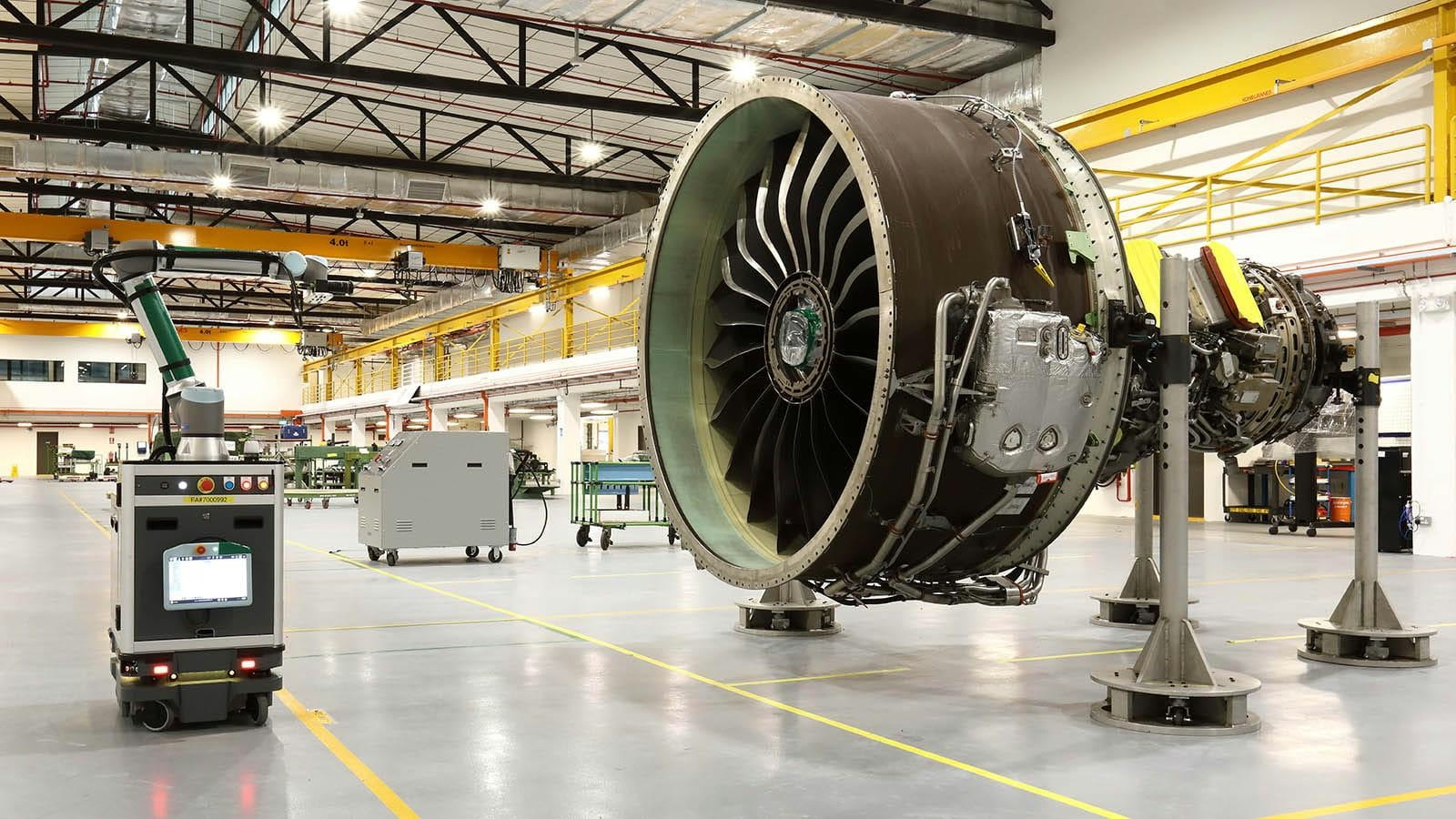
Commission Unveils Industrial Strategy for Aviation Sector
The European Commission has announced the development of a dedicated industrial strategy for the aviation sector, aimed at guiding future EU research and innovation funding. This initiative was confirmed by Filip Cornelis, director for aviation at the Commission’s transport directorate, following strong endorsement from Transport Commissioner Apostolos Tzitzikostas. Speaking at the annual conference of the Aerospace, Security and Defence Industries Association of Europe (ASD) on December 2, Tzitzikostas underscored the necessity for the EU to reassess its approach to the aeronautics and aviation industries. He emphasized that the new strategy must be crafted in close collaboration with industry stakeholders to ensure its effectiveness and relevance.
Strategic Focus and Funding Priorities
Central to the Commission’s strategy is the exploration of regulatory simplification and the future direction of its two primary Horizon Europe partnerships for aviation research: Clean Aviation and Sesar. It remains unclear whether these partnerships will continue independently or be merged. The Commission’s proposal for the post-2027 Horizon Europe programme highlights “smart and clean aviation” alongside “automated air traffic management” as flagship projects warranting comprehensive EU support, spanning from research and development through to deployment.
Industry leaders have stressed the importance of a clear and robust strategy to maintain Europe’s global leadership in aviation, a sector that currently represents approximately 40% of the world’s civil aeronautics market, according to ASD. Micael Johansson, ASD president and CEO of Saab, cautioned against complacency, referencing crises in other sectors such as automotive as warnings. The ASD’s own strategy, unveiled at the conference, calls for a significant increase in EU funding for civil aviation research within the next long-term budget. Specifically, the joint undertakings are seeking €5.3 billion for aircraft technologies and €700 million for air traffic management technologies in the upcoming Horizon Europe programme, compared to current allocations of €1.7 billion and €600 million, respectively.
The industry is also advocating for 20-25% of the Innovation Fund—financed by revenues from the EU Emissions Trading System—to be dedicated to civil aviation decarbonisation. They argue that current application processes and funding criteria do not sufficiently support innovative aviation technologies or the production of sustainable aviation fuels.
Challenges and Competitive Pressures
Despite these ambitions, the aviation sector faces significant challenges. Production costs, particularly for textile components used in aircraft manufacturing, are now 2.5 times higher in Europe than in Asia, placing considerable pressure on competitiveness. Concurrently, the industry must make substantial investments in ecological and digital transformation to meet the EU’s climate and innovation objectives. Market responses to these pressures have been mixed: Boeing’s stock has risen on the back of a positive cash flow outlook for 2026, while Airbus has been compelled to adjust delivery targets due to technical setbacks.
In light of intensifying global competition, especially from the United States and China, the EU is considering measures to reinforce its industrial base. These include encouraging the presence of multiple suppliers, prioritizing EU-based companies in public tenders for strategic sectors, and strengthening defenses against economic threats such as China’s export restrictions. The Commission also intends to support dual-use innovations that serve both civil and military applications, thereby enhancing Europe’s position in global manufacturing and security.
As the European Union advances its new industrial strategy for aviation, balancing competitiveness, innovation, and sustainability will be essential to securing the continent’s leadership in the sector for the coming decade and beyond.

Etihad Airways Suspends Airbus A380 Flights on Key Route

Aditya Birla Group Seeks Approval for Aircraft Leasing in GIFT City

Qatar Airways Highlights Innovation and Connectivity at Arabian Travel Market 2026

Hong Kong's Five-Year Plan Includes Andrew Fan's Aircraft Parts Processing Hub Proposal

ACIA Aero Leasing Delivers ATR72-600 to Air Nostrum

RTX Appoints Jill Albertelli as Head of Pratt & Whitney

TAT Technologies Joins Beyond Aero Hydrogen Aircraft Program

AURAK Study Highlights Barriers to Air Taxi Adoption in Emerging Economies

Xiamen Air Selects Altitude for 787 Maintenance at Heathrow

Etihad and Swissport Extend Global Partnership
