
将人工智能洞察转化为可执行行动

热门趋势
Categories
Ethiopian Airlines in Talks with Airbus for Widebody and Regional Jets
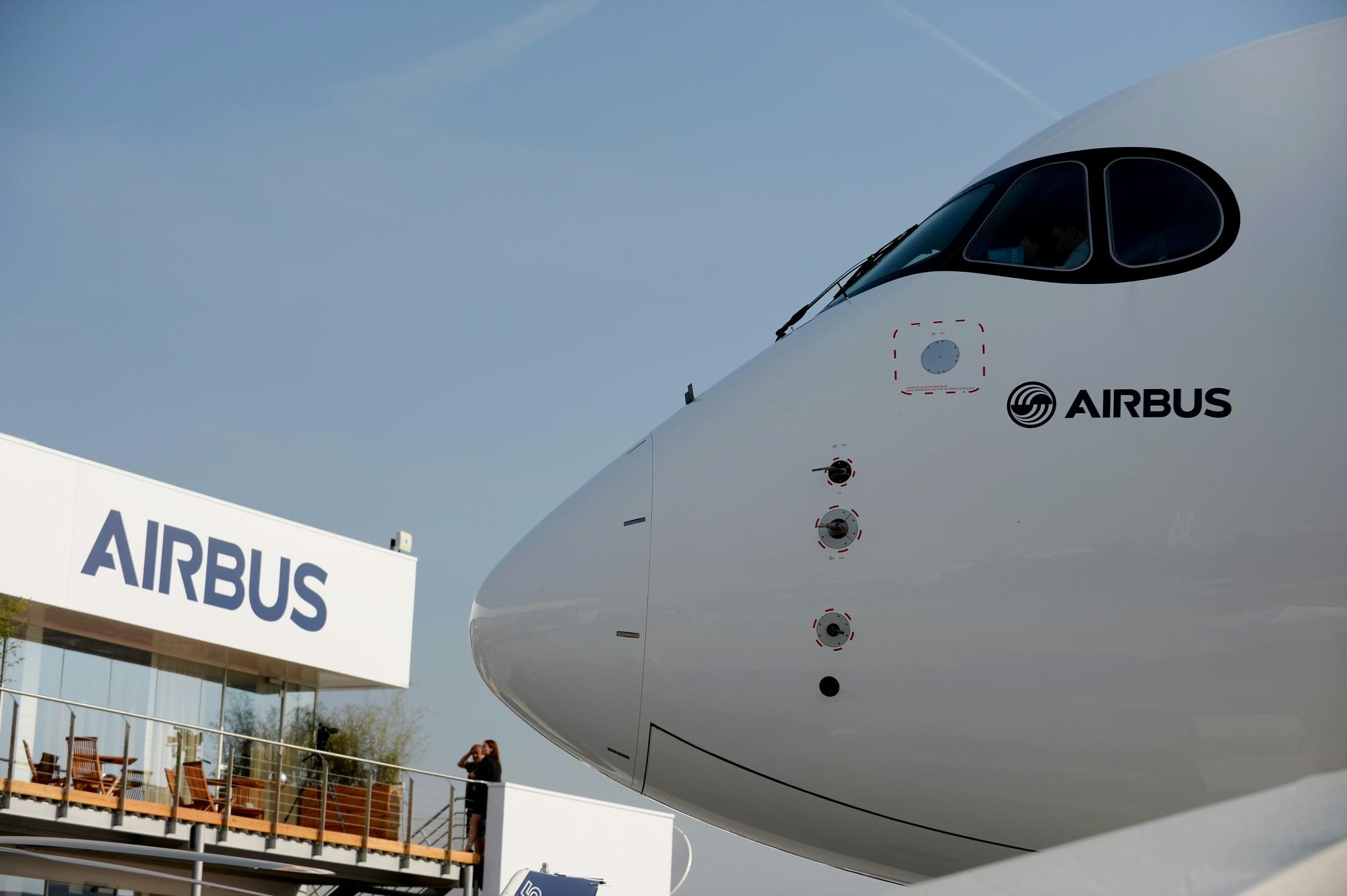
Ethiopian Airlines Engages Airbus in Preliminary Talks for Fleet Expansion
Ethiopian Airlines Group, Africa’s largest carrier, has initiated early discussions with Airbus SE regarding the potential acquisition of both widebody and regional jets. The state-owned airline is reportedly considering an order comprising approximately six Airbus A350 widebody aircraft alongside around 20 A220 regional jets. These talks remain in their infancy, with no assurances yet on the finalization of any agreement or the precise scale of the order.
The airline has not issued an official statement on the matter, while Airbus confirmed it maintains ongoing communications with current and prospective clients but declined to provide details due to confidentiality constraints.
Strategic Fleet Diversification Amid Intensifying Competition
This development occurs against a backdrop of increasing competition within the African aviation sector. Turkish Airlines, a significant regional competitor with expansion ambitions, is also engaged in negotiations with both Embraer and Airbus for regional jets. Concurrently, Ethiopian Airlines recently exercised options to acquire six additional Boeing 787-9 Dreamliners, aligning with its Vision 2035 strategy aimed at broadening its fleet and route network.
Currently, Ethiopian Airlines operates a fleet of approximately 150 aircraft, including 90 Boeing models—comprising 737s, 777s, and 787s—26 Airbus A350s, and around 50 turboprops. The carrier also holds orders for more than 60 Boeing jets. A potential agreement with Airbus would mark a significant diversification of Ethiopian’s predominantly Boeing fleet and could enhance Airbus’s presence in the African market.
Industry Challenges and Emerging Opportunities
The global aviation industry continues to face considerable challenges, including disruptions stemming from the ongoing conflict in Iran, airspace restrictions, and escalating jet fuel costs. Nevertheless, evolving global air traffic patterns, particularly the shift away from Persian Gulf hubs, may create new opportunities for African carriers such as Ethiopian Airlines to attract increased international passenger traffic.
Airbus has been actively promoting its A220 program, especially following the loss of some orders earlier in 2024. Notably, AirAsia recently placed the largest single order for the A220, acquiring 150 aircraft. Airbus also disclosed a recent order for 15 A350-900s from an undisclosed customer, signaling sustained demand for its widebody and narrowbody models.
Elsewhere, other airlines are pursuing fleet modernization initiatives. Shohin Airlines plans to acquire Airbus A320neo-family aircraft, while LATAM Airlines Group is preparing to introduce lie-flat premium seating on its incoming A321XLRs, reflecting broader industry trends toward enhanced passenger experience and operational efficiency.
Ambitious Growth Plans for the Future
Marking its 80th year, Ethiopian Airlines is advancing ambitious expansion plans, including the development of a multi-billion-dollar airport facility designed to accommodate 60 million passengers annually, with capacity projected to increase to 110 million by 2036. As the airline positions itself to compete with global giants such as Turkish Airlines and Emirates, its ongoing fleet negotiations with both Boeing and Airbus will remain a focal point for industry observers.

Etihad Airways Suspends Airbus A380 Flights on Key Route

Aditya Birla Group Seeks Approval for Aircraft Leasing in GIFT City

Qatar Airways Highlights Innovation and Connectivity at Arabian Travel Market 2026

Hong Kong's Five-Year Plan Includes Andrew Fan's Aircraft Parts Processing Hub Proposal

ACIA Aero Leasing Delivers ATR72-600 to Air Nostrum

RTX Appoints Jill Albertelli as Head of Pratt & Whitney

TAT Technologies Joins Beyond Aero Hydrogen Aircraft Program

AURAK Study Highlights Barriers to Air Taxi Adoption in Emerging Economies

Xiamen Air Selects Altitude for 787 Maintenance at Heathrow

Etihad and Swissport Extend Global Partnership
