
将人工智能洞察转化为可执行行动

热门趋势
Categories
Fuel Switches in ‘Run’ Position Found in Aftermath of AI 171 Crash
Fuel Switches in ‘Run’ Position Found in Aftermath of AI 171 Crash
Crash Site Analysis and Aircraft Impact
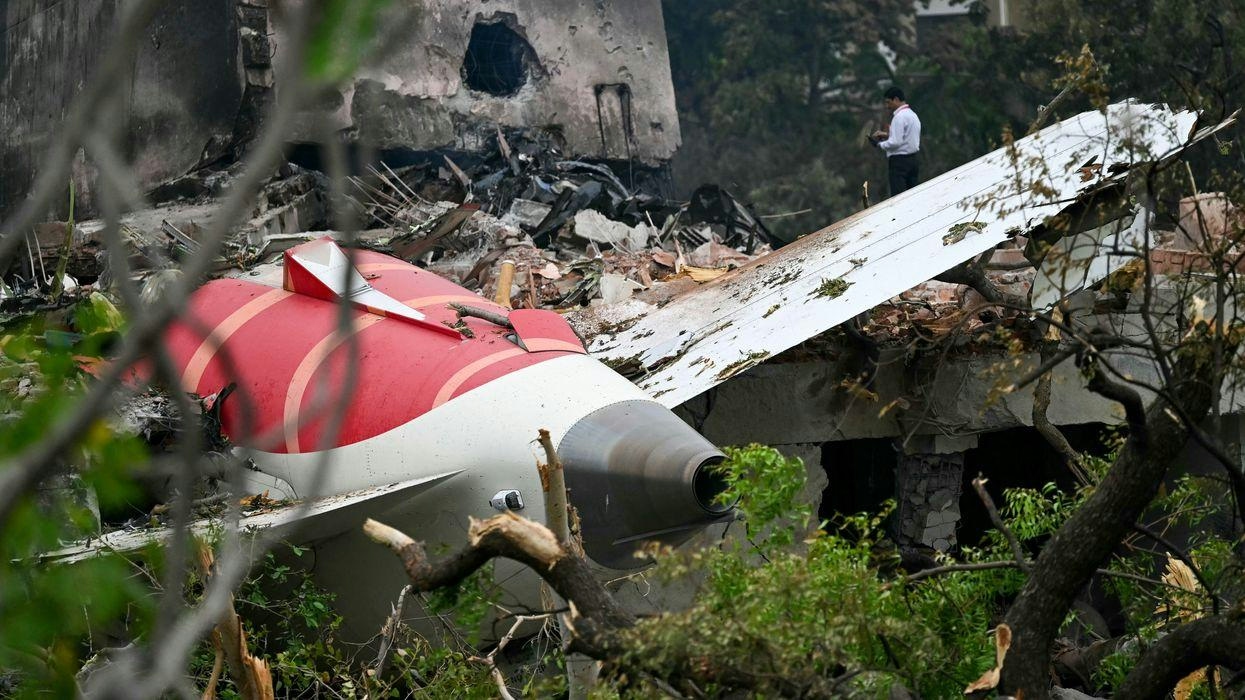
Images from the crash site of Air India Flight 171 have provided critical insights into the sequence of events leading to the accident. The aircraft, a Boeing 787 Dreamliner, descended rapidly after takeoff, initially striking a cluster of trees and an incineration chimney within the Army Medical Corps compound. This collision highlights the dangerously low altitude at which the aircraft was operating in its final moments. According to the preliminary report by the Aircraft Accident Investigation Bureau (AAIB), the distance from the first contact with the trees to the point where the aircraft impacted the northeast wall of Building A was a mere 293 feet, underscoring the minimal altitude and brief time frame before the crash.
Further examination of the wreckage revealed that parts of the right wing were scattered across Buildings A and B and the surrounding area. The right engine detached after skimming the roof of Building A and striking a concrete water tank structure, ultimately coming to rest beneath the tank near the building’s southwest wall, oriented at approximately 226 degrees. The widespread dispersal of debris from the right wing indicates the significant force of the collision. Meanwhile, the left engine separated from the aircraft and struck the north corner of Building D at ground level, coming to rest roughly perpendicular to the right engine with a heading of about 326 degrees.
Cockpit Controls and Flight Recorder Data
Investigators documented the condition of key cockpit controls amid the wreckage. The flap handle assembly, though heavily damaged by fire, was found locked in the 5-degree position, consistent with a normal takeoff configuration. The landing gear lever remained in the “DOWN” position, suggesting that the landing gear had not been retracted at the time of the emergency. The nose landing gear was located approximately 307 feet southwest of the initial impact with Building A. These physical findings were corroborated by data retrieved from the Enhanced Airborne Flight Recorder (EAFR).
A particularly significant detail emerging from the preliminary investigation concerns the position of the fuel control switches. Evidence indicates that the switches were moved to the "cutoff" position moments before the crash, resulting in a sudden loss of engine thrust. This technical action has become a central focus of the investigation, as it may have directly contributed to the loss of control and subsequent impact.
Additional Findings and Industry Implications
Airport CCTV footage captured the deployment of the Ram Air Turbine (RAT) seconds after lift-off, with no evidence of bird activity in the vicinity, effectively ruling out bird strike as a contributing factor.
The incident carries substantial implications for Air India, raising serious questions about the airline’s safety protocols and operational reliability. Industry observers suggest that the crash could lead to increased scrutiny of Air India’s management practices and safety standards. Competitors may respond by emphasizing their own safety records and conducting additional audits, while the broader Indian aviation sector is expected to face heightened regulatory oversight and a comprehensive review of safety procedures.

Etihad Airways Suspends Airbus A380 Flights on Key Route

Aditya Birla Group Seeks Approval for Aircraft Leasing in GIFT City

Qatar Airways Highlights Innovation and Connectivity at Arabian Travel Market 2026

Hong Kong's Five-Year Plan Includes Andrew Fan's Aircraft Parts Processing Hub Proposal

ACIA Aero Leasing Delivers ATR72-600 to Air Nostrum

RTX Appoints Jill Albertelli as Head of Pratt & Whitney

TAT Technologies Joins Beyond Aero Hydrogen Aircraft Program

AURAK Study Highlights Barriers to Air Taxi Adoption in Emerging Economies

Xiamen Air Selects Altitude for 787 Maintenance at Heathrow

Etihad and Swissport Extend Global Partnership
