
将人工智能洞察转化为可执行行动

热门趋势
Categories
Hypersonic blast converts diamond to graphite, could aid defense armor
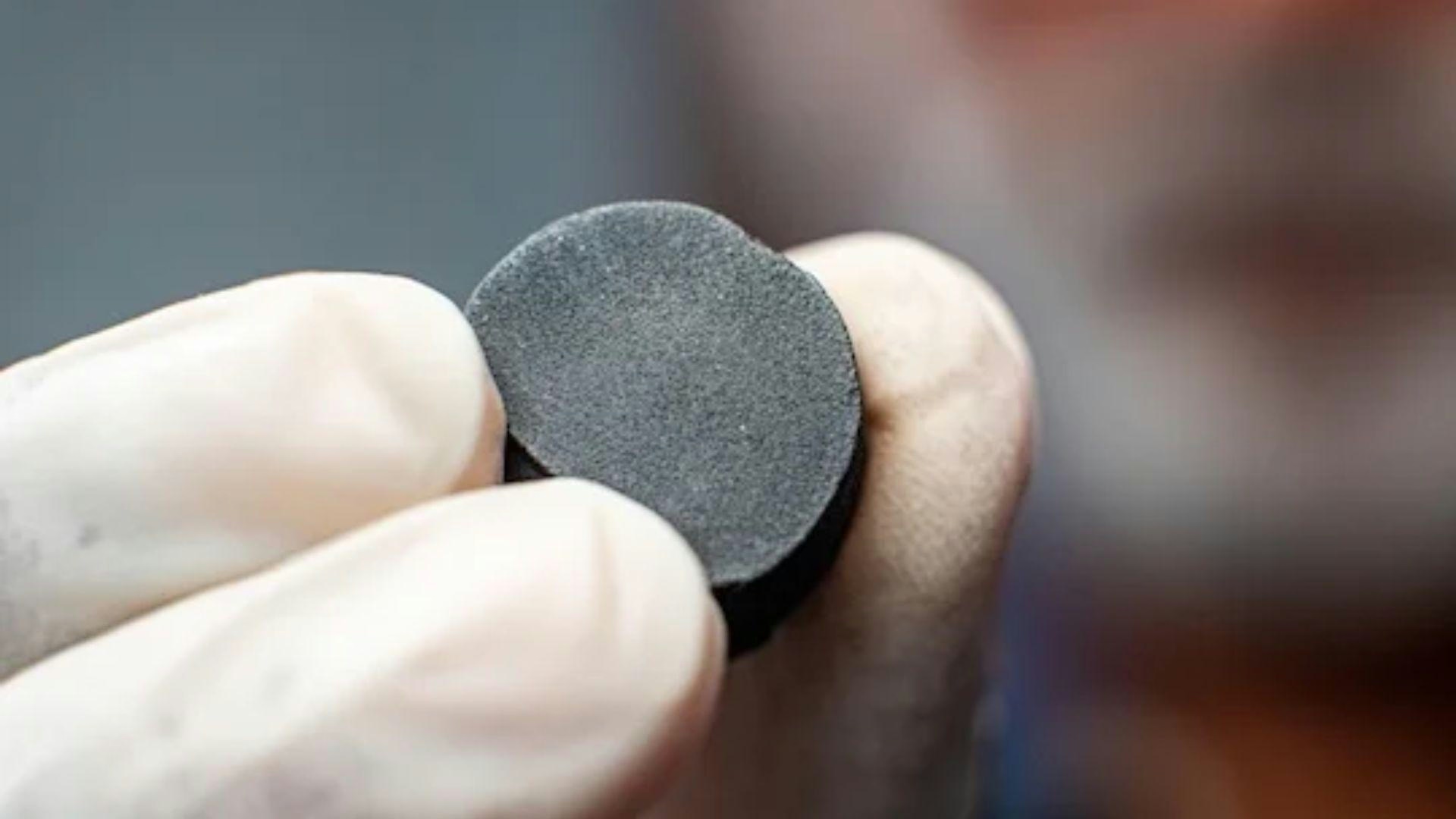
Hypersonic Blast Converts Diamond to Graphite, Paving Way for Advanced Defense Armor
A pioneering manufacturing technique developed at Rice University promises to transform the future of defense armor by stabilizing diamond during thermal processing at relatively low pressures. This advancement results in a dense and resilient composite material, overcoming longstanding barriers in the production of diamond-based components. The findings, published in Materials Today, demonstrate how combining specific powder materials can unlock new possibilities for high-performance materials in extreme environments.
Innovative Material Synthesis
The research addresses a critical challenge in material science: while small diamond particles are inexpensive and readily produced, forming them into large, solid shapes has proven difficult. Conventional sintering methods, which rely on heat and pressure to fuse particles, often cause diamond to degrade into soft graphite unless subjected to extremely high pressures. This limitation restricts the scalability and practical application of diamond composites.
To overcome this, the Rice University team engineered a multi-material blend by mixing fine diamond particles with cubic boron nitride, selected for its comparable physical properties, and incorporating cobalt as a binder to stabilize the mixture. Employing spark plasma sintering—a rapid process that simultaneously applies heat and pressure—they fused the powders into a dense, tough composite. The resulting material features diamond grains embedded within a continuous cubic boron nitride matrix, with cobalt distributed throughout. This structure renders the composite nearly impossible to machine, making it highly suitable for demanding aerospace and defense applications.
Testing Under Extreme Conditions
The mechanical resilience of the composite was evaluated through high-velocity collision experiments. Researchers subjected the material to impacts from tiny metal projectiles traveling at speeds exceeding seven times the speed of sound. The composite maintained its structural integrity under these hypersonic impacts. However, when exposed to larger projectiles at even higher velocities, the material fractured. Detailed analysis of the fracture surfaces, supported by molecular dynamics simulations, revealed that the extreme impact induced a rapid phase transformation of diamond into graphite—a process occurring within microseconds, in stark contrast to the slower, heat-driven conversion typically observed.
Abhijit Biswas, the study’s first author, explained, “Extreme impact can drive diamond to graphite within microseconds, rather than through the slower heat-driven process we normally associate with this transformation.” This discovery provides new insight into diamond’s behavior under the most severe mechanical stresses.
Implications for Defense and Industry
The ability to manufacture tough, diamond-based composites without resorting to extreme pressures could enable large-scale production of advanced armor and aerospace components. Nonetheless, the hypersonic blast-induced conversion of diamond to graphite also introduces challenges that must be addressed to ensure the process is both efficient and cost-effective.
The defense sector is already responding to these developments, with growing market interest in low-cost hypersonic weapons. Castelion’s recent $1 billion funding round to scale production exemplifies this trend, while competitors, such as South Korea, are investing in AI-driven defense technologies. Beyond defense, the broader market may also pivot toward alternative materials for battery manufacturing, capitalizing on the potential to convert waste carbon into graphite.
As research progresses, the intersection of material science and defense innovation is poised to accelerate, with the diamond-to-graphite phase change at hypersonic speeds presenting both promising opportunities and significant challenges for the industry.

Etihad Airways Suspends Airbus A380 Flights on Key Route

Aditya Birla Group Seeks Approval for Aircraft Leasing in GIFT City

Qatar Airways Highlights Innovation and Connectivity at Arabian Travel Market 2026

Hong Kong's Five-Year Plan Includes Andrew Fan's Aircraft Parts Processing Hub Proposal

ACIA Aero Leasing Delivers ATR72-600 to Air Nostrum

RTX Appoints Jill Albertelli as Head of Pratt & Whitney

TAT Technologies Joins Beyond Aero Hydrogen Aircraft Program

AURAK Study Highlights Barriers to Air Taxi Adoption in Emerging Economies

Xiamen Air Selects Altitude for 787 Maintenance at Heathrow

Etihad and Swissport Extend Global Partnership
