
将人工智能洞察转化为可执行行动

热门趋势
Categories
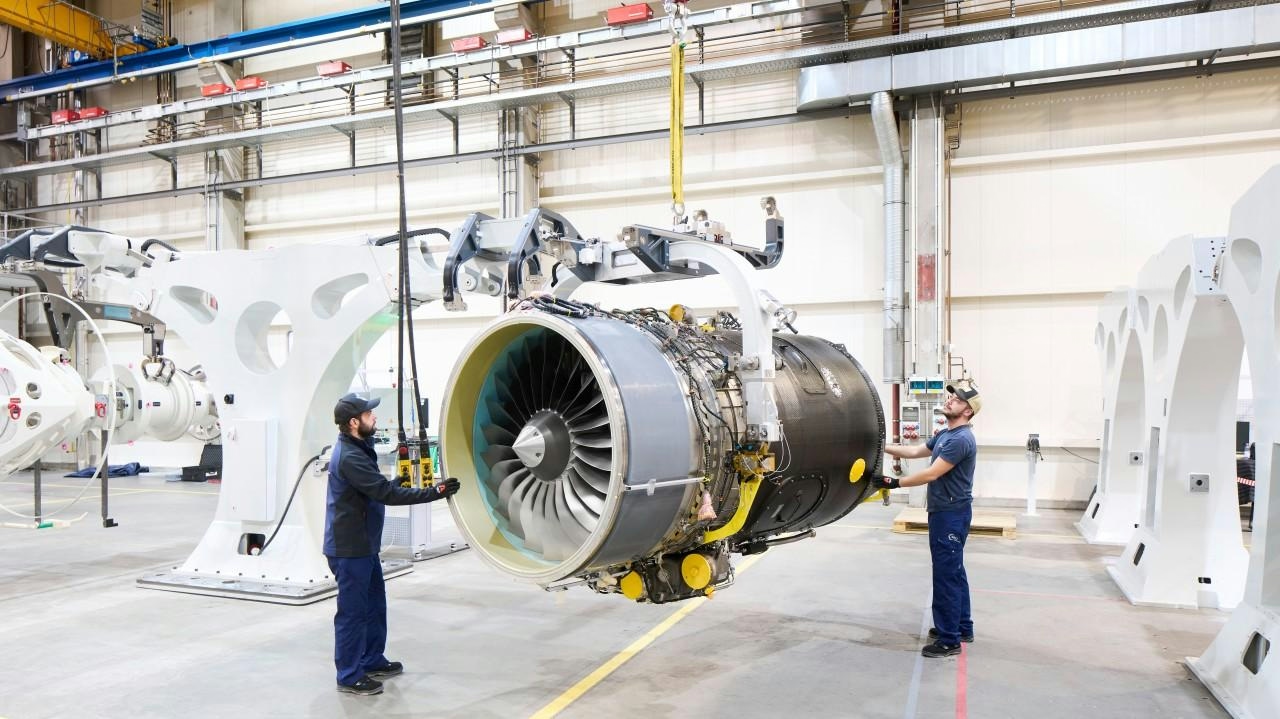
Inside the Engine Room: Lessons and Innovation in the Trent 1000 Reset
Inside the Engine Room: Lessons and Innovation in the Trent 1000 Reset
At the CAPA Airline Leader Summit – World in December 2025, senior figures from the aviation sector convened to confront one of the industry’s most pressing challenges: developing propulsion systems that are increasingly powerful, efficient, and sustainable, without sacrificing durability, reliability, or public confidence. In a keynote interview, Luke Mallows, Senior Vice President Marketing & Lessors at Rolls-Royce, provided an insightful overview of the evolution of modern widebody engines, with particular focus on the Trent 1000 programme—a narrative defined by both significant technical obstacles and groundbreaking innovation.
Engineering Challenges and Collaborative Solutions
Mallows detailed how the Trent 1000’s development reflects the extraordinary engineering demands of contemporary aircraft engines, which operate in increasingly harsh environments. Early durability issues compelled Rolls-Royce to fundamentally reassess its design methodologies, materials science applications, and testing protocols. These challenges also fostered closer collaboration with airline customers and prompted a more integrated approach to supply chain management. The incorporation of real-world operational feedback emerged as a critical driver for ongoing improvements, underscoring the necessity of aligning engineering efforts with practical service conditions.
A central theme of the discussion was how these experiences have informed Rolls-Royce’s current and future engineering philosophy. The company’s recent introduction of phase two high-pressure turbine blade enhancements, now approved by regulators, is projected to more than double engine durability. This achievement has been positively received by the market, restoring confidence in the Trent 1000’s long-term performance. Nevertheless, Mallows acknowledged that securing regulatory approvals remains a complex and demanding process, particularly as Rolls-Royce pursues further upgrades and technological advancements.
Market Dynamics and Future Outlook
The competitive landscape for widebody engines is intensifying, with GE Aerospace’s GEnx-1B engine representing a significant rival. While Rolls-Royce advances its Trent 1000 improvements, GE continues to innovate aggressively to protect its market position and meet evolving customer expectations for efficiency and reliability. The interplay between these two industry leaders is accelerating the pace and shaping the trajectory of propulsion technology development.
Looking forward, the summit discussion expanded to consider how Rolls-Royce is preparing for a future shaped by sustainability imperatives, digital transformation, and increasingly complex propulsion architectures. The conversation extended beyond technical remedies to explore evolving leadership models, corporate culture, and innovation frameworks designed to meet the sector’s escalating demands. Mallows emphasized that the Trent 1000 reset represents more than a programme recovery; it signifies a fundamental redefinition of how propulsion systems are conceived, tested, supported, and continuously enhanced.
This candid insight into Rolls-Royce’s recalibrated approach highlights a broader transformation underway in aviation propulsion. As the industry grapples with mounting regulatory, competitive, and environmental pressures, the lessons learned from the Trent 1000 programme are influencing not only the company’s trajectory but also the future of flight itself.

Etihad Airways Suspends Airbus A380 Flights on Key Route

Aditya Birla Group Seeks Approval for Aircraft Leasing in GIFT City

Qatar Airways Highlights Innovation and Connectivity at Arabian Travel Market 2026

Hong Kong's Five-Year Plan Includes Andrew Fan's Aircraft Parts Processing Hub Proposal

ACIA Aero Leasing Delivers ATR72-600 to Air Nostrum

RTX Appoints Jill Albertelli as Head of Pratt & Whitney

TAT Technologies Joins Beyond Aero Hydrogen Aircraft Program

AURAK Study Highlights Barriers to Air Taxi Adoption in Emerging Economies

Xiamen Air Selects Altitude for 787 Maintenance at Heathrow

Etihad and Swissport Extend Global Partnership
