
将人工智能洞察转化为可执行行动

热门趋势
Categories
M1 Awarded $10 Billion U.S. Army Flight Training Contract
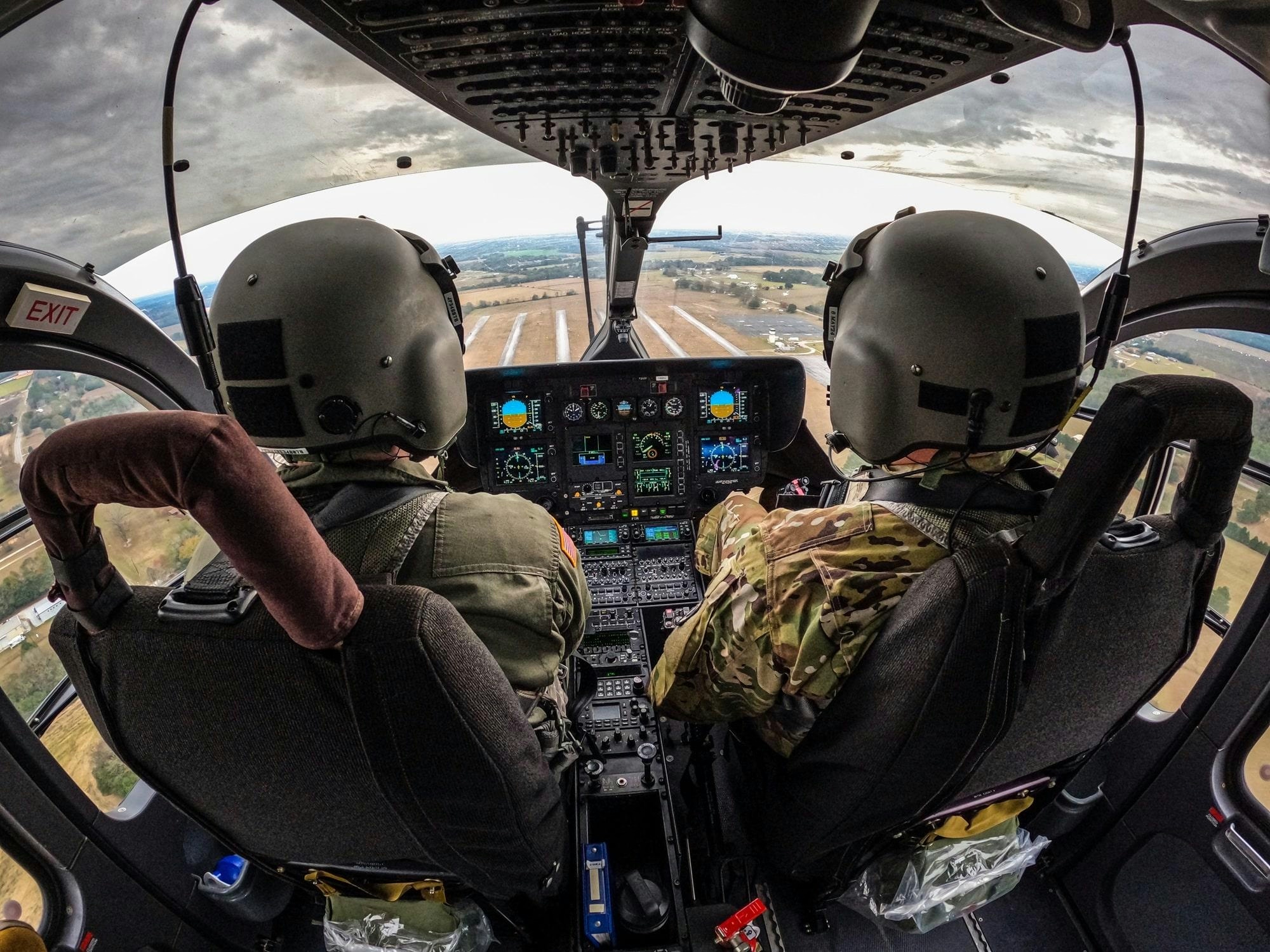
M1 Awarded $10 Billion U.S. Army Flight Training Contract
M1 Support Services (M1) has secured a significant single-award indefinite-delivery, indefinite-quantity (IDIQ) contract valued at up to $10 billion to provide Initial Entry Rotary Wing (IERW) training for the U.S. Army under the Flight School Next (FSN) program. This 26-year agreement represents a pivotal element in the Army’s efforts to modernize rotary-wing pilot training, with the dual objectives of enhancing pilot proficiency and reducing long-term operational costs.
Modernizing Army Flight Training
Under the terms of the contract, M1 will deliver a contractor-owned, contractor-operated (COCO) turnkey solution through its Flight School First platform. This innovative system incorporates an AI-enabled adaptive learning environment, advanced simulation technologies, immersive virtual training, and proficiency-based instruction, all centered around the use of Robinson R66 helicopters. To support this comprehensive approach, M1 has formed a consortium of partners that includes Robinson Helicopter Company, Quantum Helicopters, General Dynamics Information Technology, and the University of North Dakota Aerospace Foundation. This collaboration draws on a wide range of expertise spanning flight training, simulation, aircraft manufacturing, civil aviation, and academic research.
Challenges and Industry Impact
Despite the contract’s promise, M1 faces considerable challenges in integrating advanced AI-driven adaptive learning technologies and ensuring the operational reliability of the Robinson R66 helicopters. The complexity of combining cutting-edge simulation with real-world flight training environments will test both technological capabilities and operational processes. Success will depend on M1’s ability to seamlessly merge these elements while maintaining rigorous training standards.
The award has also generated notable market interest, with investors responding positively to the scale and duration of the contract. For industry competitors, the decision marks a setback, particularly for Bell, a key rival in military flight training. Bell is expected to respond by enhancing its product offerings and pursuing future contracts with increased vigor. Observers anticipate that this development will spur intensified innovation, more competitive pricing, and accelerated advancement of training technologies across the sector.
The Army’s selection of M1 highlights a broader strategic shift toward harnessing private sector innovation and technology to modernize military training programs. The long-term success of the Flight School Next initiative will hinge on M1’s capacity to fulfill its commitments and adapt to evolving training demands and technological progress.

Etihad Airways Suspends Airbus A380 Flights on Key Route

Aditya Birla Group Seeks Approval for Aircraft Leasing in GIFT City

Qatar Airways Highlights Innovation and Connectivity at Arabian Travel Market 2026

Hong Kong's Five-Year Plan Includes Andrew Fan's Aircraft Parts Processing Hub Proposal

ACIA Aero Leasing Delivers ATR72-600 to Air Nostrum

RTX Appoints Jill Albertelli as Head of Pratt & Whitney

TAT Technologies Joins Beyond Aero Hydrogen Aircraft Program

AURAK Study Highlights Barriers to Air Taxi Adoption in Emerging Economies

Xiamen Air Selects Altitude for 787 Maintenance at Heathrow

Etihad and Swissport Extend Global Partnership
