
将人工智能洞察转化为可执行行动

热门趋势
Categories
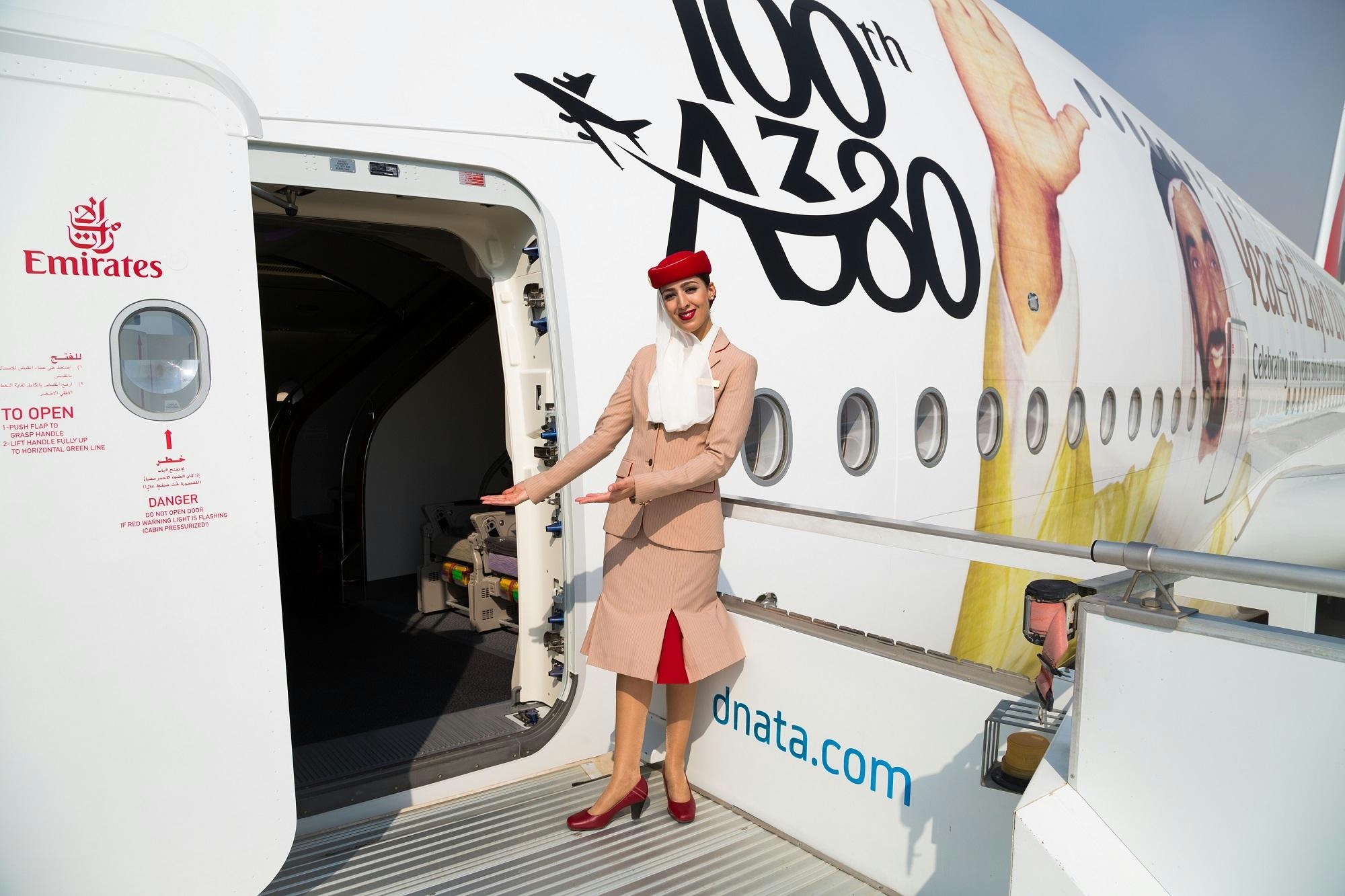
The Resurgence of the Airbus A380
The Resurgence of the Airbus A380
The unexpected revival of the Airbus A380 represents one of the most remarkable developments in contemporary aviation. Once regarded as an oversized and inefficient aircraft, leading to its early retirement by several major airlines, the superjumbo has now reemerged as a vital asset for long-haul travel. This turnaround, unforeseen by many industry experts just a few years ago, is driven by a combination of mechanical, economic, and operational factors, alongside shifting industry dynamics and emerging market pressures.
Capacity Constraints and Market Demand
At the heart of the A380’s resurgence lies the persistent demand for increased passenger capacity at the world’s busiest airports. As global air traffic has rebounded and surpassed pre-pandemic levels, major international hubs have reached their slot capacity limits, preventing airlines from adding more flights. In these slot-constrained environments, maximizing the number of passengers per departure has become essential—a challenge the A380 is uniquely positioned to address. With a standard four-class configuration accommodating over 500 passengers, the aircraft enables airlines to transport nearly twice as many travelers per takeoff compared to typical long-haul jets, without requiring additional gate space or flight slots.
Although the A380’s four-engine design results in higher fuel consumption, this disadvantage is increasingly offset by the imperative to retain high-yield passengers. The aircraft’s substantial size allows airlines to safeguard market share in key cities where airport expansion has stalled. Furthermore, ongoing delays in Boeing’s 777X program have created a void in the widebody market. Airlines that had intended to replace aging quadjets with the new 777-9 have been compelled to reconsider their fleet strategies, prompting the reactivation of stored A380s.
Engineering Challenges and Operational Realities
Reactivating an A380 from storage is a complex engineering undertaking. Many of these aircraft were parked in arid locations such as Teruel, Spain, and Victorville, California, to minimize corrosion during the downturn caused by the COVID-19 pandemic. Restoring them to operational status demands months of meticulous work to refurbish intricate hydraulic systems, wiring, and avionics—far exceeding the scope of routine maintenance.
Emerging Challenges and Market Dynamics
Despite its renewed prominence, the A380 faces significant headwinds. Airbus reported a year-over-year decline in first-quarter deliveries for 2026, raising concerns about the future demand for large aircraft and airlines’ willingness to invest in such models. Geopolitical tensions, particularly between the United States and China, are disrupting Boeing’s delivery schedules and order books in the Asia-Pacific region, potentially altering the competitive landscape and influencing global fleet decisions.
The economic environment is also evolving rapidly. The 2026 jet fuel crisis, characterized by a doubling of fuel prices, is exerting considerable pressure on airline operating costs. This surge threatens the economic viability of large, four-engine aircraft like the A380, compelling airlines to balance capacity requirements against profitability.
Complicating the market further, new entrants and strategic partnerships—such as the Adani-Embraer alliance—are set to reshape regional air travel and introduce fresh competition. These developments may influence airline strategies and the role of the A380 within global fleets.
Outlook
The Airbus A380’s return underscores the enduring value of scale in an era marked by constrained infrastructure and soaring demand. Nevertheless, its future remains uncertain amid evolving market forces, rising operational costs, and intensifying competition. For the time being, the superjumbo’s capacity to transport large numbers of passengers through the world’s busiest hubs secures its continued relevance as the aviation industry prepares for its next phase of transformation.

Etihad Airways Suspends Airbus A380 Flights on Key Route

Aditya Birla Group Seeks Approval for Aircraft Leasing in GIFT City

Qatar Airways Highlights Innovation and Connectivity at Arabian Travel Market 2026

Hong Kong's Five-Year Plan Includes Andrew Fan's Aircraft Parts Processing Hub Proposal

ACIA Aero Leasing Delivers ATR72-600 to Air Nostrum

RTX Appoints Jill Albertelli as Head of Pratt & Whitney

TAT Technologies Joins Beyond Aero Hydrogen Aircraft Program

AURAK Study Highlights Barriers to Air Taxi Adoption in Emerging Economies

Xiamen Air Selects Altitude for 787 Maintenance at Heathrow

Etihad and Swissport Extend Global Partnership
