
将人工智能洞察转化为可执行行动

热门趋势
Categories
The Technology Behind Air Force One’s Engines and Presidential Security
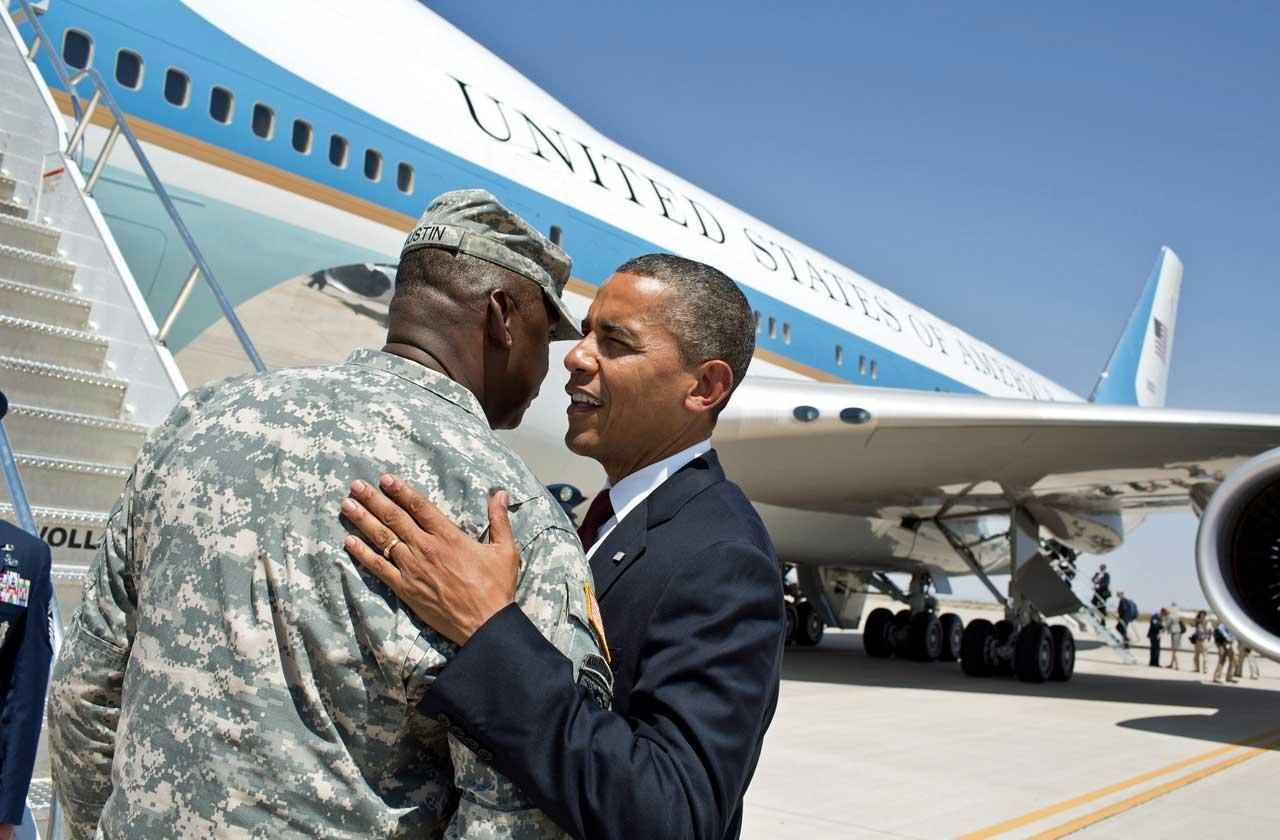
The Technology Behind Air Force One’s Engines and Presidential Security
Air Force One, officially designated the VC-25, operates at altitudes and speeds slightly beyond those of typical commercial jets. While its exterior closely mirrors that of a civilian Boeing 747, the aircraft’s interior is a fortified command center designed to maintain presidential safety and operational capability under any circumstance. Although much attention is given to its advanced communications and defensive systems, the engines powering Air Force One are equally critical, representing decades of technological refinement and security-driven innovation.
The CF6 Engine: Commercial Reliability Meets Military Demands
The VC-25A is equipped with four General Electric CF6-80C2B1 turbofan engines, each generating 56,700 pounds of thrust. These engines enable the aircraft to reach speeds up to 630 miles per hour (Mach 0.92) and altitudes of 45,100 feet, performance metrics comparable to those of modern long-haul airliners despite the aircraft’s age. The CF6 family is a cornerstone of commercial aviation, powering a range of aircraft including the Boeing 747, 767, Airbus A300, and A310. With over 50 million collective flight hours, the CF6 is among the most extensively tested engines in aviation history.
The U.S. Air Force’s choice of the CF6 was driven not by commercial priorities such as fuel efficiency or cost reduction, but by the engine’s proven reliability and capacity to operate flawlessly under extreme conditions. These engines form part of a comprehensive suite of hardened systems designed to ensure the aircraft’s survivability and continuous operation, even in the most hostile environments.
Enhancements for Security and Operational Resilience
Although visually similar to those on a standard Boeing 747-200, Air Force One’s engines have undergone extensive modifications for military application. These include integration with advanced avionics and secure communications systems, enabling the aircraft to function as a mobile command center capable of maintaining presidential command authority even during catastrophic events.
A significant design challenge has been ensuring the engines’ resilience to intense electromagnetic radiation, such as that produced by nuclear detonations or sophisticated electronic warfare. To meet this challenge, the aircraft’s systems—including its engines—are shielded and reinforced, allowing Air Force One to continue operating in conditions that would incapacitate conventional aircraft.
Industry Influence and Strategic Implications
The specialized nature of Air Force One’s engines has had a notable impact on both military and commercial aviation markets. According to Air & Space Forces Magazine, these engines deliver enhanced performance and efficiency compared to earlier models, setting new benchmarks for reliability. The demand for such robust propulsion technology has also intensified competition within the aerospace sector. Recent legal disputes, such as those between Joby Aviation and Archer Aviation over trade secrets and technology sourcing, highlight the strategic importance and global interest in advanced propulsion systems and their security ramifications.
A Legacy of Adaptation and Security
From Cold War contingencies to the complexities of today’s global security environment, the evolution of Air Force One’s engines illustrates how commercial aviation technology can be adapted, hardened, and enhanced to meet the unique demands of presidential transport. This ongoing development underscores a singular priority: safeguarding the President’s safety and command capability regardless of the threat.

Etihad Airways Suspends Airbus A380 Flights on Key Route

Aditya Birla Group Seeks Approval for Aircraft Leasing in GIFT City

Qatar Airways Highlights Innovation and Connectivity at Arabian Travel Market 2026

Hong Kong's Five-Year Plan Includes Andrew Fan's Aircraft Parts Processing Hub Proposal

ACIA Aero Leasing Delivers ATR72-600 to Air Nostrum

RTX Appoints Jill Albertelli as Head of Pratt & Whitney

TAT Technologies Joins Beyond Aero Hydrogen Aircraft Program

AURAK Study Highlights Barriers to Air Taxi Adoption in Emerging Economies

Xiamen Air Selects Altitude for 787 Maintenance at Heathrow

Etihad and Swissport Extend Global Partnership
