صورة

أيروجيني — مساعدك الذكي للطيران.

اسأل عن أي شيء. قم بتحليل كل شيء. تصرف فورًا.

الرائج الآن

Categories

Aviation Startup Merlin Labs Valued at $800 Million in Public Listing Deal
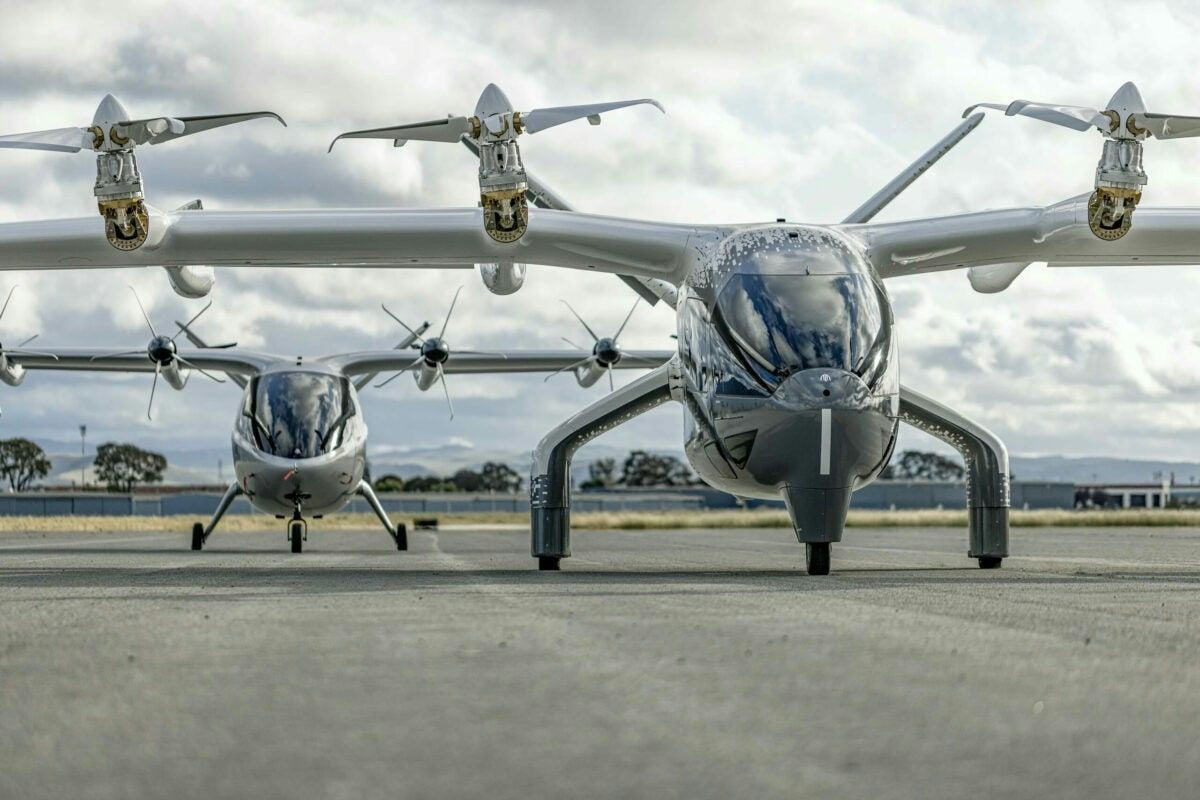
August 14, 2025By ePlane AI
Aviation Startup Merlin Labs Valued at $800 Million in Public Listing Deal
0
0
Merlin Labs
Autonomous Flight Technology
SPAC Merger

Aviation Startup Merlin Labs Valued at $800 Million in Public Listing Deal

Merlin Labs, an autonomous aviation startup based in Boston, is preparing to enter the public markets through a merger agreement with a special purpose acquisition company (SPAC) managed by New York-based Inflection Point. The transaction, expected to close early next year, values Merlin Labs at $800 million, preceding a planned private share purchase.

Expansion and Strategic Growth Plans

Under the leadership of CEO Matt George, Merlin Labs is developing technology designed to enable commercial and military aircraft to operate with a single pilot, with the ultimate goal of achieving fully autonomous flight. The capital raised from the public listing will be directed towards expanding the company’s workforce, currently numbering 170 employees, and supporting potential acquisitions. Additionally, Merlin is close to finalizing a lease agreement for a substantial portion of a former Navy hangar at Hanscom Field in Bedford, Massachusetts. This facility, previously occupied by defense contractor Raytheon (now RTX), could accommodate up to 200 employees, marking a significant step in Merlin’s operational growth.

Market Context and Industry Challenges

Merlin’s ambitious expansion occurs amid a volatile market environment and increasing competition within the aviation technology sector. Other startups are also securing substantial investments, exemplified by Firestorm Labs’ recent $47 million Series A funding and Hadrian’s $260 million Series C round. These developments underscore a broader competitive landscape as aviation innovators vie for capital and strategic partnerships.

Regulatory scrutiny presents an additional challenge, with authorities closely monitoring the advancement and implementation of autonomous flight technologies. Investor confidence in the sector’s growth potential will be critical in shaping the market’s response to Merlin’s public debut.

Despite these uncertainties, CEO Matt George remains confident that the influx of capital and expanded operations will establish Merlin Labs as a leading force in the rapidly evolving field of autonomous aviation.

More news
Indonesia Eliminates Import Duties on Aircraft Spare Parts

Indonesia Eliminates Import Duties on Aircraft Spare Parts

Indonesia Eliminates Import Duties on Aircraft Spare Parts Policy Announcement and Industry Context Jakarta has introduced a significant policy change by eliminating import duties on aircraft spare parts, aiming to bolster the nation’s aviation sector amid ongoing global challenges. The decision comes in response to the turbulence caused by the Iran conflict and the sharp rise in oil prices, which have recently surpassed $110 per barrel. Coordinating Minister for Economic Affairs Airlangga Hartarto announced the new measure during a press briefing in Jakarta, emphasizing the government’s commitment to sustaining and enhancing Indonesia’s aviation industry. He highlighted that the zero import duty policy is designed to reduce operational costs for airlines and strengthen the country’s maintenance, repair, and operations (MRO) sector. Indonesia’s aviation industry is heavily dependent on imported components, with the Indonesia Aircraft Maintenance Services Association (IAMSA) estimating that 99% of airplane parts are sourced from abroad. Freddy Fransiscus, IAMSA’s secretary-general, noted that while maintenance work relies entirely on imported materials, the workforce remains domestically based. This reliance underscores the strategic importance of the government’s decision to remove import duties, which previously generated approximately Rp 500 billion ($29.3 million) in revenue in 2025. Economic Impact and Industry Implications The removal of import duties is expected to significantly stimulate the MRO industry, with projections indicating an annual economic boost of $700 million and an additional $1.49 billion contribution to Indonesia’s gross domestic product (GDP). The policy is also anticipated to create around 1,000 direct jobs and more than 2,700 indirect positions, offering a meaningful opportunity to alleviate unemployment pressures within the country. However, the policy shift may intensify competition for local manufacturers, as foreign suppliers could leverage the duty exemption to offer more competitive pricing and enhanced services. This dynamic may result in a redistribution of market share favoring international suppliers, posing challenges for domestic businesses. To remain competitive, local manufacturers may need to improve product quality and service standards. Conversely, the policy could stimulate growth in domestic repair and maintenance services, contributing to a more resilient and competitive aviation sector. Additional Measures and Future Outlook Alongside the import duty exemption, the government has introduced a temporary waiver of value-added tax (VAT) on economy class tickets for domestic flights. This measure will be in effect for two months and is subject to review depending on developments related to the ongoing conflict. Indonesia’s imports of aircraft, spacecraft, and related parts have surged dramatically, reaching $578.9 million in January-February 2026—a nearly ninefold increase compared to $59.7 million during the same period the previous year, according to the Trade Ministry. To facilitate the implementation of the zero import duty policy, the government plans to issue technical regulations in the coming weeks. These steps reflect Indonesia’s strategic efforts to navigate global aviation challenges and reinforce its position as a key regional aviation hub.
Boeing Dreamliner Retired After 13 Flight Hours Amid Supply Chain Issues

Boeing Dreamliner Retired After 13 Flight Hours Amid Supply Chain Issues

Boeing Dreamliner Retired After 13 Flight Hours Amid Supply Chain Crisis A Boeing 787-8 Dreamliner, tail number N947BA, is being dismantled at Roswell International Air Center in New Mexico after accumulating a mere 13 flight hours. This aircraft, the 17th Dreamliner produced at Boeing’s Everett facility, is being scrapped for parts despite its nearly new condition. This unusual decision highlights the profound impact of the ongoing global aviation supply chain crisis. Industry Turmoil Drives Unprecedented Aircraft Retirement Typically, aircraft are retired and dismantled only after extensive use or when they become obsolete. The choice to scrap a virtually unused Dreamliner marks a significant departure from industry norms and reflects a shift in economic priorities within aviation. Airlines and manufacturers are increasingly valuing certain aircraft more as sources of spare parts than as operational assets. This shift is driven by severe shortages of critical components, including engines, avionics, landing gear, and cabin modules, which are affecting carriers worldwide. Both the International Air Transport Association (IATA) and the International Airlines Technical Pool (IATP) have underscored the operational risks posed by prolonged turnaround times and material shortages. As airlines expand their fleets amid unprecedented maintenance backlogs, the demand for replacement parts has surged, creating intense supply and demand pressures across the sector. Widespread Supply Chain Disruptions Affect Aviation Operations The current component shortage represents the most significant disruption since commercial jet production resumed following pandemic-related shutdowns. Airlines operating large fleets of 787s are experiencing delays of several months in sourcing replacement parts, with some aircraft grounded for extended periods while awaiting specialized components. This crisis extends beyond the Dreamliner, impacting Boeing’s broader product lines and Airbus operators alike. Further complicating the situation, a wiring defect in the Boeing 737 MAX has led to a halt in deliveries and necessitated rework, placing additional strain on production schedules. Despite these challenges, Boeing remains confident in achieving its 2026 sales target of approximately 500 MAX jets. Nevertheless, ongoing supply constraints for new aircraft and engine materials continue to fuel demand for legacy aircraft, even as some analysts suggest that a potential slowdown in travel demand could eventually alleviate market pressures and lead to increased retirements. Market Impact and Long-Term Consequences The dismantling of N947BA exemplifies a growing trend in which airlines acquire entire aircraft solely to harvest parts needed to maintain other planes. Salvage operations targeting nearly new jets enable suppliers to meet urgent demands and help airlines avoid costly groundings, but they also expose deep structural weaknesses in the aviation procurement system. These cascading effects are delaying network expansion plans and leaving new aircraft idle at manufacturing facilities, awaiting critical components. The precedent set by scrapping a nearly new Dreamliner signals that supply chain vulnerabilities will continue to influence fleet management strategies and industry economics well into 2026 and beyond.
Air Canada Introduces Lie-Flat Business Class on A321XLR Narrowbody

Air Canada Introduces Lie-Flat Business Class on A321XLR Narrowbody

Air Canada Introduces Lie-Flat Business Class on A321XLR Narrowbody Air Canada has launched its new Airbus A321XLR fleet, marking a significant milestone by offering lie-flat Signature Class suites on a single-aisle aircraft for the first time. This strategic development challenges the traditional reliance on widebody jets for transatlantic routes by combining the fuel efficiency of a narrowbody with premium amenities typically associated with larger aircraft such as the Boeing 787 Dreamliner. The advanced capabilities of the A321XLR enable Air Canada to serve secondary European destinations—including Dublin, Edinburgh, and Shannon—that were previously unviable for the operation of 300-seat widebody aircraft. By deploying a narrowbody with extended long-haul range, the airline expands its transatlantic network while maintaining profitability on routes that were either underserved or lacked premium service options. A New Benchmark for Premium Travel on Narrowbodies The Airbus A321XLR, the culmination of nearly two decades of engineering innovation, offers a range exceeding 4,700 nautical miles. Air Canada’s configuration includes 76 Signature Class lie-flat seats arranged in a 1-1 layout, ensuring every premium passenger has direct aisle access and a full-length sleeping surface. This design eliminates the middle-seat compromises often encountered in traditional widebody business cabins. With an overall capacity of approximately 244 passengers, including 76 in economy, the A321XLR maintains a favorable premium-to-economy ratio. This balance allows Air Canada to achieve higher revenue per available seat-kilometer, as premium fares help offset the aircraft’s reduced total capacity. The A321XLR’s aerodynamic efficiency, combined with Pratt & Whitney GTF engines, delivers up to 25% lower fuel consumption compared to legacy widebodies, significantly reducing operating costs while upholding high service standards. Market Impact and Industry Trends Air Canada’s introduction of lie-flat suites on a narrowbody aircraft occurs amid a broader industry trend. Competitors such as United Airlines are similarly rolling out lie-flat business class products on their A321XLR and A321neo fleets. This emerging trend is expected to intensify competition, compelling airlines to adjust pricing strategies and upgrade narrowbody cabins to attract and retain premium travelers. The market response has been immediate, with growing demand for direct, premium seating options on transatlantic routes. As more carriers adopt lie-flat configurations on narrowbodies, passengers can anticipate enhanced comfort and service on routes that previously offered only standard seating or required inconvenient connections. Enhancing Passenger Experience and Industry Implications Despite the narrower fuselage of the A321XLR, Air Canada’s lie-flat suites provide comfort that matches or surpasses that of widebody business class cabins. Passengers benefit from over six feet of sleeping space, direct aisle access, and amenities comparable to those found on larger aircraft such as the Boeing 777 and Airbus A350. The more intimate cabin environment also offers improved humidity and pressurization, contributing to enhanced passenger well-being on long-haul flights. By delivering widebody-level comfort on a more efficient platform, Air Canada is redefining expectations for transatlantic travel. This initiative not only strengthens the airline’s competitive position but also signals a broader industry shift toward premium narrowbody service, as carriers seek to balance profitability with evolving passenger demands.
What 170 AI Job Listings Reveal About Who Is Actually Building in Travel

What 170 AI Job Listings Reveal About Who Is Actually Building in Travel

What 170 AI Job Listings Reveal About Who Is Actually Building in Travel In an effort to uncover the true state of artificial intelligence investment within the travel industry, an analysis was conducted on approximately 170 AI-related job postings from 13 major public travel companies. These companies span a broad spectrum of the sector, including online travel agencies (OTAs), hotels, airlines, and global distribution system (GDS) infrastructure providers. The postings, collected between January and April 2026, were meticulously coded by seniority, technical specificity, organizational placement, and compensation to provide a comprehensive view of where and how AI is being integrated. Technical Specificity as a Key Indicator Contrary to initial expectations that hiring volume would serve as the primary indicator of AI commitment, the analysis revealed that the level of technical specificity within job descriptions is a far more telling signal. Companies genuinely investing in AI articulate advanced skill requirements, emphasize real-world deployment, and highlight integration with core products. These detailed postings suggest a clear strategic direction and a commitment to embedding AI deeply within their operations. This distinction is particularly significant as the travel industry undergoes a critical transformation. The shift from generative AI, which focuses on content creation and recommendations, to agentic AI, capable of autonomously executing complex tasks such as booking and itinerary management, demands not only technical innovation but also substantial organizational and cultural change. Companies that articulate these complexities in their job listings demonstrate a readiness to tackle these challenges head-on. Industry Momentum and Consumer Hesitancy The enthusiasm among industry players is evident. Leading OTAs like Expedia and Booking.com are actively pursuing the integration of AI agents designed to streamline booking processes and enhance personalized recommendations. However, consumer adoption remains cautious. Recent data indicates that only 2% of U.S. consumers are willing to engage fully with autonomous AI booking agents, underscoring a significant gap between industry ambitions and traveler trust. Insights from the Job Market The job listings themselves mirror this dynamic. The most technically advanced roles are concentrated within companies making substantial bets on agentic AI, with positions emphasizing orchestration, workflow automation, and the integration of AI with legacy systems. These roles require candidates capable of navigating both the technical challenges and the organizational complexities inherent in such transformations. Conversely, companies with less detailed and more generic job postings appear to be in an exploratory phase, experimenting with AI technologies without committing to the profound changes necessary for comprehensive adoption. Conclusion For those seeking to understand which travel companies are genuinely building the future of AI, job descriptions offer an unvarnished glimpse into corporate strategy. Unlike press releases or product demonstrations, the language and technical demands embedded in these postings reveal the depth of commitment and the readiness to embrace AI-driven transformation within the travel sector.
The Impact of AI and IoT on Kuwait’s Aviation Sector

The Impact of AI and IoT on Kuwait’s Aviation Sector

The Impact of AI and IoT on Kuwait’s Aviation Sector Aviation remains one of the most technologically advanced yet labor-intensive industries worldwide. From check-in procedures to aircraft departure, airports depend heavily on a skilled workforce to maintain seamless daily operations. The turnaround time for each aircraft—which includes inspections, maintenance, loading, and unloading—typically requires at least an hour, often resulting in delays and operational inefficiencies. The integration of Artificial Intelligence (AI) and the Internet of Things (IoT) is revolutionizing airport and airline operations globally. These technologies enable airports to enhance operational efficiency, accelerate maintenance processes, and streamline passenger handling. For Kuwait, a country heavily reliant on air travel for business, tourism, and international connectivity, embracing AI and IoT could be instrumental in modernizing its aviation infrastructure and services. Smarter Aircraft Maintenance Predictive maintenance represents one of the most promising applications of AI and IoT in aviation. Modern aircraft are equipped with numerous sensors that continuously monitor critical parameters such as engine temperature, pressure, and vibration. IoT facilitates the real-time transmission of this data to ground teams, while AI algorithms analyze the information to forecast potential mechanical failures before they occur. For example, detecting abnormal vibration patterns in an engine can prompt early intervention by engineers, thereby reducing the risk of unexpected breakdowns and enhancing passenger safety. Leading international carriers like Emirates and Lufthansa have already adopted such systems, and Kuwaiti airlines stand to gain significantly from similar technological advancements. Enhanced Airport Operations Airports function as complex ecosystems, managing a wide array of processes including check-in, baggage handling, and security screening. IoT sensors enable real-time tracking of luggage, which minimizes the incidence of lost baggage and improves the overall passenger experience. London Heathrow Airport’s implementation of smart baggage systems exemplifies how automation can reduce errors and increase efficiency. Additionally, AI can analyze passenger flow and travel patterns to predict peak periods, allowing airports to optimize staffing levels and reduce wait times. The adoption of these technologies at Kuwait International Airport could markedly improve operational efficiency, especially during high-traffic intervals. Advanced Air Traffic Management AI is also transforming air traffic control by processing vast amounts of data related to weather conditions, flight routes, and traffic density. This capability allows for the recommendation of more efficient flight paths, helping airlines avoid delays caused by adverse weather phenomena such as sandstorms. IoT-enabled radar systems provide continuous real-time tracking of aircraft, contributing to enhanced safety and improved fuel efficiency—both critical factors in meeting environmental objectives. Furthermore, AI-powered chatbots and facial recognition technologies are enhancing customer service by assisting passengers with bookings and providing timely information. Navigating Challenges and Market Dynamics Despite the clear benefits, the rapid adoption of AI and IoT in aviation presents significant challenges. The global dependence on Middle Eastern energy resources and the concentration of semiconductor manufacturing within the AI sector introduce systemic economic vulnerabilities. Discrepancies between AI investments and actual revenue generation, combined with intricate financial interdependencies, could precipitate an AI-driven economic downturn, potentially affecting Kuwait’s aviation sector investments. Policymakers must therefore implement proactive strategies to mitigate these risks. Moreover, structural impediments similar to those observed in Brazil’s underdeveloped aviation market could hinder Kuwait’s sector despite its growth potential. To prevent the formation of an AI bubble and ensure sustainable development, Kuwait’s aviation policies should prioritize innovation that benefits not only large corporations but also ordinary citizens and small businesses. As Kuwait’s aviation industry advances, it will be crucial to balance technological innovation with economic resilience and inclusive growth to secure long-term success.
Vertical Aerospace Conducts Piloted Electric Air Taxi Transition Flight

Vertical Aerospace Conducts Piloted Electric Air Taxi Transition Flight

Vertical Aerospace Completes First Piloted Electric Air Taxi Transition Flight Vertical Aerospace has reached a significant milestone in the development of its electric air taxi by successfully conducting its first piloted “transition” flight on April 2 at Cotswold Airport in southwest England. Test pilot Paul Stone skillfully managed the full-scale demonstrator as it took off vertically, transitioned seamlessly into forward, wingborne flight, and landed conventionally on a runway. This flight demonstrated the aircraft’s critical capability to shift from vertical to forward flight, a key step toward achieving commercial viability. The company announced the accomplishment on April 6, describing it as “the most significant technical milestone in Vertical’s 10-year history” and marking the completion of the first half of a “two-way” transition sequence. The flight was conducted under the supervision of the UK Civil Aviation Authority (CAA), representing a first for a piloted, full-scale electric vertical takeoff and landing (eVTOL) aircraft of this class in the United Kingdom. Industry Context and Competitive Landscape Vertical Aerospace’s progress comes amid intensifying competition within the eVTOL sector. While competitors such as Joby Aviation and Beta Technologies have also completed piloted transition flights, other developers including Archer Aviation, Eve Air Mobility, and Wisk Aero have yet to publicly demonstrate similar achievements with full-scale, piloted prototypes. The race to secure regulatory certifications and attract sufficient funding remains fierce, as companies compete for a foothold in the emerging electric air taxi market. The successful transition flight positions Vertical Aerospace on course to obtain certification for its production aircraft, known as Valo, by 2028. The company intends to pursue initial certifications from both the UK’s CAA and Europe’s European Union Aviation Safety Agency (EASA). Despite this progress, Vertical faces considerable challenges, including navigating complex regulatory frameworks, achieving market acceptance, and responding to competitive pressures. Notably, Eve Air Mobility has advanced its own flight testing program, while Archer Aviation recently filed a counterclaim against Joby Aviation, highlighting the high-stakes environment in which these companies operate. Vertical’s immediate objective is to complete a “two-way transition” flight, which involves taking off vertically, transitioning to forward flight, and then returning to hover for landing. The company emphasized that this flight demonstrated the aircraft’s ability to perform one of aviation’s most complex maneuvers: transferring lift from propellers to wings under real-world conditions at full scale. Financial Position and Market Outlook Financial stability remains a critical concern for Vertical Aerospace. As of late March, the company reported $58 million in cash and equivalents, sufficient to fund operations through the middle of the year. However, its outlook improved following a $50 million capital raise through a new share issue on March 30, with plans to secure an additional $30 million. Furthermore, Vertical disclosed a new financing agreement in principle that could provide up to $800 million in long-term funding. Market reactions to Vertical’s progress have been mixed, with investors closely monitoring the company’s ability to achieve further technical milestones and secure regulatory approval. Meanwhile, competitors are expected to intensify their efforts to obtain certifications and expand their presence in the rapidly evolving electric air taxi sector.
Boeing Surpasses Airbus in Deliveries Amid Ongoing Recovery Challenges

Boeing Surpasses Airbus in Deliveries Amid Ongoing Recovery Challenges

Boeing Surpasses Airbus in Deliveries Amid Ongoing Recovery Challenges In a notable development within the global aerospace industry, Boeing (NYSE:BA) has overtaken Airbus in aircraft deliveries, signaling a significant shift after years marked by production setbacks and regulatory obstacles. In February 2026, Boeing delivered 51 aircraft, its highest monthly total since 2018, surpassing Airbus and reaching a nine-year peak. This achievement comes despite persistent challenges, including ongoing quality concerns related to premium class seats on the 787 Dreamliner. Production Momentum and Strategic Wins The increase in deliveries reflects renewed momentum in Boeing’s production system, which has faced considerable difficulties in recent years. The company’s operational progress is further highlighted by key successes in its defense and space divisions. Boeing recently secured a PAC-3 missile seeker contract and played a pivotal role in the successful launch of the Artemis Space Launch System (SLS) core stage, underscoring its strategic importance in national security and space exploration efforts. Regulatory developments have also worked in Boeing’s favor. Authorities have approved higher takeoff weights for the 787 series, enhancing payload capacity and range options for airlines. This regulatory approval strengthens Boeing’s competitive position against long-haul rivals such as Airbus, as well as engine and systems partners including General Electric and Rolls Royce. Challenges and Market Implications Despite these positive indicators, Boeing’s outlook remains cautious due to several ongoing challenges. Recurring quality issues, delays in the certification of the 777X, rising fuel costs, and geopolitical tensions continue to exert pressure on both its commercial and defense operations. These factors affect production timelines, customer demand, and the pace at which order backlogs can be converted into deliveries and revenue. The recent shift in delivery figures may influence market sentiment in Boeing’s favor, while Airbus could face increased scrutiny over its own production delays. Industry analysts anticipate that Airbus will respond by intensifying efforts to improve delivery rates and resolve bottlenecks in order to reclaim market share. For investors, Boeing presents a complex profile. Operational gains, new defense contracts, and regulatory approvals may enhance the company’s competitiveness for future orders. However, unresolved quality concerns and certification delays pose risks that could impact program costs and delivery schedules. As airlines and governments continue to prioritize fleet renewal, national security, and space initiatives, Boeing’s performance remains a critical factor in the broader aviation sector. Assessing the interplay of these elements is essential for understanding Boeing’s long-term trajectory as it navigates both recovery opportunities and persistent challenges.
Solomon Airlines Suspends DHC-8-100 Operations for Maintenance

Solomon Airlines Suspends DHC-8-100 Operations for Maintenance

Solomon Airlines Temporarily Grounds DHC-8-100 for Scheduled Maintenance Solomon Airlines has announced a temporary suspension of operations for its sole DHC-8-100 turboprop aircraft, registered H4-SOL, to undergo a scheduled C-check maintenance starting April 11, 2026. In response, the airline will deploy its A320-200 aircraft on domestic routes between Honiara and Munda from April 13, 2026, aiming to alleviate service disruptions. While the airline will maintain its core domestic schedule using two DHC-6-300 aircraft, services to Arona and Lomlom will be suspended during the maintenance period. Operational Context and Challenges The DHC-8-100, a 34.7-year-old aircraft configured with 37 all-economy seats, has been a critical component of Solomon Airlines’ domestic fleet since 2012. According to ch-aviation data, the aircraft experienced mechanical difficulties in September 2025, which limited its operations to Munda while awaiting replacement parts. This latest suspension underscores ongoing operational challenges faced by the airline, particularly the difficulty in sourcing alternative aircraft or establishing partnerships to sustain service continuity. These challenges are compounded by the broader context of global supply chain constraints and maintenance delays affecting the airline industry. Solomon Airlines must also contend with potential financial losses and operational disruptions resulting from the temporary suspension of certain routes. The situation reflects a wider industry trend, as evidenced by recent coordinated efforts from organizations such as IATA and IATP to address maintenance and supply chain issues. The recent grounding of Uganda Airlines’ A330neo fleet for unscheduled maintenance further highlights the pervasive nature of these challenges. Market Implications and Industry Response The suspension of the DHC-8-100 is likely to attract increased scrutiny from regulators and raise concerns among passengers regarding the reliability of Solomon Airlines’ services. Competitors may seek to exploit this opportunity by expanding their offerings or enhancing service options to affected travelers. To date, Solomon Airlines has not announced plans to lease additional aircraft or pursue new partnerships to cover the impacted routes. Industry observers and stakeholders will be closely monitoring the airline’s response to these operational hurdles, as maintenance and supply chain pressures continue to pose significant challenges for carriers worldwide.
American Airlines Flight Delayed by Bee Swarm on Engine

American Airlines Flight Delayed by Bee Swarm on Engine

American Airlines Flight Delayed by Bee Swarm on Engine Unusual Cause of Delay at Charlotte Douglas International Airport A routine departure from Charlotte Douglas International Airport was disrupted last week when an American Airlines flight bound for San Francisco was delayed due to an unexpected and highly unusual obstacle: a swarm of bees clustered around one of the aircraft’s engines. Passengers onboard witnessed airport crews working diligently to remove the insects, a process that extended the departure time by approximately one hour. Video footage captured by a passenger documented the efforts to ensure the plane was safe for flight before takeoff. Airline Response and Industry Implications The incident posed a unique challenge for American Airlines, which had to manage both the operational delay and the communication with concerned passengers. In an industry where transparency and timely information are increasingly demanded by travelers, the airline’s handling of the situation was closely observed. American Airlines has recently enhanced its communication strategies by providing detailed explanations for delays and cancellations through its digital platforms, aiming to maintain customer trust and satisfaction amid disruptions. Such unexpected delays can have broader repercussions beyond the immediate inconvenience. Market observers and travel agencies often scrutinize airlines’ reliability, and competitors may leverage these moments to emphasize their own punctuality records in an effort to attract disaffected customers. The bee swarm incident serves as a reminder of the unpredictable challenges that can affect air travel and highlights the critical role of clear and effective communication between airlines and their passengers. Despite the delay, the flight ultimately departed safely for San Francisco, concluding an unusual episode in the daily operations of a major carrier.
EASA Warns of Potential Fraudulent Aircraft Engine Parts

EASA Warns of Potential Fraudulent Aircraft Engine Parts

EASA Issues Warning on Fraudulent Aircraft Engine Parts The European Union Aviation Safety Agency (EASA) has raised concerns over the risk of counterfeit turbofan engine parts infiltrating the aviation supply chain through unauthorized third-party vendors. This alert follows a January 2026 incident involving the theft of a shipment containing engine components that had been previously declared non-airworthy. The stolen parts were diverted to an illicit destination, preventing the contracted provider from properly disposing of them in accordance with regulatory requirements. Details of the Theft and Risks to Aviation Safety The theft encompassed 12 containers carrying a total of 625 serialized engine parts, including several critical components subject to life limitations. Importantly, none of the stolen items are approved for installation or use on operational aircraft. EASA has urged maintenance organizations and aircraft operators to exercise heightened vigilance by carefully cross-referencing part and serial numbers when procuring new inventory. This measure aims to prevent the inadvertent acquisition and use of unapproved or counterfeit equipment, which could compromise aircraft safety. To mitigate the risks, EASA recommends rigorous incoming inspections of all parts potentially linked to the stolen shipment. Any parts confirmed to be fraudulent should be immediately removed from inventory and aircraft. Additionally, the agency advises prompt reporting of suspicious or unapproved components to the relevant Competent Authority. To support these efforts, EASA has circulated comprehensive lists detailing both serialized and non-serialized parts involved in the theft. Industry Implications and Ongoing Response The incident is anticipated to have significant repercussions across the aviation sector. Airlines and maintenance providers may encounter increased regulatory scrutiny and more stringent verification protocols for engine parts, potentially resulting in elevated operational costs and insurance premiums. The necessity for thorough inspections could also lead to maintenance delays, affecting overall operational efficiency. In response, industry stakeholders and competitors are expected to enhance supply chain controls and strengthen collaboration with regulatory bodies to prevent future occurrences of fraud. As investigations proceed, EASA underscores the critical importance of industry-wide vigilance to verify the authenticity and airworthiness of all aircraft components. This commitment is essential to maintaining operational integrity and ensuring passenger safety throughout the aviation ecosystem.
line










