
حوّل رؤى الذكاء الاصطناعي إلى أفعال منسّقة

الرائج الآن
Categories
FAA Mandates SpaceX Mishap Investigation Before Starship Launches Resume
FAA Orders SpaceX Mishap Investigation, Halting Starship Launches
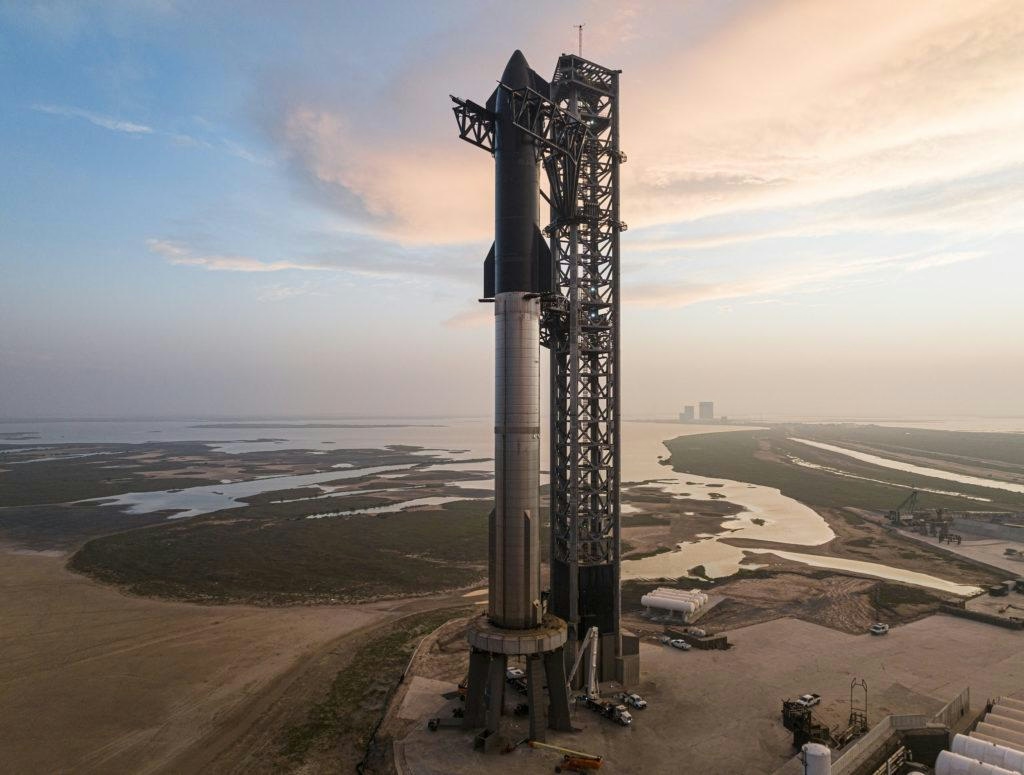
The Federal Aviation Administration (FAA) has mandated that SpaceX conduct a thorough mishap investigation following the 12th flight of its Starship-Super Heavy rocket. This directive effectively suspends further launches until the investigation is completed and approved by the agency. The FAA’s decision follows a detailed review of the May 22 mission, which ended with the Super Heavy booster failing to perform the planned engine burns necessary for a controlled return, culminating in a hard splashdown in the Gulf of Mexico.
Details of the Incident and Investigation Requirements
The FAA classified the off-nominal performance of the Super Heavy booster, known as Booster 19, as a mishap under federal regulations. The agency emphasized that it will oversee the SpaceX-led investigation, participating in every stage of the process and retaining authority to approve the final report and any corrective measures. During the ascent, one of the 33 Raptor V3 engines on Booster 19 shut down approximately one minute and 42 seconds after liftoff. Shortly thereafter, SpaceX initiated a staggered shutdown of engines in preparation for stage separation, reducing active engines from 32 to five. Onboard telemetry indicated that several engines failed to reignite as planned for the boostback burn, leading to an early shutdown.
Dan Huot, a member of SpaceX’s communications team, acknowledged during the company’s live broadcast that fewer booster engines ignited than expected for the boostback maneuver, though six engines remained operational on the ship. SpaceX later confirmed that the booster was unable to ignite all engines required for the boostback burn, resulting in a partial and prematurely terminated maneuver. The booster then attempted to reignite engines for landing but ultimately experienced a hard splashdown.
In contrast, the upper stage of the Starship rocket, designated tail number S39, successfully executed its maneuver to the intended splashdown site in the Indian Ocean. Although one of its three Raptor Vacuum engines failed to reignite during the coast phase, the FAA did not consider this a factor warranting inclusion in the mishap investigation.
Regulatory Oversight and Implications for SpaceX
The FAA’s involvement reflects standard regulatory oversight for commercial spaceflight incidents, aimed at ensuring public safety and compliance with federal regulations. The agency’s requirement that it review and approve SpaceX’s investigation and corrective actions means that no further Starship launches will be authorized until the process is complete.
This enforced pause may have significant repercussions for SpaceX’s immediate plans. The company is reportedly preparing for a potential initial public offering (IPO) in mid-June and is advancing efforts to deploy a megaconstellation of orbital data centers. Delays in Starship launches could affect these timelines, highlighting the broader impact of the FAA’s decision.
SpaceX must finalize its investigation and implement any mandated changes before receiving FAA authorization to resume Starship flights.

Etihad Airways Suspends Airbus A380 Flights on Key Route

Aditya Birla Group Seeks Approval for Aircraft Leasing in GIFT City

Qatar Airways Highlights Innovation and Connectivity at Arabian Travel Market 2026

Hong Kong's Five-Year Plan Includes Andrew Fan's Aircraft Parts Processing Hub Proposal

ACIA Aero Leasing Delivers ATR72-600 to Air Nostrum

RTX Appoints Jill Albertelli as Head of Pratt & Whitney

TAT Technologies Joins Beyond Aero Hydrogen Aircraft Program

AURAK Study Highlights Barriers to Air Taxi Adoption in Emerging Economies

Xiamen Air Selects Altitude for 787 Maintenance at Heathrow

Etihad and Swissport Extend Global Partnership
