
حوّل رؤى الذكاء الاصطناعي إلى أفعال منسّقة

الرائج الآن
Categories
Five Aviation Rivalries Reshaping Global Air Travel
Five Aviation Rivalries Reshaping Global Air Travel
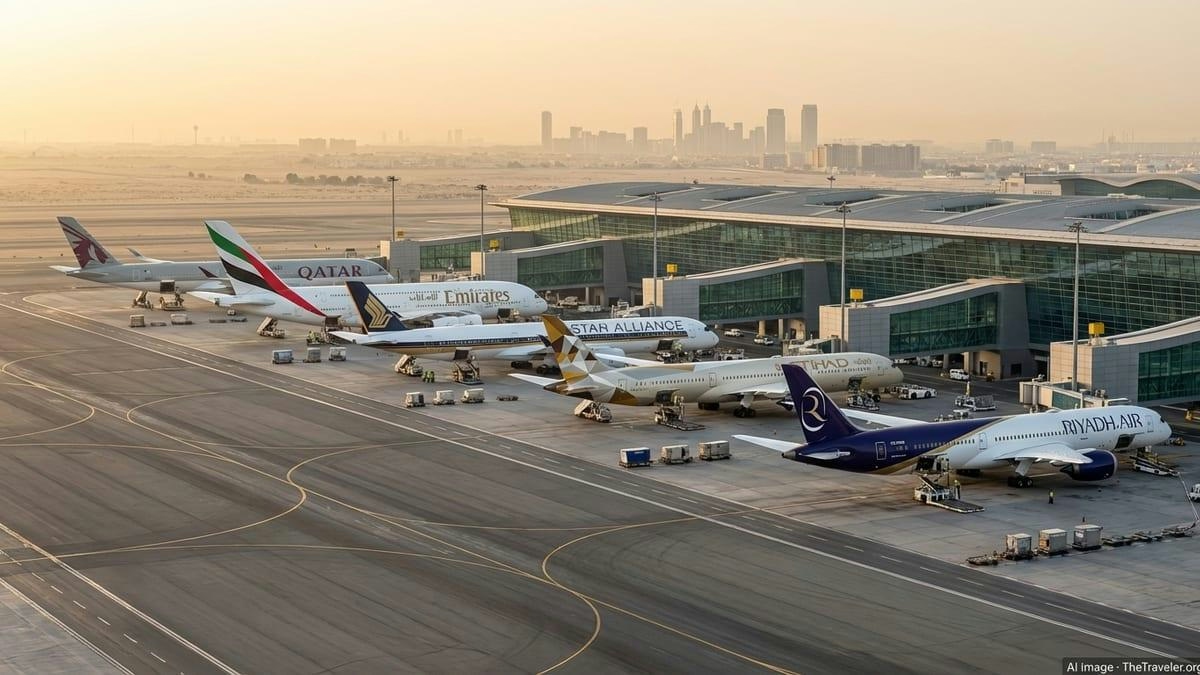
From the manufacturing plants of Toulouse and Seattle to the major transit hubs across Europe and the Gulf, a series of intense rivalries are fundamentally transforming global air travel in the mid-2020s. These competitive dynamics are influencing airline strategies, driving aircraft innovation, shaping passenger experiences, and redefining the structure of international aviation networks.
Airbus and Boeing: Navigating a Duopoly Under Pressure
The longstanding competition between Airbus and Boeing continues to dominate the aerospace industry. Both manufacturers are managing record order backlogs as airlines seek to modernize their fleets with more fuel-efficient aircraft. Airbus has taken a lead in the single-aisle market, with its A320neo family surpassing Boeing’s 737 as the most delivered jet series worldwide. Boeing, meanwhile, is focused on regaining market share in the narrow-body segment and securing significant long-haul orders through its 787 and 777X programs.
This rivalry has evolved beyond price and performance to emphasize production stability and delivery reliability. Boeing faces heightened scrutiny following safety concerns and production slowdowns related to the 737 MAX, while Airbus contends with its own supply chain disruptions and legal challenges. Airlines are responding by diversifying their orders between the two manufacturers to mitigate risks, signaling a shift from brand loyalty to strategic risk management.
Gulf Megacarriers and Turkish Airlines: Contesting the Global Crossroads
In the realm of long-haul travel, the competition among Gulf super-connectors—Emirates, Qatar Airways, and Etihad—and Istanbul-based Turkish Airlines is reshaping global connectivity patterns. The Gulf carriers have traditionally dominated by channeling traffic through Dubai, Doha, and Abu Dhabi, facilitating one-stop connections between continents. Turkish Airlines, leveraging Istanbul’s strategic geographic position, has aggressively expanded its network across Europe, Central Asia, Africa, and the Middle East to challenge this dominance.
Recent growth figures highlight Turkish Airlines’ rapid expansion, supported by a diverse fleet and a strategic focus on secondary cities. Meanwhile, Emirates and Qatar Airways continue to invest heavily in new widebody aircraft and premium cabin enhancements, aiming to uphold their reputations for luxury while increasing capacity on key routes. The competitive focus is shifting away from traditional capital cities toward mid-sized urban centers, as carriers seek to capture passengers earlier in their journeys before they reach competing European hubs.
Latin America’s Structural Challenges and Growth Potential
In Latin America, particularly Brazil, persistent structural barriers continue to limit aviation growth. Regulatory constraints and inadequate infrastructure remain significant challenges, as noted by Azul’s CEO. Despite these obstacles, the region presents substantial opportunities for expansion. Airlines operating in Latin America are navigating these complexities while positioning themselves to capitalize on the potential for enhanced connectivity and increased market share.
Shifting Passenger Preferences: Premium Versus Low-Cost Models
A notable trend is emerging as major carriers such as United and Delta shift away from low-cost strategies toward expanding premium services. This includes increasing business and first-class seating to meet evolving passenger expectations. This strategic pivot is prompting competitors to reevaluate their service offerings, intensifying the rivalry between legacy carriers and low-cost airlines as they vie to capture diverse market segments.
Innovation and Emerging Technologies: Aircraft and eVTOL Competition
The introduction of new aircraft models, including Radia’s Windrunner and Gulfstream’s G550 and G600, is reshaping fleet renewal options for airlines. Concurrently, the electric vertical takeoff and landing (eVTOL) sector is gaining momentum, with companies such as Archer and Vertical competing to establish leadership in this nascent market. These technological advancements are adding new dimensions to the competitive landscape in aviation.
External Shocks and Market Volatility
Recent geopolitical tensions, particularly conflicts in the Middle East, have caused operational disruptions including flight cancellations and schedule adjustments. These developments highlight the volatility and complexity airlines face as they operate within an increasingly unpredictable global environment.
Collectively, these five rivalries—spanning aircraft manufacturing, global hub competition, regional market challenges, evolving service models, and technological innovation—are driving the evolution of global air travel and setting the trajectory for the industry’s future.

Etihad Airways Suspends Airbus A380 Flights on Key Route

Aditya Birla Group Seeks Approval for Aircraft Leasing in GIFT City

Qatar Airways Highlights Innovation and Connectivity at Arabian Travel Market 2026

Hong Kong's Five-Year Plan Includes Andrew Fan's Aircraft Parts Processing Hub Proposal

ACIA Aero Leasing Delivers ATR72-600 to Air Nostrum

RTX Appoints Jill Albertelli as Head of Pratt & Whitney

TAT Technologies Joins Beyond Aero Hydrogen Aircraft Program

AURAK Study Highlights Barriers to Air Taxi Adoption in Emerging Economies

Xiamen Air Selects Altitude for 787 Maintenance at Heathrow

Etihad and Swissport Extend Global Partnership
