
حوّل رؤى الذكاء الاصطناعي إلى أفعال منسّقة

الرائج الآن
Categories
Former Pilots Lead Innovation at Axial Aero
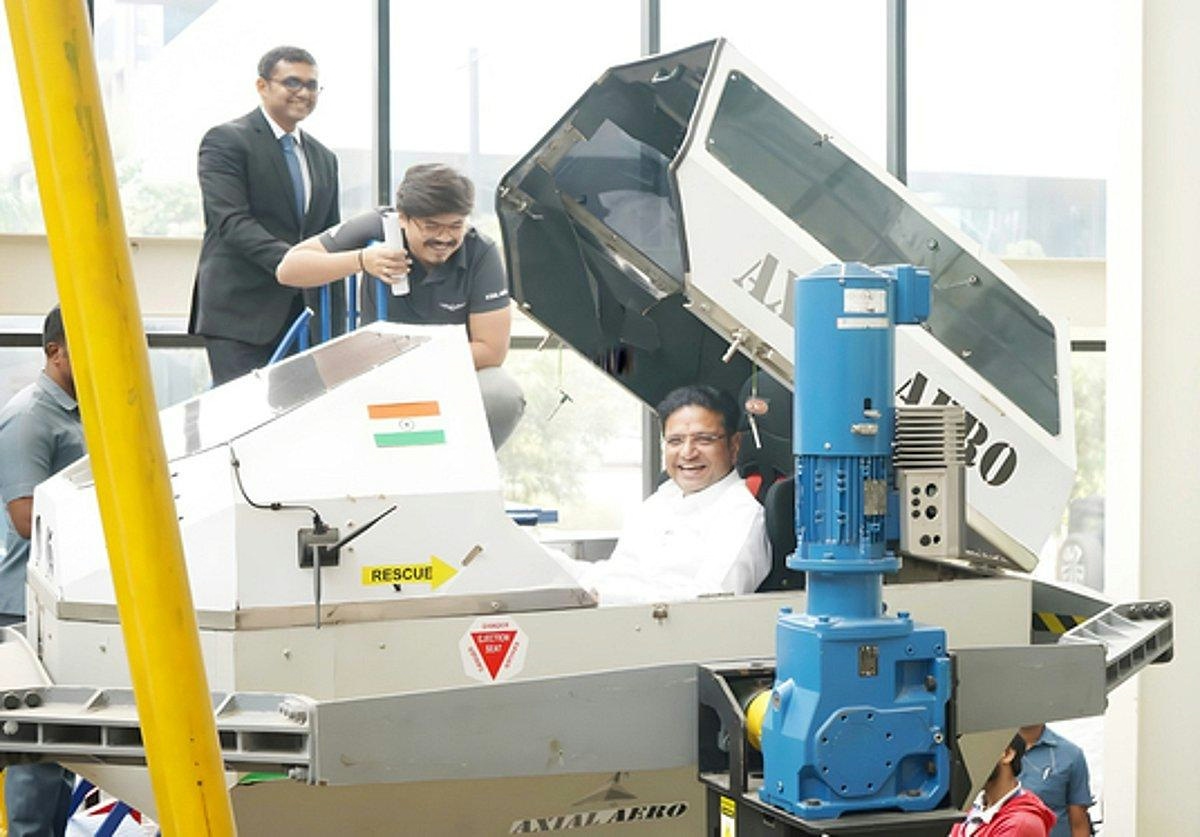
Former Fighter Pilots Lead Innovation at Axial Aero Amid Industry Challenges
Transitioning from military aviation to aerospace entrepreneurship, the founders of Axial Aero are applying their extensive experience as former Indian Air Force pilots to address critical deficiencies in pilot training technology. Both co-founders, alumni of the National Defence Academy, bring decades of combined operational expertise. Following early retirements, one pursued an MBA in Aviation from Concordia University in Canada, while the other continued flying for major Indian airlines. Their third partner, an engineer and longtime associate, completes the founding team, blending technical and operational insights.
From Military Cockpits to Aviation Innovation
The founders’ journey from fighter jets to startup leadership was influenced by a combination of professional ambition and personal circumstances. After holding aviation management roles across Africa, the United States, and Qatar, one founder returned to India due to a family health emergency and transitioned into IT leadership. The onset of the COVID-19 pandemic in 2020 provided the impetus for the trio to collaborate on developing an aerospace product. Initially focused on propulsion systems, budget limitations common to bootstrapped startups necessitated a strategic pivot toward flight simulators.
Drawing on their firsthand knowledge, the founders identified a significant shortcoming in conventional six-degrees-of-freedom Stewart platform simulators. These systems apply uniform motion across all axes, whereas actual aircraft—particularly fighters and helicopters—rely predominantly on rotational rather than translational movement. This discrepancy, well documented by the International Civil Aviation Organisation (ICAO) and Indian armed forces, had yet to be effectively addressed by existing industry solutions.
Innovation Amidst a Competitive Landscape
The global flight simulator market is dominated by three major companies, with unit costs ranging between $10 million and $15 million. Recognizing an opportunity to innovate, Axial Aero self-funded the development of a prototype simulator designed to more accurately replicate real-world flight dynamics. The founders emphasized the importance of pilot involvement in evaluating new training technologies. Their simulator underwent testing and validation by the Indian Air Force, Navy, and Army, which facilitated further development and submission to the IDEX defense innovation program.
Despite these advances, Axial Aero faces considerable challenges in scaling its innovations. The electric aircraft sector is intensely competitive, with established players such as Elektra Solar expanding rapidly. Industry analysts remain skeptical about the scalability and cost-effectiveness of emerging entrants like Axial Aero, particularly as traditional aerospace giants including Airbus and Boeing intensify research and development efforts to maintain their market dominance amid evolving electric aircraft trends.
The broader aerospace industry is also preparing for significant transformation. By 2026, increased production rates and critical decisions regarding future aircraft models are expected to reshape the market landscape. These developments may indirectly affect Axial Aero’s positioning as larger manufacturers adjust strategies and allocate resources in response to technological advancements and shifting market demands.
Nonetheless, the founders of Axial Aero remain steadfast in their mission to bridge the gap between authentic flight dynamics and simulator training. Their unique combination of operational, technical, and business expertise highlights both the potential and complexity inherent in innovating within a rapidly evolving aerospace sector.

Etihad Airways Suspends Airbus A380 Flights on Key Route

Aditya Birla Group Seeks Approval for Aircraft Leasing in GIFT City

Qatar Airways Highlights Innovation and Connectivity at Arabian Travel Market 2026

Hong Kong's Five-Year Plan Includes Andrew Fan's Aircraft Parts Processing Hub Proposal

ACIA Aero Leasing Delivers ATR72-600 to Air Nostrum

RTX Appoints Jill Albertelli as Head of Pratt & Whitney

TAT Technologies Joins Beyond Aero Hydrogen Aircraft Program

AURAK Study Highlights Barriers to Air Taxi Adoption in Emerging Economies

Xiamen Air Selects Altitude for 787 Maintenance at Heathrow

Etihad and Swissport Extend Global Partnership
