صورة

حوّل رؤى الذكاء الاصطناعي إلى أفعال منسّقة

انضم إلى قائمة الانتظار لـ AeroGenie اليوم!

الرائج الآن

Categories

JAL and MHI Form Joint Venture for Regional Aircraft Maintenance
June 2, 2026By ePlane AI
JAL and MHI Form Joint Venture for Regional Aircraft Maintenance
0
0
Japan Airlines
Mitsubishi Heavy Industries
Regional Aircraft Maintenance

JAL and MHI Establish Joint Venture to Enhance Regional Aircraft Maintenance

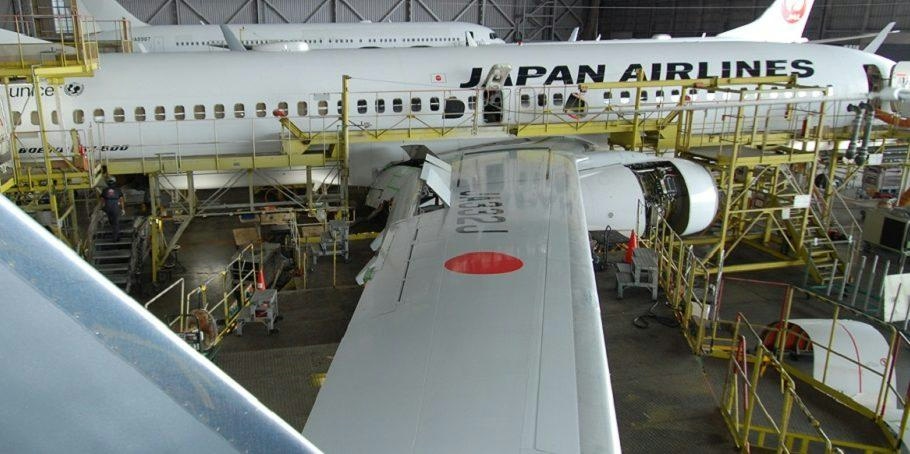
Japan Airlines’ engineering subsidiary and Mitsubishi Heavy Industries (MHI) have joined forces to create a new joint venture dedicated to regional aircraft maintenance. Named Aero Breath and headquartered in Nagoya, the company is structured with JAL Engineering holding a 51% stake and MHI owning 49%. The venture is set to commence operations within the current fiscal year, aiming to meet the rising demand for maintenance, repair, and overhaul (MRO) services as air travel recovers globally.

Strategic Collaboration to Strengthen Aviation Services

The establishment of Aero Breath follows a formal agreement signed in August 2024, which marked the beginning of a collaborative exploration into the aircraft aftermarket sector. This development builds upon a memorandum of understanding reached nearly two years prior, underscoring the strategic intent of both JAL and MHI to consolidate their positions within the competitive aviation services market.

Aero Breath is designed to capitalize on the complementary strengths of its parent companies. It will combine JAL and JAL Engineering’s extensive operational and maintenance expertise with MHI’s advanced technical capabilities. The partners have emphasized their commitment to supporting the sustainable growth of Japan’s aviation industry while ensuring safe and reliable flight operations. In their joint statement, they highlighted the venture’s role in responding to the increasing maintenance demands driven by the resurgence of air passenger traffic.

Navigating a Competitive and Regulated Market

The joint venture enters a market already served by established MRO providers catering to regional aircraft operators. Industry analysts suggest that Aero Breath’s success will hinge on its ability to seamlessly integrate JAL’s operational experience with MHI’s technical innovation. This integration is essential for addressing the evolving requirements of regional carriers and for distinguishing the venture’s service offerings amid intense competition.

Market response to the announcement has been largely positive, with stakeholders acknowledging the potential for improved maintenance services and enhanced support for regional airlines. Nonetheless, Aero Breath faces significant challenges, including managing the surge in maintenance demand, adhering to stringent aviation safety regulations, and effectively coordinating the expertise of both parent companies.

As the venture prepares to launch, JAL Engineering and MHI have pledged to work closely with Aero Breath. Their shared objective is to foster the development of Japan’s aircraft aftermarket business and to contribute to the sustainable expansion of the aviation sector, all while maintaining the highest standards of safety and reliability.

More news
Kazakhstan Tests Central Asia’s First Air Taxi in Almaty

Kazakhstan Tests Central Asia’s First Air Taxi in Almaty

Kazakhstan Tests Central Asia’s First Air Taxi in Almaty Kazakhstan has embarked on a groundbreaking venture in advanced air mobility by conducting the first test flight of Central Asia’s inaugural air taxi in Almaty. This initiative marks a significant milestone in the region’s urban transportation landscape, aiming to reduce traffic congestion and provide rapid transit alternatives. The demonstration has attracted considerable interest from investors and aviation stakeholders, highlighting Kazakhstan’s ambition to lead innovation in mobility solutions. Advancing Urban Mobility with eVTOL Technology The air taxi tested is an electric vertical take-off and landing (eVTOL) aircraft, showcased during a demonstration flight over Almaty. This technology promises to revolutionize urban travel by offering swift, flexible, and environmentally friendly transportation options. The project aligns with Kazakhstan’s broader strategy to modernize its transport infrastructure and establish itself as a hub for cutting-edge mobility technologies. Challenges and Industry Response Despite the promising outlook, the deployment of air taxi services faces several challenges. Regulatory frameworks are still under development, with authorities working to define safety protocols and operational standards for this nascent technology. Infrastructure requirements pose another significant hurdle, necessitating the construction of dedicated landing pads, charging facilities, and seamless integration with existing transport networks. Furthermore, the presence of established aviation operators in the region intensifies competition, prompting companies to vie for early market dominance. Nevertheless, the market response has been predominantly optimistic. Investors and airlines have demonstrated strong enthusiasm for the sector, anticipating robust growth driven by increasing urban populations seeking efficient travel solutions. This confidence is exemplified by recent agreements, such as the contract signed by Kazakhstan’s Alatau Advance Air Group to acquire 50 AutoFlight eVTOL aircraft, underscoring the momentum behind the country’s advanced air mobility ambitions. Regional Implications and Future Prospects Kazakhstan’s pioneering efforts have spurred competitors across Central Asia to announce plans for similar air taxi services, signaling a burgeoning market and heightened competition. This dynamic is expected to accelerate technological innovation and broaden consumer options within the region’s urban transport ecosystem. As Kazakhstan continues to refine and expand its air taxi operations, it is positioning itself at the forefront of a rapidly evolving sector. The outcomes of these trials may well influence the wider adoption of air taxis throughout Central Asia, potentially transforming urban and intercity mobility in the years ahead.
Delayed Again: Boeing 777X Certification Setback Puts 2027 Deliveries At Risk

Delayed Again: Boeing 777X Certification Setback Puts 2027 Deliveries At Risk

Delayed Again: Boeing 777X Certification Setback Puts 2027 Deliveries At Risk Certification Delays and Impact on Deliveries The Boeing 777X program has encountered yet another significant delay, with certification now unlikely to be granted before 2027. This postponement jeopardizes early deliveries and adds to the mounting pressures on the struggling manufacturer. At the recent CAPA Airline Leaders’ Summit in Charleston, South Carolina, Federal Aviation Administration (FAA) Administrator Bryan Bedford confirmed that the 777X certification will follow the completion of the 737 MAX trials, which are expected to conclude by the end of this year. This latest setback places the 777X at least seven years behind its original schedule, with 14 years having elapsed since the program’s launch in 2013. Boeing had initially aimed for FAA certification by October 2026, but no detailed explanation has been provided for the revised timeline. The company insists that no new technical issues have arisen, attributing the delay primarily to the certification process itself. Lufthansa, the launch customer, had anticipated receiving its first 777X aircraft in early 2027 but now faces increased uncertainty. The first production-standard 777-9 for Lufthansa completed its maiden flight in Everett, Washington, in May 2026 and is currently undergoing extensive real-world systems testing, including evaluations of cabin amenities and connectivity features. Boeing’s Response and Industry Implications Despite these challenges, Boeing CEO Kelly Ortberg expressed cautious optimism at the Bernstein Strategic Decisions Conference in New York. He stated, “You should expect that we will hopefully be done with our flight test program by the end of the year, with the exception of ETOPS... But we’re building the airplanes and getting ready to start the deliveries next year.” Nevertheless, with 30 aircraft already constructed deemed “at risk,” substantial rework will be necessary to bring these airframes up to the final certified standard. Airlines have indicated a preference to wait for newly built aircraft rather than accept modified existing frames. The delays come at a critical juncture for Boeing, as competition in the widebody aircraft market intensifies. Airbus and other manufacturers are accelerating their own development programs to capitalize on Boeing’s difficulties. Investor concerns are growing, and airlines are compelled to reschedule orders and adjust fleet strategies accordingly. The broader aerospace supply chain is also under strain; Airbus has experienced delays affecting Qantas’s plans for nonstop flights to London and New York, while Russia’s Rostec has postponed the first deliveries of its MC-21 aircraft until 2027. The 777X: Innovation Amid Uncertainty The 777X combines the proven airframe of the original 777 with advanced technologies derived from the 787 Dreamliner, including industry-first folding wingtips and the record-breaking GE9X engines. The aircraft’s cabin features, such as larger electronically dimmable windows and a lower cabin altitude, are designed to set new standards for passenger comfort. However, test airframes built since 2020 now require retrofitting to comply with updated FAA requirements, further complicating the path to certification and delivery. With this latest delay, Boeing confronts not only operational and reputational challenges but also a shifting competitive landscape. Airlines and investors are carefully evaluating their options amid ongoing turbulence in the aerospace industry.
Travel Industry Prepares for WMES 2026 in Madrid to Revamp Maintenance and Supply Chains

Travel Industry Prepares for WMES 2026 in Madrid to Revamp Maintenance and Supply Chains

Travel Industry Prepares for WMES 2026 in Madrid to Revamp Maintenance and Supply Chains Confronting Persistent Challenges in Aviation Maintenance The global aviation community is set to gather in Madrid for the World Maintenance & Engineering Symposium (WMES) 2026, an event organized by the International Air Transport Association (IATA) that aims to tackle pressing issues in aircraft maintenance and supply chain management. This symposium arrives at a critical juncture for the travel industry, which continues to face significant disruptions including engine servicing backlogs, delayed aircraft deliveries, and escalating operational costs. These challenges have placed considerable strain on airlines and ground support teams, resulting in extended wait times for passengers and increased ticket prices. Industry analyses, such as those conducted by Oliver Wyman, reveal that labor and material shortages within the aviation maintenance sector pose substantial risks to recovery efforts. Additionally, logistical concerns are intensifying, with potential disruptions at key hubs like Newark Liberty International Airport threatening the reliability of both international travel and cargo operations. WMES 2026 seeks to foster collaboration across the sector and develop practical strategies to restore stability and efficiency to aviation supply chains. Insights from Broader Supply Chain Dynamics The difficulties confronting the aviation sector are reflective of wider challenges in global supply chains. For instance, the hotel industry recently reported lower-than-anticipated bookings for the 2026 FIFA World Cup in the United States, highlighting the complexities of demand forecasting and supply management. Similarly, retailers are adjusting their logistics frameworks to navigate ongoing uncertainties related to trade policies and tariffs. These experiences offer valuable lessons in resilience and adaptability that aviation leaders are eager to incorporate as they address their own operational hurdles. Symposium Focus: Innovation and Operational Efficiency WMES 2026 will concentrate on two principal thematic tracks. The first, centered on supply chain management, will explore issues such as delivery delays for aircraft and engines, improving parts availability, and balancing maintenance schedules with operational demands. Cost containment remains a critical concern as airlines contend with economic pressures and unpredictable supply conditions. The second track will emphasize operational efficiency through technological innovation. Discussions will cover advancements in digital record keeping, predictive maintenance systems, and the integration of sophisticated information platforms designed to streamline technical operations and enhance reliability. Leading experts from aerospace engineering, major aircraft manufacturers, and IATA leadership will guide these sessions, offering insights into the root causes of supply delays and maintenance inefficiencies. Their collective objective is to bolster global travel reliability and mitigate the economic consequences of technical disruptions. Embracing Digital Transformation for Future Resilience A recurring theme throughout the symposium is the adoption of digital technologies. Industry specialists stress the importance of maintaining up-to-date maintenance information and deploying responsive systems to meet the demands of modern aviation. Innovations such as artificial intelligence-driven diagnostics and comprehensive digital records are anticipated to play a pivotal role in enhancing the agility and resilience of technical operations. As the travel industry prepares for WMES 2026 in Madrid, the emphasis remains on overcoming labor and material shortages, reinforcing supply chains, and harnessing technological advancements to secure a more dependable future for global aviation.
AI Agents Disrupt Airline Economics in 2026

AI Agents Disrupt Airline Economics in 2026

AI Agents Disrupt Airline Economics in 2026 Artificial intelligence-powered agents are fundamentally transforming the economic landscape of the airline and hotel industries in 2026. These AI systems challenge long-standing pricing and demand management strategies by conducting relentless, automated searches across booking platforms, metasearch engines, and distribution systems. Unlike human travelers, who typically settle on a booking after limited comparison shopping, AI agents perform continuous, exhaustive price checks. This shift is eroding the profit margins that airlines and hotels have traditionally safeguarded through carefully calibrated pricing models. The End of Predictable Search Behavior Travel pricing models have historically depended on the assumption that customers possess finite patience and cognitive capacity. Leisure travelers generally compared a limited number of options before making a booking, while business travelers often selected the first itinerary that met their needs. This predictability enabled airlines to forecast demand accurately, optimize inventory, and implement dynamic pricing strategies that maximized revenue, particularly for last-minute bookings. AI agents have upended these assumptions by executing thousands of price checks per hour without pause, indifferent to time zones, booking windows, or seasonal fluctuations. This relentless activity has led to a surge in server traffic and infrastructure costs, as booking platforms and metasearch engines struggle to accommodate the volume of machine-generated queries that far exceed human-scale demand. These increased operational expenses are increasingly being passed on to consumers through higher ticket prices and booking fees. Disrupting the Revenue Model The continuous, algorithmic search behavior of AI agents eliminates the behavioral constraints that once shaped the travel market. Airlines can no longer rely on traditional tactics such as anchoring—where high-priced options are presented first to make mid-tier fares appear more attractive—or exploiting information asymmetries. AI agents systematically identify and exploit every pricing loophole, thereby undermining the effectiveness of conventional revenue management strategies. Intermediaries and metasearch platforms also face significant challenges to their economic models. Historically reliant on advertiser commissions and click-through fees, these companies now contend with infinite AI-driven searches that generate vast numbers of clicks without corresponding revenue, threatening the sustainability of their business models. Market Reactions and Industry Adaptation The rise of AI agents is reshaping the competitive dynamics within the travel sector. AI-native companies are attracting increased investment and market attention, while traditional and non-AI startups struggle to maintain visibility. In response, some travel companies are creating new roles, such as "Agent Supervisor," to oversee and manage AI agents. Additionally, significant investments are being made in infrastructure upgrades to transition AI systems from experimental tools to fully integrated production environments. A new trust economy is emerging, particularly within the luxury travel segment, where governance, security, and data quality have become critical differentiators. As AI agents increasingly serve as the primary customer interface, companies are focusing on building deeper relationships by emphasizing unique offerings and personalized experiences. Navigating the New Reality The transition from human to algorithmic customers presents both challenges and opportunities for the travel industry. While AI agents threaten established pricing power and distribution strategies, they also compel companies to innovate in customer engagement and operational resilience. The tension between AI-driven ambitions and operational realities—such as maintaining customer trust and managing complex distribution channels—is prompting travel companies to fundamentally rethink their approaches to supply, demand, and value creation in an AI-driven marketplace.
Malaysia Airlines Secures Largest Support Deal for CFM56-7B Engines with MTU

Malaysia Airlines Secures Largest Support Deal for CFM56-7B Engines with MTU

Malaysia Airlines Secures Largest Support Deal for CFM56-7B Engines with MTU Landmark Agreement for Engine Maintenance Malaysia Airlines Bhd has formalized a significant 10-year maintenance agreement with German engineering firm MTU, covering over 100 CFM56-7B engines that power its Boeing 737-800 fleet. This exclusive contract, confirmed by Malaysia Airlines group CEO Captain Izham Ismail and MTU representatives, represents the largest CFM56-7B engine support deal in MTU’s history. The partnership entrusts MTU with comprehensive engine services, including repairs, overhauls, on-site support, lease-engine provision, life-limited parts management, and engine trend monitoring, ensuring coverage throughout the engines’ operational lifespan until retirement. Maintenance operations will be conducted by MTU Maintenance Zhuhai, a joint venture between MTU and China Southern Airlines. Captain Izham characterized the collaboration as a “flexible, reliable service” aimed at delivering an “optimised cost per flight-hour” for Malaysia Airlines. MTU has committed to implementing “smart strategies to minimise cost” as the engines near the end of their service life, drawing on its extensive expertise in engine lifecycle management. Industry Context and Technological Advancements This agreement arrives amid growing challenges for Malaysia Airlines and the broader aviation sector, including rising fuel costs and persistent market volatility. Large-scale maintenance contracts such as this are increasingly evaluated for their influence on fuel efficiency and sustainability. Airlines are responding by investing in advanced technologies and upgrading to more efficient fleets. For example, AirAsia’s recent record order of 150 Airbus A220 aircraft highlights the industry’s shift toward newer, more fuel-efficient models. MTU’s continued investment in digital solutions, particularly artificial intelligence-driven engine platforms, is expected to enhance Malaysia Airlines’ maintenance capabilities. These technologies provide advanced monitoring and predictive maintenance functions, which can reduce operational risks and support cost management as the airline adapts to a rapidly evolving market environment. As competitors adopt similar strategies to improve efficiency and sustainability, Malaysia Airlines’ partnership with MTU positions the carrier to meet both immediate operational requirements and future industry expectations.
Rolls-Royce Delivers 1,500th Trent 700 Engine

Rolls-Royce Delivers 1,500th Trent 700 Engine

Rolls-Royce Marks Delivery of 1,500th Trent 700 Engine with AirAsia X Rolls-Royce has reached a significant milestone with the delivery of its 1,500th Trent 700 engine, a landmark celebrated alongside AirAsia X at Kuala Lumpur International Airport 2 (KLIA2). Introduced in 1995 as the first member of the Trent engine family, the Trent 700 has since amassed over 30 million flying hours and is operated by 66 airlines worldwide. This engine model remains a cornerstone of Rolls-Royce’s civil aviation portfolio. Dominance in the Airbus A330ceo Market Currently, more than 1,650 Trent 700 engines are either in service or on firm order, making it the largest Trent engine fleet in operation. The Trent 700 has established itself as the preferred engine for the Airbus A330ceo, capturing 67 percent of new orders over the past three years and maintaining a similar share of future A330ceo deliveries. The extensive operational experience with the Trent 700 has also informed the development of the Trent 7000, which powers the newer Airbus A330neo. Earlier this year, AirAsia X announced an order for 50 A330neo aircraft, further strengthening its partnership with Rolls-Royce. The delivery ceremony was attended by Azran Osman-Rani, CEO of AirAsia X, and Eric Schulz, President of Civil Large Engines at Rolls-Royce. Osman-Rani highlighted the engine’s exceptional performance on the A330ceo and expressed pride that the milestone engine would enter service with AirAsia X. Schulz emphasized the Trent 700’s status as the market leader for A330ceo operators, noting ongoing improvements in efficiency to maintain its competitive edge. AirAsia X currently operates 17 Airbus A330ceos powered by Trent 700 engines, with its first aircraft entering service in 2008. Challenges Amid a Competitive Landscape Despite this achievement, Rolls-Royce faces a competitive and evolving market environment. The Trent 700 contends with rival engines from manufacturers such as General Electric and Pratt & Whitney, who offer alternative powerplants for the same aircraft models. Additionally, the aerospace industry continues to grapple with supply chain disruptions that have the potential to affect future engine deliveries. Market observers may scrutinize Rolls-Royce’s pricing and maintenance costs in comparison to its competitors, potentially intensifying competition in the widebody aircraft engine sector. Competitors are likely to increase their marketing efforts to promote their own technologies, which could further challenge Rolls-Royce’s market share. Nonetheless, the delivery of the 1,500th Trent 700 engine underscores Rolls-Royce’s robust position in the civil aviation market and its sustained commitment to innovation and customer support.
Boeing 787 Dreamliner Loses Door at Remote Pacific Airport

Boeing 787 Dreamliner Loses Door at Remote Pacific Airport

Boeing 787 Dreamliner Door Detaches at Remote Easter Island Airport A Boeing 787 Dreamliner experienced an unusual and concerning incident at Mataveri Airport on Easter Island, one of the most isolated airports globally, when a door detached from the fuselage during ground handling. The aircraft was parked and empty at the time, and no injuries were reported. Nevertheless, the event has prompted engineers and aviation authorities to launch a thorough investigation to determine the cause. Incident Details and Technical Considerations The Dreamliner was undergoing preparations for a subsequent long-haul flight when the door unexpectedly separated from the aircraft. Ground personnel and on-site engineers were reportedly taken by surprise. Commercial aircraft doors are equipped with multiple safety mechanisms designed to prevent accidental opening or detachment, making such occurrences exceedingly rare. The Boeing 787 employs a plug-type door system, which relies on cabin pressure during flight to maintain a secure seal. On the ground, the door’s integrity depends on mechanical latches, hinges, and assist mechanisms. The detachment of a door while the aircraft was stationary suggests a potential failure in components such as the hinge assembly or door stop fittings, or possibly an issue related to ground handling procedures. Investigators are examining whether the door was in operation at the time, if ground equipment played a role, and whether any pre-existing maintenance concerns contributed to the incident. As of now, no definitive cause has been identified. Challenges Posed by Easter Island’s Remoteness The extreme remoteness of Mataveri Airport—located nearly 4,000 miles from major aviation maintenance centers—complicates the response and repair efforts. The airport lacks the heavy maintenance infrastructure necessary for widebody aircraft like the 787, which incorporates advanced composite materials requiring specialized handling. Consequently, replacement parts, specialized tools, and expert technicians must be transported to the site, likely resulting in an extended grounding of the aircraft. Industry and Corporate Implications This incident occurs amid heightened scrutiny of Boeing’s aircraft safety record, following a high-profile door plug blowout on a Boeing 737 MAX 9 earlier in 2024. Such events have intensified regulatory attention and may lead to additional inspections or temporary groundings of affected aircraft models. The safety concerns raised by this latest event could also affect Boeing’s reputation and market performance. Despite recent positive developments, including reports of substantial orders from China, Boeing’s stock has remained vulnerable. The company is concurrently contending with ongoing investigations into its fuel-switch testing procedures, highlighted by a recent incident involving Air India. Competitors are closely monitoring the situation. Airlines such as Delta Air Lines, which are investing in emerging technologies like air taxi services through partnerships with firms like Joby Aviation, may seek to leverage Boeing’s challenges. Additionally, ongoing trade investigations could further influence the competitive dynamics within the industry. For operators of the Boeing 787, this incident may prompt a reassessment of fleet management and maintenance protocols, particularly when servicing remote destinations where logistical challenges are pronounced. As the investigation proceeds, the aviation sector will be attentive to any findings and their potential implications for Boeing’s flagship long-haul aircraft.
WSU Solar Car Team Displays Student-Built Vehicles at Western Sydney International Airport

WSU Solar Car Team Displays Student-Built Vehicles at Western Sydney International Airport

WSU Solar Car Team Displays Student-Built Vehicles at Western Sydney International Airport The Western Sydney University (WSU) Solar Car Team recently showcased their innovative, student-built solar vehicles on the taxiway of Western Sydney International (Nancy-Bird Walton) Airport (WSI). This demonstration offered a compelling vision of the future of sustainable transport and regional tourism, set against the backdrop of the airport’s anticipated opening for passenger and cargo operations in late 2026. The event underscored both technological advancement and the rapid development occurring in the Western Sydney region. Partnership Advancing Skills and Regional Growth This exhibition forms part of a broader collaboration established through a Memorandum of Understanding (MoU) signed in December 2024 between WSU and WSI. The partnership is designed to enhance skills pathways, aviation opportunities, and tourism engagement by integrating student innovation with airport operations. By combining WSU’s academic expertise with WSI’s infrastructure, the MoU aims to support workforce development and position the airport as a key driver of travel, tourism, and economic growth in Western Sydney. Since the MoU’s inception, WSU students have engaged directly with airport operations through a range of initiatives. Two students completed internships focused on airport management, contributing to the airport’s operational readiness. Additionally, 28 students undertook research projects addressing real-world challenges in airport operations and aviation infrastructure planning. More than 200 participants have also completed the Introduction to Aviation Operations micro-credential, equipping a new generation of professionals to meet the demands of the region’s expanding aviation and tourism sectors. Community Engagement and Career Development The partnership between WSU and WSI extends beyond academic collaboration to emphasize community involvement and career pathway development. Approximately 200 students and alumni volunteered in a full-scale airport emergency exercise, gaining valuable practical experience. Outreach programs have connected local residents with aviation and tourism career opportunities, while immersive experiences such as flight simulators and airport activations have introduced students and visitors to potential careers in aviation. Furthermore, six employment networking events have facilitated connections between students and local aviation employers, fostering human capital development and promoting Western Sydney as a centre for education and tourism. Challenges and Industry Transformation Despite the success of the solar car demonstration, the WSU Solar Car Team continues to face challenges in securing sufficient funding and resources for vehicle development and maintenance. The broader automotive industry is also undergoing a significant transformation, with 2026 identified as a pivotal year for sustainability and innovation. This evolving landscape has generated increased interest from educational institutions and automotive companies in sustainable technologies. As a result, competitor universities are expected to intensify their own solar car initiatives, while automotive firms may increase investments in green vehicle technologies. Innovation at the Nexus of Travel and Sustainability The solar car display at Western Sydney International Airport exemplifies the intersection of student-led innovation with regional travel and tourism development. As the airport prepares to commence operations, collaborations such as this not only enhance workforce readiness but also position Western Sydney at the forefront of sustainable transport and economic progress.
Why Does the Boeing 757 Board Passengers from the Mid-Cabin?

Why Does the Boeing 757 Board Passengers from the Mid-Cabin?

The Boeing 757’s Unique Mid-Cabin Boarding Process The Boeing 757 distinguishes itself among narrowbody aircraft through its unconventional boarding procedure. Unlike most single-aisle jets that board passengers exclusively through the front door, many 757 flights utilize the second door (2L), located at the midpoint of the cabin. Upon entering, first-class passengers proceed left toward the aircraft’s nose, while economy passengers move right toward the rear, effectively separating the flow of passengers during boarding. This mid-cabin boarding arrangement was not intentionally designed to enhance passenger experience but rather emerged from the aircraft’s structural and regulatory requirements. Measuring 155 feet (47.24 meters) in length, the 757 is notably longer than comparable narrowbodies such as the Boeing 737-800 (129 feet) and the Airbus A321 (146 feet). To meet stringent FAA and EASA emergency evacuation standards—which require that all passengers be evacuated within 90 seconds—Boeing incorporated an additional set of doors forward of the wing. This design decision positioned door 2L at the natural division between premium and economy cabins, making it a practical entry point for boarding. Boarding Practices Across Aircraft Types Most narrowbody aircraft, including the Boeing 737 and Airbus A320 families, board passengers solely through the front door (1L). Passengers enter at the nose and proceed down a single aisle, filling the cabin sequentially from front to back. This straightforward approach aligns with the structural simplicity of these aircraft, which do not necessitate dividing boarding flows. In contrast, widebody aircraft such as the Boeing 777 or Airbus A380 employ multiple doors and jetbridges to accommodate their larger passenger capacities, often ranging from 300 to 500 seats. Their twin-aisle configurations and wider fuselages facilitate simultaneous boarding through several entry points, expediting the process. The 757 occupies a unique position between these categories. As a single-aisle narrowbody, it nonetheless boards through a mid-cabin door when gate infrastructure permits. This method resembles widebody boarding patterns but is primarily a consequence of regulatory compliance and aircraft design rather than a passenger-focused innovation. Operational Implications and Industry Responses While mid-cabin boarding offers a logical solution given the 757’s design, it introduces operational challenges. Boarding through door 2L can sometimes extend boarding times, potentially affecting on-time departures and frustrating passengers accustomed to more conventional procedures. Airlines must balance these factors carefully, and opinions on the practice vary. Some carriers embrace mid-cabin boarding as a distinctive characteristic of the 757, while others view it as misaligned with evolving passenger expectations. In response, competitors have experimented with alternative boarding strategies, including front or rear-cabin entry, aiming to enhance efficiency and passenger satisfaction. These operational considerations are influencing broader fleet management decisions. For instance, airlines such as Icelandair are contemplating the accelerated retirement of older 757s in favor of newer, more efficient aircraft that support more conventional boarding processes. Ultimately, the Boeing 757’s mid-cabin boarding remains a legacy of its unique design and regulatory environment, continuing to influence airline operations and fleet strategies within the competitive landscape of commercial aviation.
Transportation Secretary Sean Duffy Pilots Electric Air Taxi

Transportation Secretary Sean Duffy Pilots Electric Air Taxi

Transportation Secretary Sean Duffy Pilots Electric Air Taxi, Marking Milestone for eVTOL Industry Historic Flight Demonstrates Federal Commitment to eVTOL Technology U.S. Transportation Secretary Sean Duffy recently made history as the first transportation secretary to pilot an electric vertical takeoff and landing (eVTOL) aircraft. The flight took place at Beta Technologies’ headquarters in Burlington, Vermont, where Duffy flew the company’s Alia model. Describing the experience as a “historic flight into the future,” Duffy emphasized the transformative potential of eVTOLs, stating that they will “fundamentally change the way people and products move.” His remarks underscore the growing federal interest in advancing electric aviation technologies. This milestone coincides with the Department of Transportation’s (DOT) preparations to broaden the integration of eVTOL aircraft into U.S. airspace. Beta Technologies is among several manufacturers participating in the Federal Aviation Administration’s (FAA) eVTOL Integration Pilot Program (eIPP), which is expected to launch as early as September. The program, set to run for at least three years across 26 states, will enable participants to operate precertified eVTOL aircraft at real airports. Collaborating closely with air traffic controllers, the initiative aims to test a variety of applications, including urban air taxi services, regional passenger transport, autonomous flight, and cargo and medical deliveries. Industry Collaboration and Technological Advancements The DOT has designated eight lead participants comprising state and local transportation departments working alongside manufacturers, operators, and infrastructure providers. Beta Technologies is actively engaged with seven of these groups. Secretary Duffy highlighted the broad range of potential uses for next-generation aircraft, from emergency organ transplants to regional air travel, signaling a future where electric flight plays a critical role in transportation. Beta plans to deploy both the Alia eVTOL, which Duffy piloted, and the CX300, a conventional takeoff and landing variant, during the eIPP. Both aircraft are fully electric, powered by Beta’s proprietary H500A engine, and designed for operational efficiency. The Alia is optimized for short-haul passenger and cargo missions, while the CX300 targets longer-range flights. Beta emphasizes the cost-effectiveness of its technology, noting that the Alia consumed only $3 worth of electricity during the demonstration flight. The company’s charging infrastructure currently spans approximately 50 sites nationwide, with plans for further expansion. Challenges and Industry Outlook Despite the progress, the electric air taxi sector faces significant obstacles. Regulatory challenges persist, particularly regarding FAA certification processes and the establishment of comprehensive charging infrastructure. Market responses remain mixed, with skepticism about the business model’s long-term viability and safety concerns related to integrating eVTOLs with traditional aircraft operations. The industry is also contending with legal disputes that could delay regulatory approvals and program implementation. Competitors in the eVTOL space are responding in diverse ways. While some companies grapple with legal issues and diminishing investor confidence, others, such as Archer Aviation, maintain optimism about regulatory support and public acceptance. The eVTOL Integration Pilot Program, initiated under the Trump administration, has provided some validation for the sector, though ongoing legal challenges continue to pose risks. Beta Technologies’ aircraft have already been tested by pilots beyond the company’s own staff. Republic Airways pilots have conducted multiple demonstration flights, including landings at Orlando International Airport and winter testing in New York and Vermont. Other industry players such as Bristow Group and Air New Zealand have evaluated Beta’s aircraft, while Surf Air Mobility plans to commence Alia passenger flights in Hawaii. Additionally, logistics companies UPS and United Therapeutics are exploring the aircraft’s potential for cargo operations. As the eVTOL industry advances amid regulatory, technical, and market challenges, Secretary Duffy’s flight represents a significant moment of federal engagement and may signal a turning point for the future of electric aviation in the United States.
line









