
حوّل رؤى الذكاء الاصطناعي إلى أفعال منسّقة

الرائج الآن
Categories
New AI Framework Developed to Enhance Aircraft Safety in Naval Operations
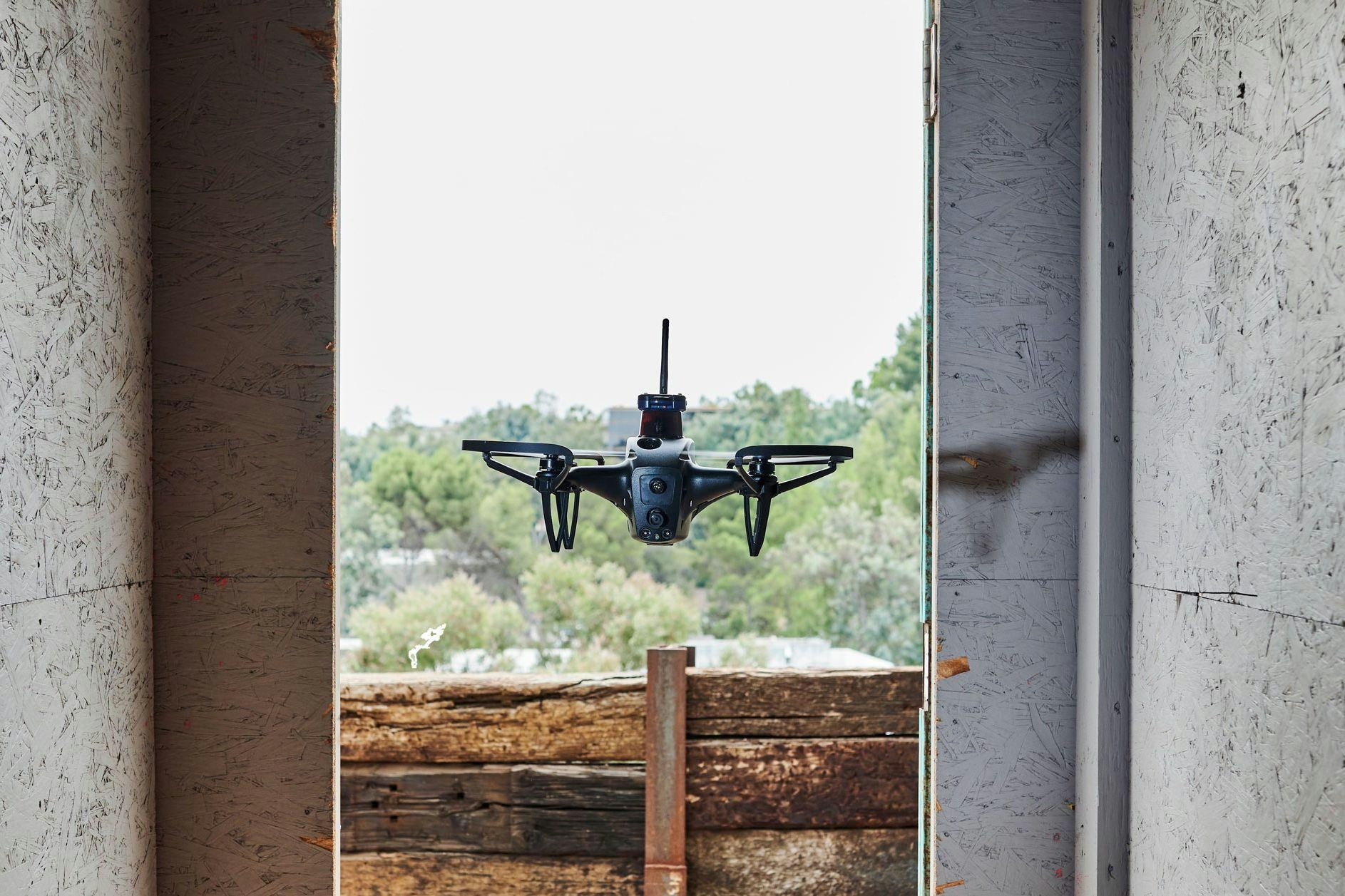
New AI Framework Developed to Enhance Aircraft Safety in Naval Operations
Advancing Airwake Prediction through Artificial Intelligence
Researchers at Oklahoma State University are pioneering an advanced artificial intelligence system aimed at improving aircraft safety during ship-based operations, one of the most challenging environments in aviation. The project, known as AIRWISE, focuses on predicting turbulent airflow conditions—referred to as airwakes—that form around moving ships and can significantly affect aircraft during critical phases such as takeoff and landing.
Airwakes arise from the complex interaction between wind and a ship’s structure, generating unstable and unpredictable airflow patterns that can alter flight trajectories and increase pilot workload. Existing training systems often depend on simplified models that inadequately represent these complexities, while more precise simulations demand computational resources that are impractical for real-time application.
Under the leadership of Dr. Kursat Kara and Dr. Ryan Paul, the Oklahoma State team is integrating computational fluid dynamics with AI to produce high-fidelity airflow predictions in near real time. By training AI models on extensive simulation data, AIRWISE is capable of replicating intricate wind patterns with far greater efficiency than traditional methods. Dr. Kara emphasized the significance of this approach, stating, “Ship airwakes are highly complex and directly affect the safety of flight operations. This project gives us a path toward efficiently modeling those environments to enhance the fidelity of simulations and increase the quality of decisions made when studying this environment.”
Implications for Aviation Safety and Military Technology
Once fully operational, AIRWISE is expected to generate detailed three-dimensional wind models in under 100 milliseconds by leveraging advanced graphics processing units. This rapid modeling capability holds promise for a variety of applications, including pilot training, aircraft performance evaluation, and the development of autonomous flight systems. Dr. Paul highlighted the potential impact, noting, “Shipboard landing is one of the most challenging operations in aviation. Better predictive tools can make a meaningful difference in safety.”
The development of AIRWISE coincides with a period of intensified focus on advanced military technologies. The defense sector experienced notable revenue growth in the first quarter of 2026, driven by increased demand for innovations that enhance operational safety and efficiency. Prominent technology companies such as Thales, Air Space Intelligence, and Palantir are actively competing to lead the Federal Aviation Administration’s AI initiatives, while the Department of War is exploring similar AI applications to expedite decision-making in military contexts.
Despite these advancements, the integration of AI into critical systems introduces new challenges. Cybersecurity experts, including those at Okta, have expressed concerns regarding potential vulnerabilities, as AI agents may gain access to sensitive or mission-critical infrastructure. Addressing these risks will be crucial as AI frameworks like AIRWISE see broader adoption.
Beyond its immediate operational benefits, the AIRWISE project also provides valuable research opportunities for students specializing in AI, high-performance computing, and aerospace engineering. Its potential applications span both defense and civilian aviation sectors, positioning the framework at the forefront of efforts to enhance the safety and reliability of shipboard flight operations.

Etihad Airways Suspends Airbus A380 Flights on Key Route

Aditya Birla Group Seeks Approval for Aircraft Leasing in GIFT City

Qatar Airways Highlights Innovation and Connectivity at Arabian Travel Market 2026

Hong Kong's Five-Year Plan Includes Andrew Fan's Aircraft Parts Processing Hub Proposal

ACIA Aero Leasing Delivers ATR72-600 to Air Nostrum

RTX Appoints Jill Albertelli as Head of Pratt & Whitney

TAT Technologies Joins Beyond Aero Hydrogen Aircraft Program

AURAK Study Highlights Barriers to Air Taxi Adoption in Emerging Economies

Xiamen Air Selects Altitude for 787 Maintenance at Heathrow

Etihad and Swissport Extend Global Partnership
