
حوّل رؤى الذكاء الاصطناعي إلى أفعال منسّقة

الرائج الآن
Categories
Safran Expands Le Creusot Facility to Support LEAP and M88 Engine Production
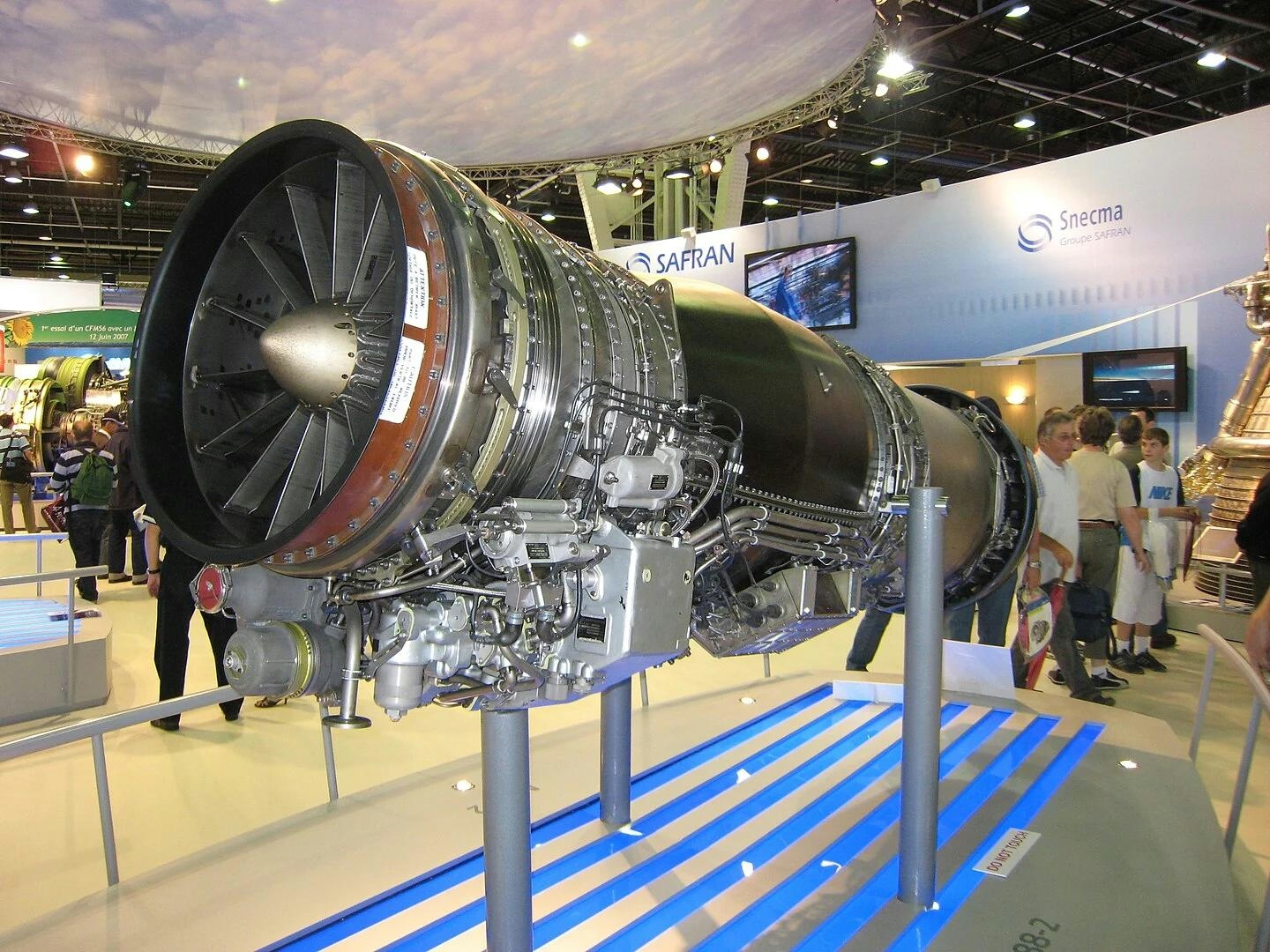
Safran Expands Le Creusot Facility to Support LEAP and M88 Engine Production
Safran Aircraft Engines has unveiled a €70 million ($76 million) investment to expand its Le Creusot facility, aiming to enhance production capacity and strengthen supply chain resilience. Scheduled to be fully operational by 2029, this expansion will transform the site from a specialized civil aviation hub into a dual-use facility, integrating both military and commercial engine manufacturing.
Expansion Details and Production Capabilities
Currently, the Le Creusot plant focuses on machining low-pressure turbine disks for CFM International’s LEAP and CFM56 engines. While demand for the CFM56 has declined, the LEAP engine—used in the Airbus A320neo and Boeing 737 MAX—has experienced significant growth. Safran, in partnership with GE Aerospace through their CFM joint venture, faces increasing pressure to scale production as airlines and lessors, including Avolon with its recent order of 100 LEAP engines, expand their fleets.
The planned expansion will add 9,000 square meters (96,875 square feet) to the existing facility, bringing the total industrial space to 26,000 square meters (279,861 square feet) by the end of the decade. Alongside physical growth, Safran intends to increase its workforce from 200 to 300 employees by 2032 and invest in advanced manufacturing technologies. The upgraded facility will also begin machining complex rotating parts for the GE90 engine, which powers legacy Boeing 777 aircraft, and crucially, the M88 turbofan engine used in the Dassault Rafale fighter jet.
Machining for these new engine lines is expected to commence within the current facility as early as 2026, with operations transitioning to the expanded area upon completion. This development is particularly significant for the M88 program, as critical components have traditionally been produced at Safran’s Évry-Corbeil site. Establishing Le Creusot as a second production source aims to reduce single-source vulnerabilities, a strategic response to recent global supply chain disruptions.
Strategic Importance Amid Rising Demand and Industry Challenges
The timing of this expansion is critical. After a period of slow sales in the 2010s, the Rafale program has seen a surge in export orders from countries such as Croatia, Greece, Indonesia, the United Arab Emirates, and Egypt, alongside sustained demand from the French military. This commercial momentum has created an urgent need to accelerate engine production to meet delivery schedules. By adding a second M88 production line at Le Creusot, Safran not only increases capacity but also mitigates risks of production bottlenecks and supply chain interruptions.
Safran’s expansion occurs against a backdrop of broader industry challenges. Supply chain constraints continue to pose risks, as evidenced by GE Aerospace’s ongoing recovery in commercial engine deliveries, which is expected to stabilize by 2025. Competition is intensifying, with GE Aerospace ramping up its own commercial engine output and Rolls-Royce advancing engine testing for the U.S. Future Long-Range Assault Aircraft (FLRAA) program. In this competitive environment, Safran must maintain its edge as demand for LEAP and M88 engines grows.
By expanding the Le Creusot facility, Safran is strategically positioning itself to meet increasing market demands, support accelerated production schedules, and safeguard its critical engine programs against future disruptions.

Etihad Airways Suspends Airbus A380 Flights on Key Route

Aditya Birla Group Seeks Approval for Aircraft Leasing in GIFT City

Qatar Airways Highlights Innovation and Connectivity at Arabian Travel Market 2026

Hong Kong's Five-Year Plan Includes Andrew Fan's Aircraft Parts Processing Hub Proposal

ACIA Aero Leasing Delivers ATR72-600 to Air Nostrum

RTX Appoints Jill Albertelli as Head of Pratt & Whitney

TAT Technologies Joins Beyond Aero Hydrogen Aircraft Program

AURAK Study Highlights Barriers to Air Taxi Adoption in Emerging Economies

Xiamen Air Selects Altitude for 787 Maintenance at Heathrow

Etihad and Swissport Extend Global Partnership
