
حوّل رؤى الذكاء الاصطناعي إلى أفعال منسّقة

الرائج الآن
Categories
Why a Major Airline Still Uses the Airbus A380 on Its Longest Routes
Why a Major Airline Still Uses the Airbus A380 on Its Longest Routes
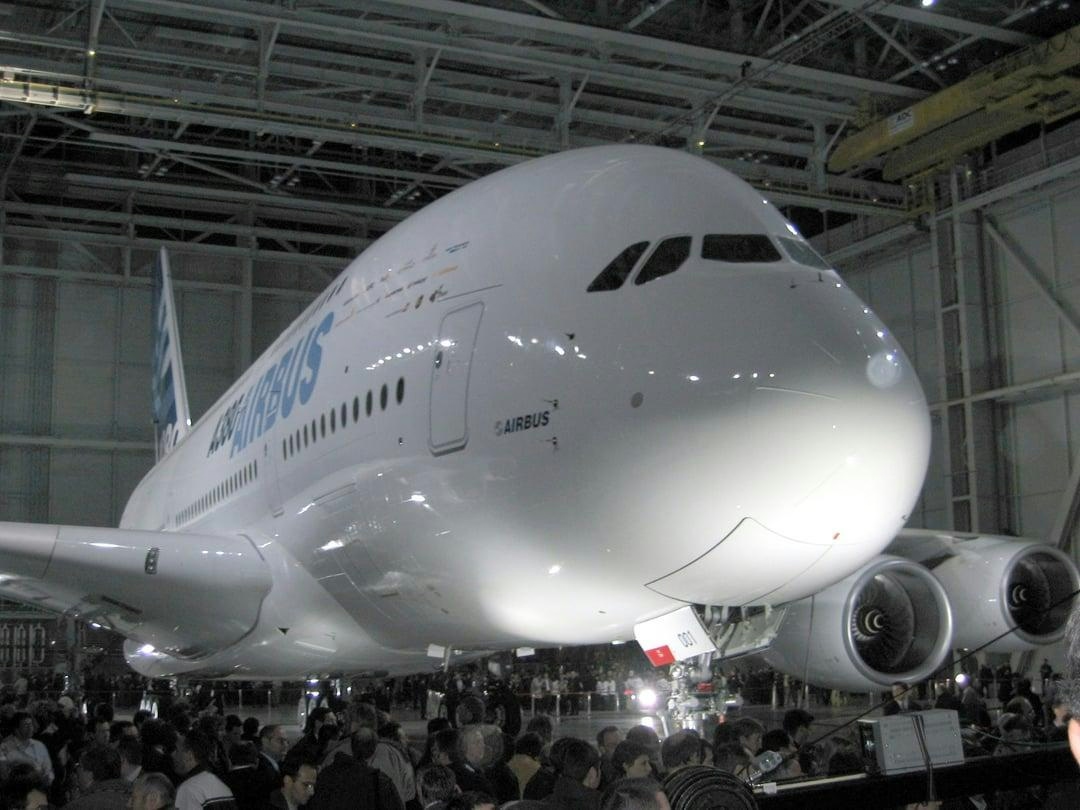
Nearly two decades after becoming the launch customer for the Airbus A380, Singapore Airlines continues to operate the superjumbo on some of its longest and most strategically important routes. Despite a broader industry shift towards newer, more fuel-efficient aircraft such as the Boeing 787 and Airbus A350, the A380 remains a central component of Singapore Airlines’ fleet for several key reasons.
Premium Capacity and Strategic Deployment
The Airbus A380’s distinctive advantage lies in its ability to combine exceptionally high passenger capacity with strong per-seat profitability. Singapore Airlines leverages this by offering its flagship Suites—its most exclusive and high-profile cabin product—exclusively on the A380. This exclusivity ensures the aircraft plays a pivotal role on marquee routes where demand from premium and high-yield customers is concentrated.
The airline’s deployment of the A380 is highly selective, focusing on dense trunk routes characterized by consistently high load factors and robust corporate or luxury leisure traffic. Airports such as London Heathrow and Dubai International are heavily slot-constrained, limiting the possibility of increasing flight frequencies. In these environments, the use of a larger aircraft like the A380 is the most effective means to expand capacity and maintain a competitive edge.
Commercial Relevance Amid Industry and Geopolitical Shifts
While many carriers have retired or downsized their A380 fleets in favor of more flexible twin-engine jets, Singapore Airlines’ continued investment in the aircraft underscores its ongoing commercial relevance. The airline’s expanded Summer 2026 A380 schedule highlights that the superjumbo is not merely a nostalgic flagship but a precise instrument for maximizing revenue on select routes.
This strategic choice is further influenced by intensifying competition and evolving geopolitical dynamics. Rival airlines are deploying widebody aircraft to capture market share on lucrative long-haul routes, while global route networks are being reshaped by tensions such as the ongoing conflict in Iran. These developments have compelled airlines like Qantas to reroute flights away from the Middle East, benefiting carriers such as Turkish Airlines, while others like Qatar Airways have experienced declines. In this context, the A380’s capacity and efficiency on slot-restricted, high-demand routes provide Singapore Airlines with a distinct strategic advantage.
The Enduring Role of the A380
As the largest passenger airliner ever built, the Airbus A380 was designed to alleviate congestion at major global hubs by offering full-length double decks and four engines capable of transporting large numbers of passengers over long distances. Its spacious premium cabins, onboard bars, and suites have established a standard that smaller jets find difficult to match. However, the aircraft’s economics remain highly route-specific, proving profitable primarily on dense markets with a strong premium passenger base.
Singapore Airlines’ deliberate and selective use of the A380 illustrates that, despite ongoing industry evolution, there remains a vital niche for the superjumbo where demand, airport constraints, and premium service converge.

Etihad Airways Suspends Airbus A380 Flights on Key Route

Aditya Birla Group Seeks Approval for Aircraft Leasing in GIFT City

Qatar Airways Highlights Innovation and Connectivity at Arabian Travel Market 2026

Hong Kong's Five-Year Plan Includes Andrew Fan's Aircraft Parts Processing Hub Proposal

ACIA Aero Leasing Delivers ATR72-600 to Air Nostrum

RTX Appoints Jill Albertelli as Head of Pratt & Whitney

TAT Technologies Joins Beyond Aero Hydrogen Aircraft Program

AURAK Study Highlights Barriers to Air Taxi Adoption in Emerging Economies

Xiamen Air Selects Altitude for 787 Maintenance at Heathrow

Etihad and Swissport Extend Global Partnership
