
حوّل رؤى الذكاء الاصطناعي إلى أفعال منسّقة

الرائج الآن
Categories
WSS 2026 in Brussels Brings Global Leaders Together to Advance Aviation Decarbonization
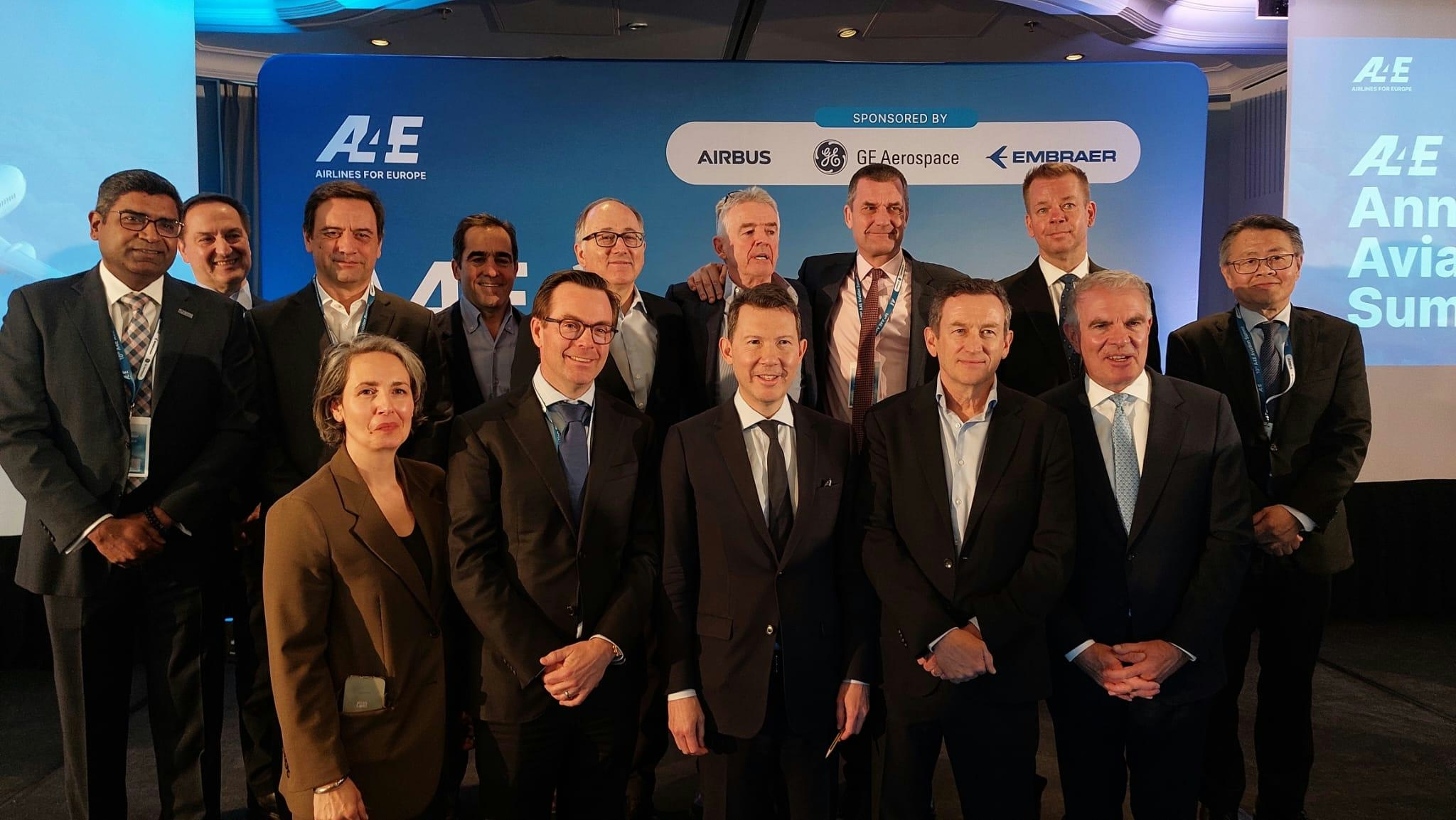
WSS 2026 in Brussels Brings Global Leaders Together to Advance Aviation Decarbonization
The World Sustainability Symposium (WSS) 2026, held in Brussels, is convening a diverse group of global leaders from Belgium, the United States, the United Kingdom, Germany, France, Japan, and other nations to intensify efforts toward decarbonizing the aviation industry. Against the backdrop of an urgent need for sustainable solutions, the event gathers governments, airlines, original equipment manufacturers (OEMs), airports, and regulatory bodies to collaboratively chart a course toward achieving net-zero emissions by 2050.
Driving Decarbonization Through Collaboration
WSS 2026 functions as a vital platform for stakeholders across the aviation supply chain to exchange insights, develop actionable initiatives, and foster innovation. The symposium places particular emphasis on practical strategies for airlines and airports to reduce carbon emissions while aligning with international sustainability targets. Delegates are engaging with emerging technologies such as sustainable aviation fuels (SAF), artificial intelligence-driven maintenance optimization, and hybrid-electric ground support equipment.
Despite these advancements, the sector confronts significant challenges. The slow adoption of SAF and limited governmental intervention have raised concerns regarding the pace of progress. Airlines are reevaluating their net-zero commitments amid a sluggish global energy transition, while competition for agricultural feedstocks is expected to intensify as demand for SAF increases. In response, some carriers are exploring alternative fuels and technologies to sustain momentum toward decarbonization.
Policy and Regulatory Engagement
The symposium features active participation from representatives of the European Commission, the International Civil Aviation Organization (ICAO), member states of the International Air Transport Association (IATA), and national aviation authorities. Their involvement ensures that regulatory updates concerning fuel standards, emissions reporting, and incentive programs are clearly communicated to industry leaders. Governments are also presenting case studies highlighting successful public-private partnerships that bridge the gap between legislation and practical implementation.
This inclusion of policymakers fosters constructive dialogue aimed at harmonizing approaches to carbon reporting, sustainable fuel adoption, and compliance monitoring. Such collaboration enables decision-makers to address regional disparities, evaluate incentive models, and implement effective strategies to reduce environmental impacts without compromising operational efficiency.
Industry Strategies and Market Dynamics
Leading airlines including Lufthansa, KLM, and Air France are utilizing WSS 2026 as an opportunity to coordinate with OEMs such as Airbus, Boeing, and Rolls-Royce on integrating energy-efficient aircraft, predictive maintenance, and AI-enabled operations. Interactive workshops facilitate the identification of barriers, co-development of solutions, and sharing of best practices for quantifying emissions reductions and deploying sustainable fuels.
The ICAO has recently launched a program aimed at accelerating decarbonization, which is expected to influence state action plans and industry strategies discussed during the symposium. As the market responds to evolving regulatory and technological landscapes, airlines and manufacturers are adapting their approaches to meet both environmental objectives and business imperatives.
Looking Ahead
WSS 2026 highlights that achieving net-zero aviation emissions is a collective responsibility shared among carriers, suppliers, and regulators. By integrating sustainability goals with innovation-driven strategies, the symposium seeks to translate environmental ambitions into measurable operational outcomes, ensuring that Europe’s aviation sector—and the global industry at large—continues to advance climate objectives in accordance with international mandates.

Etihad Airways Suspends Airbus A380 Flights on Key Route

Aditya Birla Group Seeks Approval for Aircraft Leasing in GIFT City

Qatar Airways Highlights Innovation and Connectivity at Arabian Travel Market 2026

Hong Kong's Five-Year Plan Includes Andrew Fan's Aircraft Parts Processing Hub Proposal

ACIA Aero Leasing Delivers ATR72-600 to Air Nostrum

RTX Appoints Jill Albertelli as Head of Pratt & Whitney

TAT Technologies Joins Beyond Aero Hydrogen Aircraft Program

AURAK Study Highlights Barriers to Air Taxi Adoption in Emerging Economies

Xiamen Air Selects Altitude for 787 Maintenance at Heathrow

Etihad and Swissport Extend Global Partnership
