
image

AeroGenie — 您的智能副驾驶。

询问一切。分析一切。立即行动。

热门趋势

Categories

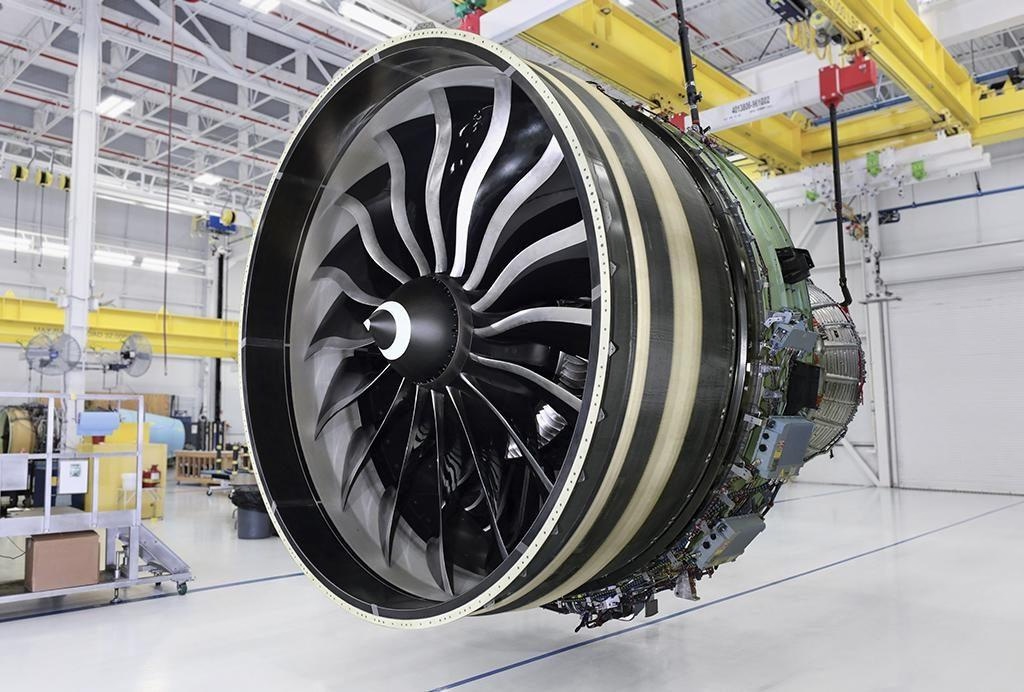
GE Aerospace Reports Extended GE90 Engine Use on Boeing 777s and Reduced Liabilities
February 21, 2025By ePlane AI
GE Aerospace Reports Extended GE90 Engine Use on Boeing 777s and Reduced Liabilities
0
0
GE Aerospace
GE90 Engine
Boeing 777

GE Aerospace Benefits from Extended Use of GE90 Engines Amid Boeing 777X Delays

Delays in Boeing’s 777X program have led airlines to retain their existing Boeing 777 fleets, which are powered by GE Aerospace’s GE90 engines, for longer operational periods. This extension has proven advantageous for GE Aerospace, as detailed in the company’s latest annual report. The report highlights a notable reduction in insurance and pension liabilities alongside a decrease in the company’s share count, reflecting improved financial health.

Sustained Demand and Market Confidence

The prolonged reliance on the GE90 engine underscores its established reputation for reliability and performance, reinforcing confidence in GE Aerospace’s technological capabilities. As airlines continue to operate their 777 fleets, GE Aerospace is positioned to benefit from increased demand for engine servicing and maintenance. This steady revenue stream provides a buffer amid the ongoing delays affecting the 777X program.

Financial Strength and Strategic Initiatives

Despite persistent competition within the aerospace sector, GE Aerospace’s strong market position with the GE90 engine has contributed to a 3% rise in the company’s valuation. The company is also advancing plans for significant share buybacks and dividend increases, signaling robust financial strength and a clear commitment to enhancing shareholder value.

The combination of extended GE90 engine use, reduced liabilities, and proactive financial strategies is strengthening GE Aerospace’s outlook as the industry contends with program delays and competitive challenges.

More news
Joby Receives First CAE Flight Simulator to Enhance Air Taxi Pilot Training in Marina

Joby Receives First CAE Flight Simulator to Enhance Air Taxi Pilot Training in Marina

Joby Receives First CAE Flight Simulator to Enhance Air Taxi Pilot Training in Marina Santa Cruz-based Joby Aviation has marked a pivotal advancement in its electric air taxi program with the delivery of its first CAE flight simulator at Marina Municipal Airport. This state-of-the-art simulator is intended to expedite pilot training as the company prepares to launch commercial operations both domestically and internationally. Advancing Pilot Training and Aircraft Development Joby’s electric aircraft, capable of carrying up to four passengers alongside a pilot and luggage, are powered by six electric motors and feature vertical take-off and landing (VTOL) capabilities. The company emphasizes that its aircraft operate at noise levels 100 times quieter than conventional helicopters, aiming to provide a more comfortable and less intrusive urban air mobility experience for passengers and surrounding communities. During recent test flights at Marina, Joby engineers gathered essential performance data, closely monitoring the behavior of motors, propellers, and batteries across various speeds. According to a Joby engineer, the company develops computer models to predict aircraft performance under different configurations. By comparing these models with real-world data, Joby refines its simulations to enhance future aircraft performance. The newly installed CAE simulator replicates the physical cockpit of Joby’s air taxi and runs the same software as the actual aircraft, offering pilots an immersive and realistic training environment. This setup enables pilots to rehearse a wide range of scenarios, including system failures, within a safe and controlled setting. The engineer highlighted the aircraft’s robust safety design, noting that if a primary system fails, secondary and even tertiary backup systems are in place to ensure continued operation. Regulatory Challenges and Market Outlook Joby anticipates commencing passenger flights in Dubai as early as next year. However, commercial operations in the United States remain contingent upon securing Federal Aviation Administration (FAA) certification, a process that presents significant regulatory challenges. The broader electric vertical take-off and landing (eVTOL) industry continues to grapple with stringent safety standards and cost-related hurdles. Despite these obstacles, market analysts maintain a positive outlook on the sector’s growth potential. Joby’s recent initiatives, including plans to double manufacturing capacity and a strategic partnership with Toyota, have solidified its position as a leader in the emerging eVTOL market. Competitors are responding with increased investments and new alliances, intensifying the race to commercialize air taxi services. As Joby advances its technology and expands pilot training capabilities, the company remains at the forefront of an industry poised to transform urban transportation. The realization of widespread air taxi adoption will depend on overcoming regulatory barriers and ensuring that these services are both accessible and affordable to the public.
Nomad Technics Completes Maintenance on Challenger 650

Nomad Technics Completes Maintenance on Challenger 650

Nomad Technics Completes Comprehensive Maintenance on Challenger 650 Nomad Technics, an EASA Part-145 approved organisation, has successfully completed an extensive maintenance programme on a Bombardier Challenger 650, returning the aircraft to full airworthiness after a prolonged period of inactivity. The project involved a thorough overhaul of both engines, a scheduled 48-month inspection, and a series of additional inspections and functional tests tailored to the specific condition of the aircraft. Beyond the technical work, the company also refurbished the cabin interior, including newly upholstered seats, replacement of the carpet, and repairs to damaged woodwork, ensuring the aircraft was restored to optimal operational and aesthetic standards before redelivery. Navigating a Competitive and Evolving Market This accomplishment occurs amid intensifying competition within the business aviation maintenance sector. Key players such as ExecuJet and Duncan Aviation are expanding their service offerings to include advanced connectivity solutions like Starlink, reflecting a broader industry trend towards integrating cutting-edge technology onboard. Bombardier itself continues to incorporate smart routers into its jets, while recent acquisitions of Challenger models by prominent operators such as NetJets and the Royal Canadian Air Force underscore the growing demand for sophisticated business aircraft. Market volatility, influenced by recent Federal Reserve signals and elevated asset valuations, has increased scrutiny on investments in business aviation. Maintenance providers now face mounting pressure to distinguish their services and retain market share. In response, competitors are likely to accelerate enhancements to their technical capabilities and onboard technology offerings, as clients increasingly seek providers that can deliver both technical excellence and advanced connectivity. Nomad Technics’ successful completion of the Challenger 650 maintenance programme highlights its dedication to providing comprehensive solutions that address the full spectrum of operator needs. As the business aviation landscape continues to evolve, the company’s ability to offer tailored, high-quality maintenance services will be essential in meeting the expectations of discerning clients and navigating the challenges of a dynamic industry.
Joby Aviation Prepares for Air Taxi Pilot Training Ahead of CES 2026

Joby Aviation Prepares for Air Taxi Pilot Training Ahead of CES 2026

Joby Aviation Advances Pilot Training Ahead of CES 2026 Joby Aviation (NYSE: JOBY) is intensifying its efforts to launch commercial urban air mobility services, announcing significant progress in pilot training as it prepares for a prominent presence at CES 2026. The company revealed plans to install the first of two advanced CAE flight simulators at its expanded pilot training facility in Marina, California. This development represents a critical step toward securing regulatory approval and initiating commercial operations. Enhancing Pilot Training and Facility Expansion The new simulators, featuring Level 7 and Level C certifications and developed in partnership with CAE, are designed to facilitate the certification process for commercial pilots seeking powered-lift type ratings. These ratings are essential for operating Joby’s all-electric eVTOL (electric vertical takeoff and landing) aircraft. The Marina facility, which has recently doubled its production capacity, now functions as a comprehensive hub for manufacturing, testing, and pilot training. This expansion aligns with Joby’s broader strategy of vertical integration, allowing the company to maintain stringent safety standards by managing all aspects of its service internally—from aircraft hardware to pilot preparation. Navigating Regulatory and Market Challenges Despite these advancements, Joby faces significant challenges on the path to commercialization. Securing Federal Aviation Administration (FAA) certification remains a complex and critical hurdle. Concurrently, the company is working to scale manufacturing operations to meet its ambitious goal of producing four aircraft per month by 2027. The competitive landscape in the eVTOL sector is intensifying, with rivals such as Archer Aviation and Vertical Aerospace making notable progress. Vertical Aerospace’s recent stock surge following a key materials agreement highlights the dynamic nature of this emerging market. Investor confidence in Joby remains robust, with the company’s stock appreciating by more than 50 percent over the past six months. Analysts anticipate further gains as Joby approaches its planned commercial launch in late 2026. The company aims to double its manufacturing capacity by 2027 to support a global rollout of its air taxi service. Looking Ahead to CES 2026 This week, attention turns to Las Vegas, where Joby CEO JoeBen Bevirt is scheduled to speak at CES 2026. Bevirt is expected to discuss the integration of physical artificial intelligence and software-defined mobility, underscoring Joby’s vision for the future of urban transportation. The company’s advancements in pilot training and its high-profile engagement at CES signal a significant shift as urban air taxis move closer to becoming a practical reality. As Joby Aviation continues to address regulatory, competitive, and operational challenges, its recent initiatives highlight both the potential and complexity involved in bringing electric air taxis to commercial service.
Fuel Exhaustion Caused by Incorrect Fuel Selector Installation

Fuel Exhaustion Caused by Incorrect Fuel Selector Installation

Fuel Exhaustion Incident Highlights Risks of Incorrect Fuel Selector Installation A recent accident involving a Cessna 172 near Terrell, Texas, has brought renewed attention to the dangers posed by fuel exhaustion linked to improper fuel selector installation. The incident underscores significant safety and operational challenges within the aviation industry. Sequence of Events Leading to the Accident The pilot departed Arlington Municipal Airport (KGKY) after refueling with 12.75 gallons of 100LL aviation fuel, reporting that both wing tanks were “topped off.” The flight was intended to build flight hours, with planned stops at East Texas Regional Airport (KGGG) and Terrell Municipal Airport (KTRL). Upon landing at KGGG and subsequently at KTRL, the pilot attempted to refuel at Terrell but discovered the fuel pumps were “out of order.” Notably, KTRL does not offer self-service fueling; all refueling is conducted by a technician using a fuel truck, with after-hours service available only by prior arrangement—a request that was not made on the night of the accident. Using a fuel measurement stick, the pilot estimated approximately four gallons remained in the right tank and twelve gallons in the left. Choosing to proceed to Mesquite Metro Airport (KHQZ) for refueling, the pilot observed a “rough” engine idle before takeoff but decided to continue after the engine appeared to stabilize at higher throttle settings. Shortly after departing Runway 18 at KTRL, at an altitude of roughly 400 to 450 feet above ground level, the engine lost all power. Although the pilot briefly restarted the engine, it failed again, necessitating an emergency landing in a nearby field. The aircraft sustained substantial damage, but both occupants escaped with only minor injuries. Investigation Findings and Industry Implications Post-accident examination revealed approximately two gallons of fuel remaining in the left tank and a mere quarter gallon in the right. The fuel selector was positioned on “both,” and no external fuel leaks were detected. The pilot reported observing a “steady stream” of fuel from the left side after landing. These findings suggest that incorrect fuel selector installation and fuel management errors contributed directly to the engine failure. This incident highlights the critical safety risks and operational disruptions that can arise from improper fuel system installation and inadequate fuel management. Beyond the immediate threat to life, such events impose significant financial burdens on operators. In response, the aviation sector is experiencing heightened scrutiny of safety protocols, with insurance providers reportedly increasing premiums for companies engaged in aviation and transportation. Competitors within the industry are accelerating innovation in fuel management technologies and reinforcing quality control measures to mitigate the risk of similar occurrences. These efforts coincide with ongoing energy reforms that are already exerting pressure on profit margins, further challenging resources allocated to fuel management and safety enhancements. The accident serves as a stark reminder of the essential need for correct fuel system installation, comprehensive preflight inspections, and strict adherence to fueling procedures to maintain flight safety and operational integrity.
American Airlines to Offer Free Wi-Fi to Select Passengers

American Airlines to Offer Free Wi-Fi to Select Passengers

American Airlines to Provide Complimentary Wi-Fi for AAdvantage Members American Airlines has announced plans to offer free Wi-Fi access to members of its AAdvantage loyalty program, joining a growing number of U.S. carriers providing complimentary in-flight internet services. The initiative will commence on January 6, initially available on narrowbody aircraft and two-class regional jets, with the airline aiming to extend the service to nearly its entire fleet by spring. Details of the Wi-Fi Service and Access Access to the free Wi-Fi will be exclusive to passengers enrolled in the AAdvantage program. The service is sponsored by AT&T and delivered through partnerships with Intelsat and Viasat. Heather Garboden, American Airlines’ chief customer officer, emphasized the importance of connectivity for modern travelers, stating that free high-speed Wi-Fi is no longer a luxury but a necessity. She highlighted that once the rollout is complete, every AAdvantage member will be able to stay connected, stream content, and share experiences throughout their journey without additional cost. This move aligns American Airlines with competitors such as Delta Air Lines, which was the first major U.S. legacy carrier to offer free Wi-Fi fleetwide to loyalty program members, and United Airlines, which has implemented similar services. Historically, American charged passengers for onboard internet access, with prices starting at $10 per flight or through monthly and annual subscription plans. Some T-Mobile customers currently benefit from complimentary access, and paid Wi-Fi options will remain available on select flights during the transition period. Industry Implications and Competitive Landscape The introduction of free Wi-Fi is anticipated to particularly attract business and premium travelers, potentially driving increased demand and revenue for American Airlines. Nevertheless, the airline faces considerable challenges, including the substantial costs associated with installing and maintaining the necessary Wi-Fi infrastructure, as well as the technical complexities involved in delivering reliable, high-speed connectivity across a diverse fleet. Ensuring a seamless internet experience will be crucial as the service expands. In response, competitors may accelerate their own Wi-Fi enhancements or introduce additional benefits to maintain market share. For instance, Alaska Airlines currently offers Wi-Fi for purchase at $8 per flight and is in the process of installing Starlink technology, with plans to provide free Wi-Fi to members of its Atmos loyalty program by 2027. Breeze Airways offers Wi-Fi for purchase on select Airbus A220 flights, while Allegiant Air does not currently provide Wi-Fi services. What Passengers Should Know Free Wi-Fi will be available exclusively to AAdvantage loyalty program members starting January 6, with coverage expanding to most of the fleet by spring. Passengers must be enrolled in the program and log in during their flight to access the service. Paid Wi-Fi options will continue to be offered on certain flights until the full rollout is complete. As airlines increasingly prioritize enhancing the passenger experience, complimentary in-flight Wi-Fi is rapidly becoming an industry standard. American Airlines’ phased implementation represents a significant development in the ongoing effort to keep travelers connected at cruising altitude.
The Growing Role of eVTOL Aircraft

The Growing Role of eVTOL Aircraft

The Growing Role of eVTOL Aircraft Electric vertical take-off and landing (eVTOL) aircraft, powered by advancements in battery technology, are rapidly reshaping the future of urban air mobility. These aircraft, which share the vertical take-off, hovering, and landing capabilities of helicopters, have become increasingly practical for short-range air taxi services. Recent improvements in battery energy density now enable eVTOLs to cover distances ranging from 32 to 80 kilometers, making them a viable option for point-to-point urban and regional travel. Expanding Market Demand and Industry Developments The demand for eVTOL air taxis has surged since the early 2020s, driven primarily by growing urban congestion and the need for faster, more direct transportation options. Major airlines are actively pursuing opportunities to connect key international airports such as London Heathrow, New York JFK, and Paris Charles de Gaulle with nearby regional cities. In March 2025, Virgin Atlantic announced a strategic partnership with Joby Aviation to offer air taxi services linking regional cities to major UK hubs including Heathrow and Manchester airports. This momentum was further underscored in August 2025 when Joby Aviation completed the first eVTOL air taxi flight within US Federal Aviation Authority (FAA) controlled airspace, operating between Marina and Monterey airports in California. By December, Vertical Aerospace unveiled plans to launch the United Kingdom’s first eVTOL air taxi service by 2029, proposing routes that would connect Canary Wharf with Heathrow, Gatwick, Oxford, and Cambridge. The sector’s rapid growth has attracted substantial investment and fostered a competitive environment. Alongside Joby Aviation, companies such as Archer Aviation, Vertical Aerospace, Beta Technologies, and Wisk are advancing their own eVTOL projects. Market confidence is reflected in the formation of partnerships and the development of dedicated vertiport networks, with Joby Aviation’s proposals gaining particular traction. Interest is also expanding beyond traditional markets, with the Gulf region emerging as a notable area for state-funded infrastructure investments aimed at supporting widespread eVTOL adoption. Regulatory and Infrastructure Challenges Despite the optimism surrounding eVTOL technology, the industry faces significant regulatory and infrastructural challenges. The FAA’s certification process for eVTOL aircraft remains ongoing, while the UK Civil Aviation Authority (CAA) is working toward establishing a comprehensive regulatory framework expected by 2028. In September 2025, the UK CAA published the eVTOL Delivery Model, which outlines key objectives including the establishment of agreed type classifications, the introduction of new and amended legislation governing flight operations and pilot licensing, updated guidance protocols, and enhanced systems for processing license applications and safety reports. Infrastructure development is critical to the success of eVTOL services, particularly the creation of vertiports and their integration with existing transportation networks. In the near term, eVTOL air taxi services are anticipated to primarily serve high-net-worth individuals, as affordability for the broader public remains a challenge. This emerging market dynamic could disrupt traditional charter flight providers and executive jet manufacturers, given eVTOLs’ potential for significantly lower carbon emissions and reduced operating costs. While the prospect of fully autonomous eVTOL operations remains under discussion, the immediate priorities for the sector are regulatory approval, infrastructure rollout, and market expansion. As competition intensifies and investment continues to grow, eVTOL aircraft are positioned to assume an increasingly prominent role in the future of urban and regional mobility.
Joby Aviation Receives First of Two Advanced Flight Simulators from CAE

Joby Aviation Receives First of Two Advanced Flight Simulators from CAE

Joby Aviation Receives First of Two Advanced Flight Simulators from CAE Milestone in Pilot Training and FAA Certification Joby Aviation, Inc. (NYSE: JOBY) has taken delivery of the first of two advanced flight simulators developed in collaboration with CAE (NYSE: CAE) (TSX: CAE), marking a significant advancement in the company’s efforts to secure Federal Aviation Administration (FAA) certification for its S4 electric vertical take-off and landing (eVTOL) air taxi. These simulators are integral to Joby’s pilot training program and are expected to expedite the company’s transition into commercial service. The initial simulator, a fixed-base training device, is scheduled for installation this month at Joby’s pilot training facility in Marina, California. A second, full-motion simulator is anticipated to arrive later this year. Together, these units will have the capacity to train up to 250 pilots annually, a critical component as Joby prepares for its inaugural commercial flights planned for later in 2024. Bonny Simi, President of Operations at Joby, emphasized the importance of the simulators in the FAA certification process, noting that they are being delivered on schedule to support pilot training ahead of the company’s commercial launch. The first simulator is expected to achieve certification as a Level 7 Flight Training Device, while the second will meet the standards of a Level C Full Flight Simulator. Advanced Technology and Development Both simulators incorporate CAE’s Prodigy Image Generator, which utilizes Epic Games’ Unreal Engine to render highly detailed three-dimensional urban environments with a 300-by-130-degree field of view. The systems also simulate real-world flight conditions through integrated audio cues, turbulence, and vibration. Development of the simulators began in 2022, with Joby conducting component and software testing at facilities in California and Costa Rica. The delivery of these simulators represents a crucial step not only for regulatory approval but also for scaling Joby’s operational capacity. The company plans to double its U.S. manufacturing output by 2027, reflecting its commitment to meeting growing demand and regulatory requirements. Market analysts have responded positively, projecting substantial growth for Joby within the advanced air mobility sector by 2026. Nonetheless, the company continues to face challenges, including the demanding FAA certification process and the necessity for extensive pilot training. Competitors are expected to respond by investing in simulator technologies and expanding production to maintain competitiveness. CAE’s Expanding Role in Aviation Training CAE, with a market capitalization of $10.25 billion and a stock increase exceeding 34% over the past year, is broadening its footprint in both civil and defense aviation training. Alexandre Prévost, President of Civil Aviation at CAE, stated that the simulators “set a new benchmark for training infrastructure in urban air mobility.” In addition to its partnership with Joby, CAE recently reported strong financial results for the second quarter of 2025, surpassing market expectations with adjusted earnings per share of $0.23 and revenue of $1.24 billion. The company also secured a $270 million CAD contract to deliver the Future Air Mission Training System for the Royal Australian Air Force and entered into a global cooperation agreement with Saab for training and simulation related to the GlobalEye Airborne Early Warning and Control aircraft. Joby Aviation aims to operate its own air taxi service while also selling aircraft to other operators, positioning itself as a leader in the emerging electric air taxi market. The delivery of these advanced simulators marks a pivotal step in Joby’s progression toward commercial operations and industry leadership.
New Aviation Fund Manager Secures $1.6 Billion for Engine Deals

New Aviation Fund Manager Secures $1.6 Billion for Engine Deals

New Aviation Fund Manager Secures $1.6 Billion for Engine Deals Willis Lease Finance Corporation (NASDAQ: WLFC), a prominent lessor of commercial aircraft engines and provider of global aviation services, has announced the establishment of Willis Aviation Capital (WAC), a new asset management division dedicated to overseeing third-party aviation assets and capital through discretionary funds. This strategic initiative significantly broadens WLFC’s asset management capabilities, with WAC successfully securing $1.6 billion in capital commitments from major institutional investors to support engine transactions. Strategic Partnerships and Leadership WAC’s initial capital base comprises a $1 billion leasing partnership with Blackstone Credit & Insurance, complemented by up to $600 million in credit facilities from Liberty Mutual Investments. These partnerships will be managed collaboratively by WAC, alongside the supervision of WLFC’s existing joint ventures with Mitsui & Co. and China Aviation Supplies Company, as well as select third-party aviation assets in which WLFC holds no equity interest. The new platform is designed to generate recurring management fees, carried interest, and servicing revenues, aligning with WLFC’s broader strategy to deleverage its balance sheet and enhance shareholder value. Austin C. Willis, Chief Executive Officer of WLFC, emphasized that WAC aims to deliver attractive returns by leveraging the company’s industry-leading leasing and services platform. Brian R. Hole, who joined WLFC in 2014 and has served as President since 2016, has been appointed Global Head of Managed Funds and Credit to lead WAC. He will oversee the expansion of managed funds and credit strategies. Dan Coulcher, formerly Chief Commercial Officer for WLFC in Europe, the Middle East, and Africa, has been named Senior Vice President of Joint Ventures, reporting directly to Hole. Market Context and Industry Trends The launch of WAC occurs amid a dynamic and highly competitive aviation market. Demand for commercial jet engines and aftermarket services remains strong, as reflected in the recent surge in GE Aerospace’s stock price. GE Aerospace continues to address persistent supply chain challenges, a hurdle also faced by new entrants like WAC as they deploy capital for engine acquisitions. Meanwhile, industry competitors are intensifying their efforts; Boeing recently secured a $2 billion engine replacement contract, underscoring the sector’s focus on maintaining and upgrading engine technology. Broader aerospace and defense investment trends further contextualize WAC’s emergence. The European Union’s recent allocation of a €1 billion defense fund for 2026, with a significant portion dedicated to hypersonic defense systems, highlights the growing strategic importance of advanced propulsion and engine technologies across both commercial and defense sectors. Business Model and Growth Prospects WAC’s structure is designed to support WLFC’s return profile through durable income streams and recurring revenues derived from institutional funds, joint ventures, and select aviation assets. The platform aims to increase the volume of aviation assets serviced across WLFC’s operating and joint venture businesses, encompassing engine materials, maintenance, repair and overhaul (MRO), airframe maintenance, consulting, and engine testing. Additionally, WAC seeks to enhance transaction scale, enabling more programmatic investments and greater diversification among lessees. Brian R. Hole expressed enthusiasm about the launch, stating, “We are excited to officially launch Willis Aviation Capital with two great partners in Blackstone and Liberty Mutual Investments. This new platform allows us to leverage our team’s deep experience as an asset manager on a much larger scale, positioning us to capture incremental demand for engine leasing, lending, maintenance services, and programs.” Willis Lease Finance Corporation continues to lease large and regional spare commercial aircraft engines, auxiliary power units, and aircraft to airlines, engine manufacturers, and MRO providers worldwide, reinforcing its position as a key player in the global aviation industry.
SkyWest Expands Maintenance Operations in Salina

SkyWest Expands Maintenance Operations in Salina

SkyWest Expands Maintenance Operations in Salina SkyWest Airlines has announced the establishment of a new aircraft maintenance facility at Salina Regional Airport (SLN) in Kansas, signaling a major investment in the region’s aviation infrastructure and local economy. Scheduled to become operational by early spring 2026, the facility will service a segment of SkyWest’s fleet of over 500 regional jets, including those operating United Express flights to and from Salina. Economic and Operational Impact The expansion is poised to generate numerous well-compensated technical jobs at the airport, complementing the airline’s existing customer service workforce in Salina. Recruitment efforts for aircraft maintenance technicians are already underway, demonstrating SkyWest’s commitment to workforce development and establishing a long-term operational presence in central Kansas. By situating maintenance operations in Salina, SkyWest aims to improve the reliability and safety of its passenger services. The airline operates multiple daily United Express flights connecting Salina with major hubs such as Denver, Chicago, and Houston. These routes are critical for regional connectivity, providing Kansas travelers with access to United Airlines’ extensive domestic and international network. Strategic Alignment and Challenges The decision to base maintenance activities in Salina aligns with Kansas Governor Laura Kelly’s broader initiative to expand aviation maintenance, repair, and overhaul (MRO) operations across the state. Kansas continues to position itself as an attractive destination for aviation investment by leveraging its skilled workforce, supportive public institutions, and rich aviation heritage. Nevertheless, SkyWest’s expansion faces potential challenges. The growing demand for qualified technicians both locally and nationally may strain workforce availability. Additionally, regulatory compliance and competition from other maintenance providers could complicate operational efficiency and cost management. These factors are expected to attract heightened scrutiny from investors and stakeholders. In response, competitors may seek to enhance their own maintenance capabilities or pursue strategic partnerships to maintain market share. SkyWest’s move reflects a broader industry trend, with regional airlines increasingly investing in local maintenance facilities to support expanding fleets and ensure service dependability. Collaborative Efforts and Regional Significance The new facility is the product of coordinated efforts among local and state stakeholders, including the Kansas Department of Commerce, the City of Salina, Saline County, the Salina Airport Authority, and the Salina Community Economic Development Organization. This collaboration highlights the critical role of public–private partnerships in attracting high-value aviation projects and fostering regional economic growth. The establishment of SkyWest’s maintenance base represents a strategic achievement for the airline, Salina, and the state of Kansas. It reinforces Salina’s status as a regional aviation hub, provides high-quality technical employment opportunities, and supports the continued delivery of reliable air services that connect Kansas communities to the broader national and global economy.
Massachusetts startup developing AI copilots for military aircraft to go public

Massachusetts startup developing AI copilots for military aircraft to go public

Massachusetts Startup Merlin Labs to Go Public with AI Copilots for Military Aircraft Boston-based Merlin Labs, a pioneering startup developing artificial intelligence copilots for military aircraft, is preparing for a public listing in 2026 through a merger with Inflection Point Acquisition Corp. IV, a special purpose acquisition company (SPAC). This move positions Merlin as one of the first Massachusetts technology firms expected to enter the public markets next year, amid a period of heightened scrutiny and evolving investor sentiment toward AI companies. Advancing Autonomous Flight Technology for Military Applications Named after the iconic World War II aircraft engine, Merlin Labs is focused on creating AI systems that enable aircraft to operate autonomously from takeoff to landing. The company’s initial efforts concentrate on military platforms, including Boeing’s aerial refueling tanker and Lockheed Martin’s C130J Super Hercules cargo plane. In parallel, Merlin is pursuing Federal Aviation Administration certification for its AI technology on the Cessna Caravan, a small aircraft widely used in civilian cargo and passenger transport. Merlin’s flagship product, the “Merlin Pilot,” is designed as an AI copilot capable of managing all pilot duties during flight. Rather than aiming to eliminate human pilots entirely, the company seeks to reduce cockpit crew requirements, potentially allowing military aircraft to operate with a single pilot or fewer relief pilots on extended missions. CEO Matt George emphasized the practical approach, stating, “If you are out there trying to say, ‘Hey, next year, we’re gonna take all the Air Force airplanes and they’re gonna fly with nobody aboard’… that’s not realistic. And if you’re waiting for that environment to be real before the Air Force adopts autonomy, we’re going to be waiting a really long time.” Significant technical challenges remain, particularly in ensuring the AI can interact seamlessly with human air traffic controllers and collaborate effectively with onboard pilots. George explained that the system integrates on-screen data and spoken communication to provide context when the AI requires human assistance, underscoring the importance of human-machine interaction in the cockpit. Growth, Funding, and Market Challenges Ahead Operating out of Boston, Merlin conducts flight testing in New Zealand and North Kingstown, Rhode Island, with plans to open a new research and development facility at Hanscom Field in Bedford next year. The company currently employs approximately 200 staff and has raised $134 million from investors including First Round Capital and GV, Google’s venture capital arm. The upcoming SPAC merger is expected to inject an additional $200 million in funding to support Merlin’s growth and development. Merlin’s planned public debut arrives amid a period of uncertainty for AI startups. The market is closely monitoring anticipated initial public offerings from major players such as SpaceX, Anthropic, and OpenAI, while skepticism persists regarding sustained investor appetite for high valuations in the AI sector. Venture capitalists predict that 2026 may see many AI startups face significant challenges or fail due to shifting funding landscapes and performance pressures. Merlin will need to navigate these complex market dynamics carefully to secure investor confidence and distinguish itself within a competitive and rapidly evolving industry.
Ask AeroGenie









