
将人工智能洞察转化为可执行行动

热门趋势
Categories
The Aircraft Succeeding Boeing’s Largest Quadjet
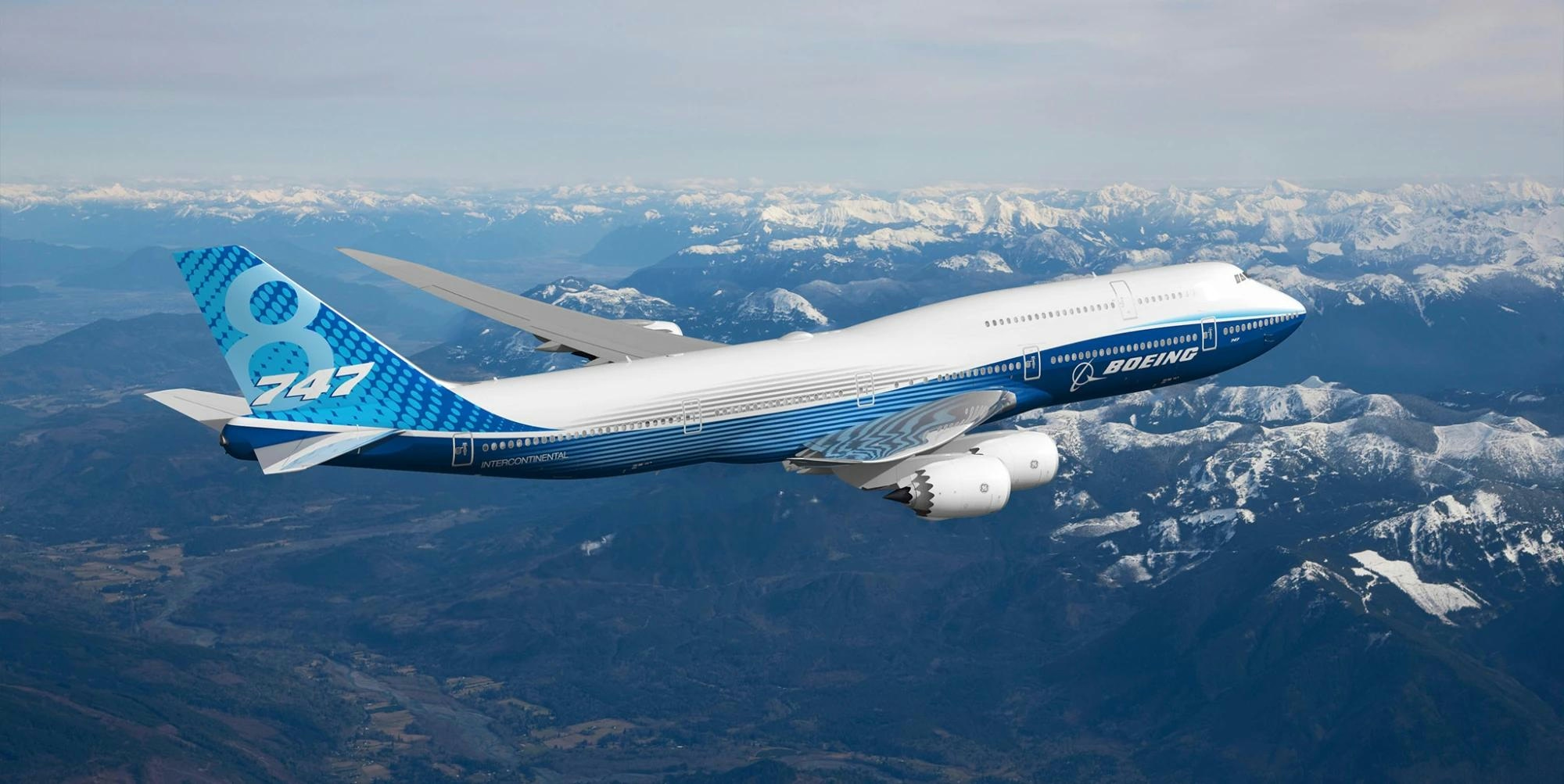
The Aircraft Succeeding Boeing’s Largest Quadjet
For more than fifty years, the Boeing 747 stood as an emblem of the golden age of mass air travel, earning its title as the Queen of the Skies. Renowned for its long-haul capabilities and iconic four-engine design, the 747 dominated international routes and symbolized the scale and ambition of commercial aviation. However, over the past decade and a half, the aviation industry has witnessed a decisive shift away from such large quadjets. Airlines have increasingly prioritized operational efficiency, cost reduction, and flexibility, driven by rising fuel prices, changing travel patterns favoring point-to-point connections, and significant advancements in twin-engine widebody aircraft technology. These factors have collectively accelerated the global retirement of 747 fleets.
The Rise of Twin-Engine Widebodies
Modern twin-engine aircraft now rival or exceed the 747’s range while offering substantial improvements in fuel efficiency and maintenance requirements. This evolution has fundamentally reshaped airline fleet strategies and network economics. Rather than a single direct replacement, the 747’s role is now fulfilled by a new generation of long-haul aircraft, including the Airbus A350, Boeing 787 Dreamliner, and the forthcoming Boeing 777X. Each model embodies a distinct design philosophy: the A350 is celebrated for its long-range efficiency, the 787 for its technological innovation and operational versatility, and the 777X for its high passenger capacity combined with enhanced fuel economy. Together, these aircraft target the upper market segment once dominated by the 747, offering airlines more adaptable and cost-effective options.
The decline of the 747 was influenced by more than just technological progress. Its four-engine configuration, once essential for transoceanic flights, became a disadvantage as twinjets demonstrated the ability to perform similar missions at significantly lower operating costs. By the late 2010s, major carriers such as British Airways, Qantas, and Virgin Atlantic publicly announced plans to retire their 747 fleets, citing unsustainable fuel consumption, high maintenance expenses, and declining load factors relative to newer aircraft. The COVID-19 pandemic further accelerated this trend, as a sharp drop in passenger demand rendered the operation of large-capacity quadjets economically unviable. Consequently, the resale and leasing values of the 747 plummeted, prompting airlines to retire the aircraft rather than continue operating at a loss.
Industry Challenges and Competitive Dynamics
The transition away from the 747 has not been without its challenges. Boeing has undertaken significant measures to secure the success of its next-generation widebodies, including a $4.7 billion acquisition of Spirit AeroSystems. This move aims to vertically integrate critical production processes and enhance supply chain resilience amid ongoing pressures. Despite maintaining a strong commercial backlog, Boeing continues to face scrutiny over production quality and execution risks, factors reflected in its stock price, which hovered around $189 per share as of December 2025. Meanwhile, Airbus has encountered its own difficulties, notably with flawed fuselage panels on the A320 family that have caused delivery delays and attracted regulatory investigations. The competitive landscape is further evolving as Dassault prepares to commence flight testing of its Falcon 10X business jet, signaling renewed competition in the high-end aircraft segment.
As airlines evaluate their fleet options, the successors to the 747 are defined by their capacity to deliver efficiency, flexibility, and profitability in an industry undergoing rapid transformation. While the era of the iconic quadjet is drawing to a close, its legacy persists in the innovative aircraft now shaping the future of long-haul air travel.
Comments

Etihad Airways Suspends Airbus A380 Flights on Key Route

Aditya Birla Group Seeks Approval for Aircraft Leasing in GIFT City

Qatar Airways Highlights Innovation and Connectivity at Arabian Travel Market 2026

Hong Kong's Five-Year Plan Includes Andrew Fan's Aircraft Parts Processing Hub Proposal

ACIA Aero Leasing Delivers ATR72-600 to Air Nostrum

RTX Appoints Jill Albertelli as Head of Pratt & Whitney

TAT Technologies Joins Beyond Aero Hydrogen Aircraft Program

AURAK Study Highlights Barriers to Air Taxi Adoption in Emerging Economies

Xiamen Air Selects Altitude for 787 Maintenance at Heathrow

Etihad and Swissport Extend Global Partnership
